

This mathematics problem involves applying core mathematical principles and formulas. Below you will find a complete step-by-step solution with detailed explanations for each step, helping you understand not just the answer but the method behind it.
ScanSolve AI Answer
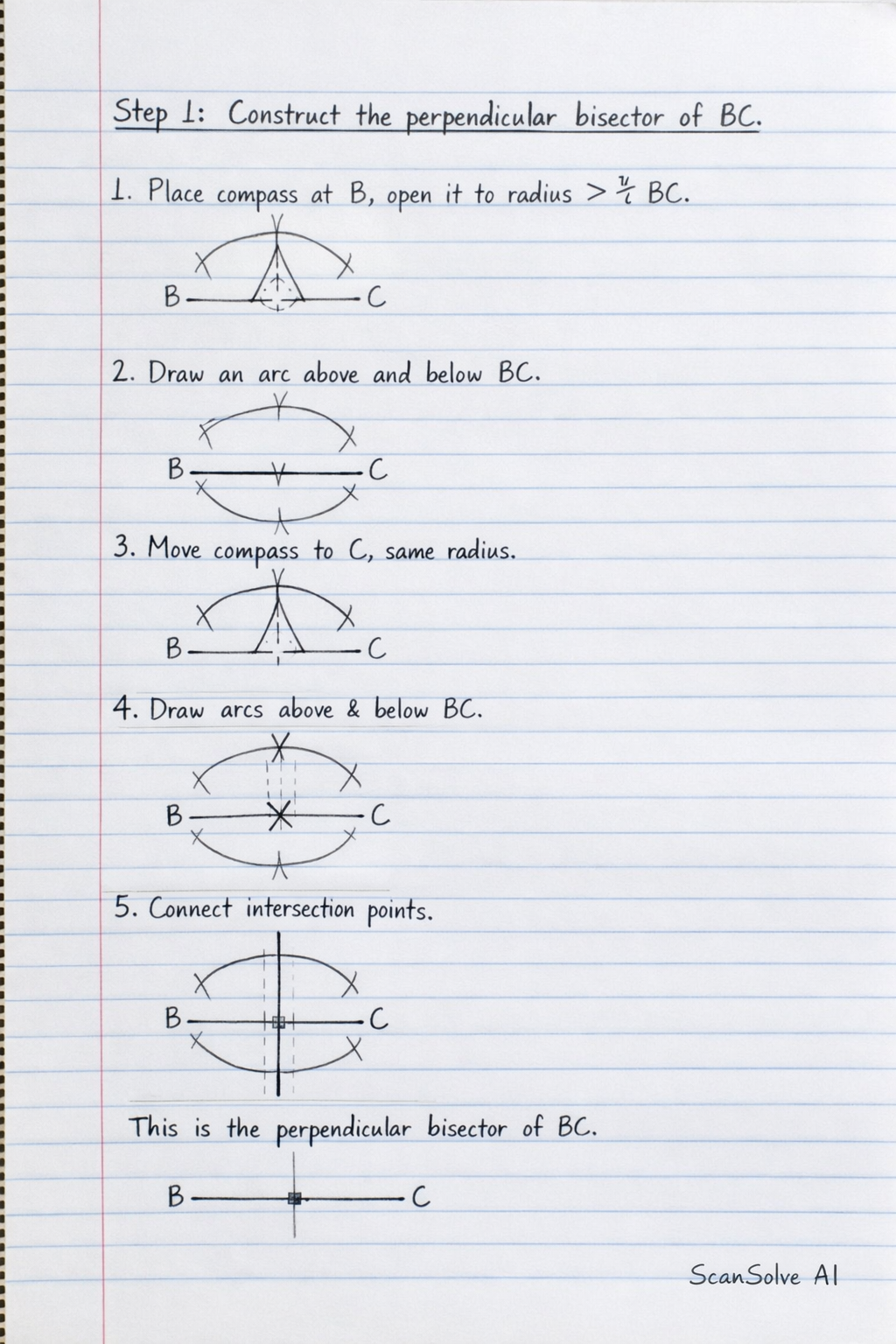
Step 1: Construct the perpendicular bisector of BC. • Place the compass needle at point B and open it to a radius greater than half the length of BC. Draw an arc above and below BC. • Without changing the compass radius, place the needle at point C and draw arcs above and below BC, intersecting the previously drawn arcs. • Draw a straight line connecting the two points where the arcs intersect. This line is the perpendicular bisector of BC. Step 2: Construct the locus of point P. The condition APB = ACB means that P lies on a circle that passes through points A, B, and C. This is the circumcircle of ABC. • To find the center of this circle (the circumcenter), construct the perpendicular bisector of another side, for example, AB. • Place the compass needle at point A and open it to a radius greater than half the length of AB. Draw an arc above and below AB. • Without changing the compass radius, place the needle at point B and draw arcs above and below AB, intersecting the previously drawn arcs. • Draw a straight line connecting the two points where these new arcs intersect. This line is the perpendicular bisector of AB. • The point where the perpendicular bisector of BC (from Step 1) and the perpendicular bisector of AB intersect is the circumcenter of ABC. Let's call this point O. • Place the compass needle at O and open it to the radius OA (or OB or OC, as they are all equal). • Draw the circle. This is the circumcircle of ABC. • The locus of point P is the arc of this circumcircle that lies on the same side of AB as point C.