
How to convert numbers to percentage and angles exam separately
ScanSolve AI Answer
let's look at converting numbers to percentages and angles.
Converting Numbers to Percentages
To convert any number (decimal or fraction) to a percentage, you multiply the number by 100 and then add the percent symbol (). A percentage represents a fraction out of 100.
-
Example 1: Converting a decimal to a percentage Convert 0.75 to a percentage.
-
Example 2: Converting a fraction to a percentage Convert to a percentage. First, convert the fraction to a decimal:
Then, multiply by :
Converting Numbers to Angles (in a circle)
To convert a number representing a fraction or proportion of a whole into an angle (typically in degrees for a circle), you multiply that number by the total degrees in a full circle, which is .
-
Example 1: Converting a fraction of a circle to an angle Convert of a circle to an angle in degrees. Multiply the fraction by :
\frac{2}{3} \times 360^\circ = \frac{720^\circ}{3} = \boxed{\text{240^\circ}} -
Example 2: Converting a decimal proportion to an angle Convert 0.25 of a circle to an angle in degrees. Multiply the decimal by :
0.25 \times 360^\circ = \boxed{\text{90^\circ}}
Still stuck on this one?
Ask a follow-up, and the answer starts from this question.
More Mathematics Questions
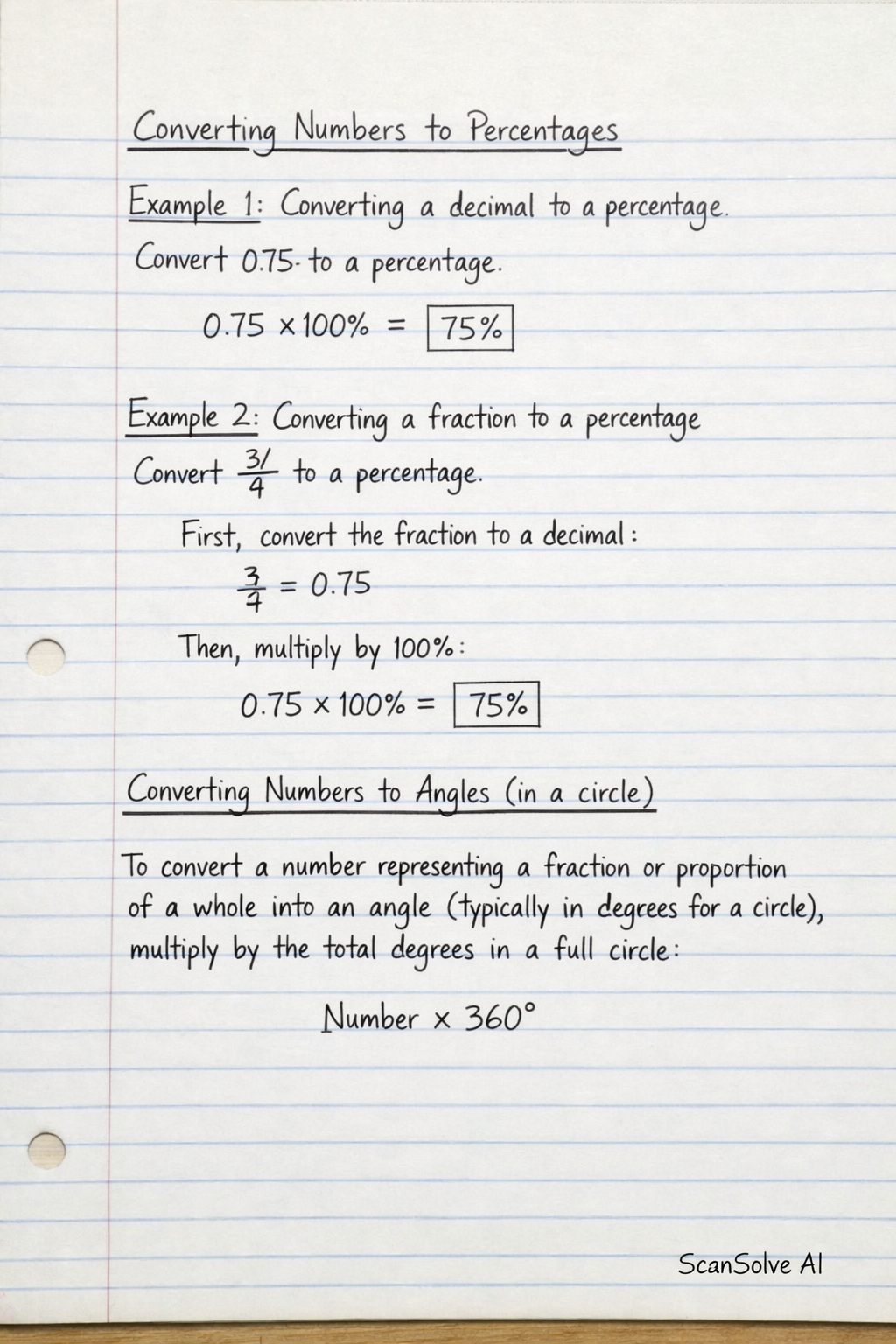
Handwritten Step-by-Step Solution
Get this as a handwritten image on WhatsApp — like a tutor wrote it for you.
Try on WhatsApp