
We read your photo as:
Convert "sawa sau lah" to a decimal fraction, and express "8.5 rupees" and "50 meters 4 cm" in their respective units.
ScanSolve AI Answer
Step-by-step solution
10 stepsHere are the solutions to the problems:
Question 7 (continued from previous page):
b) 8.5 روپے مطلب (8.5 rupees means)
Separate the whole number and the decimal part.
Convert the decimal part of rupees to paisa.
Since ,
So, means .c) 50 میٹر 4 سم یعنی (50 meters 4 cm means)
Convert centimeters to meters.
Since ,
Add the meters together.
So, means .d) سوا سو لہ اس کسر کو عشری علامت کا استعمال کر کے لکھیے۔ (Write "sawa sau lah" as a decimal fraction.)
The term "سوا" (sawa) means "one and a quarter" or . The instruction asks to write this as a decimal fraction.Convert the mixed fraction to an improper fraction.
Convert the fraction to a decimal.
(The terms "سو لہ" appear to be extraneous or a typo in this context, as "سوا" directly translates to the required decimal fraction.)
The decimal fraction is .Question 8:
a) ذیل کے اعداد میں مثلثی عدد کے گرد دائرہ بنائیے۔ (Circle the triangular number among the following numbers.)
The given numbers are: 4, 5, 6, 8, 9, 10, 12.
Triangular numbers are numbers obtained by summing consecutive positive integers starting from 1.
The sequence of triangular numbers is:
From the given list, the triangular numbers are 6 and 10. Since the question asks for "the" triangular number (singular), we will identify the first one in the list.
The triangular number is .b) ذیل کے تواتر کو مکمل کیجیے۔ (Complete the following sequence.)
The sequence is: 10, 15, 21, .........Find the difference between consecutive terms.
Observe the pattern in the differences.
The differences are increasing by 1 (5, then 6). So, the next difference should be 7.
Add the next difference to the last term to find the next number in the sequence.
Next term =
The completed sequence is 10, 15, 21, .c) ذیل کے تواتر کو مکمل کیجیے۔ (Complete the following sequence.)
The sequence shows patterns of dots:- First image: 5 rows of 5 dots, total dots.
- Second image: 4 rows of 4 dots, total dots.
- Third image: 3 rows of 3 dots, total dots. The pattern is a sequence of decreasing perfect squares: .
Determine the next terms in the sequence.
The next term should be dots.
The term after that should be
Still stuck on this one?
Ask a follow-up, and the answer starts from this question.
More Mathematics Questions
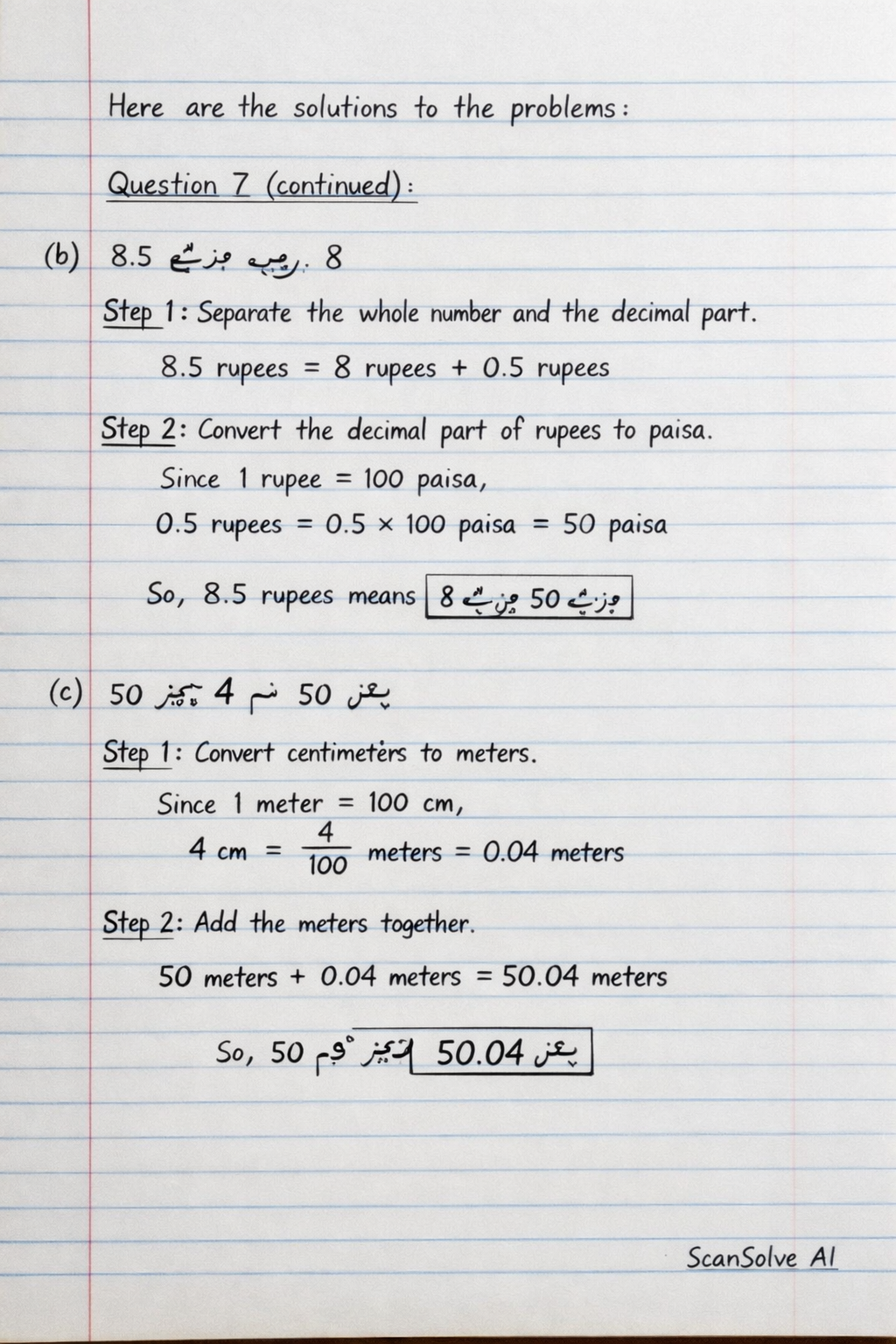
Handwritten Step-by-Step Solution
Get this as a handwritten image on WhatsApp — like a tutor wrote it for you.
Try on WhatsApp