ScanSolve logoScanSolve
Toggle sidebar
  • Homework
  • Tutor
  • Humanizer
  • AI Detector
  • Questions
  • Blog
  • History
  • Mobile App

  • Homework
  • Tutor
  • Humanizer
  • AI Detector

  • Questions
  • Math homework helpMath
    Physics homework helpPhysics
    Chemistry homework helpChemistry
    Biology homework helpBiology
    Computer Science homework helpComputer Science
    History homework helpHistory
    More homework helpMore
  • Blog
  • History

  • Mobile App
ScanSolvePLUS
  • Unlimited answers
  • ScanSolve AI Pro
Start Free Trial →
Try on WhatsApp
Home > Mathematics Homework Help > Solution

Convert the percentage abundances to fractional abundances.

Asked on March 28, 2026|Mathematics

This mathematics problem involves applying core mathematical principles and formulas. Below you will find a complete step-by-step solution with detailed explanations for each step, helping you understand not just the answer but the method behind it.

ScanSolve AI AnswerAnswered on March 28, 2026
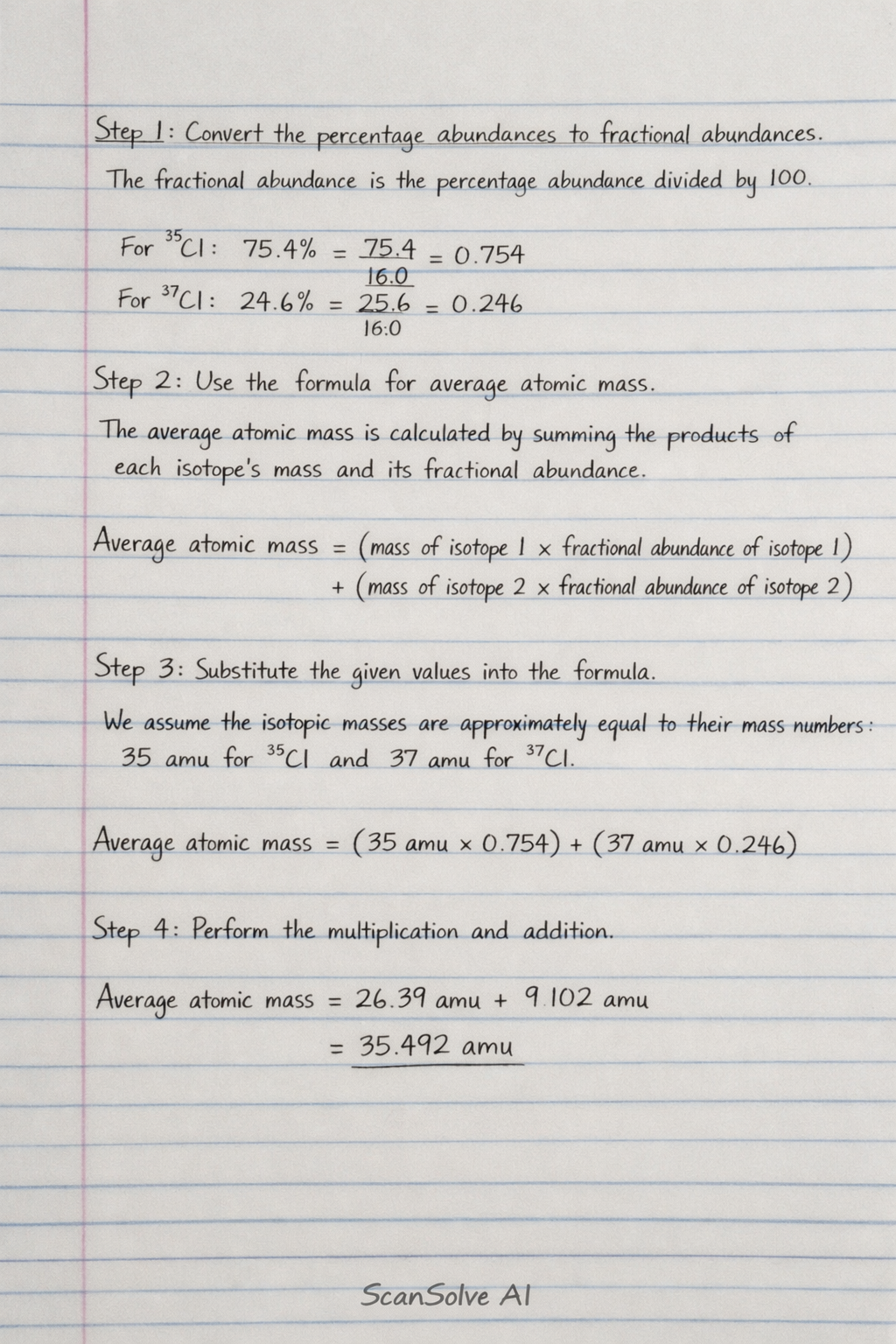
Step 1: Convert the percentage abundances to fractional abundances. The fractional abundance is the percentage abundance divided by 100. For $^{35}\text{Cl}$: $75.4\% = \frac{75.4}{100} = 0.754$ For $^{37}\text{Cl}$: $24.6\% = \frac{24.6}{100} = 0.246$ Step 2: Use the formula for average atomic mass. The average atomic mass is calculated by summing the products of each isotope's mass and its fractional abundance. $$\text{Average atomic mass} = (\text{mass of isotope 1} \times \text{fractional abundance of isotope 1}) + (\text{mass of isotope 2} \times \text{fractional abundance of isotope 2})$$ Step 3: Substitute the given values into the formula. We assume the isotopic masses are approximately equal to their mass numbers, i.e., $35$ amu for $^{35}\text{Cl}$ and $37$ amu for $^{37}\text{Cl}$. $$\text{Average atomic mass} = (35 \text{ amu} \times 0.754) + (37 \text{ amu} \times 0.246)$$ Step 4: Perform the multiplication and addition. $$\text{Average atomic mass} = 26.39 \text{ amu} + 9.102 \text{ amu}$$ $$\text{Average atomic mass} = 35.492 \text{ amu}$$ The average atomic mass of chlorine is $\boxed{\text{35.492 amu}}$.

Related Mathematics Questions

  • 1+1=22+88+33+88+12+48+21345
  • Given the equation 2x = sqrt(3)2.
  • Set up the partial fraction decomposition.
  • What is the Pythagorean theorem?
  • 1. Find the degree of each polynomial
  • Differentiate each term using the power rule (d)/(dx)(ax^n) = anx^n-1 and the rule for constants (d)/(dx)(c) = 0.
See all Mathematics questions

This step-by-step solution was generated by ScanSolve AI. Need help with more mathematics problems? Browse Mathematics solutions or ask your own question.

Home›Mathematics Homework Help›Convert the percentage abundances to fractional abundances.
Q

Convert the percentage abundances to fractional abundances.

March 28, 2026|Mathematics
Convert the percentage abundances to fractional abundances.

Convert the percentage abundances to fractional abundances.

ScanSolve AI

ScanSolve AI Answer

Answered on March 28, 2026

Step 1: Convert the percentage abundances to fractional abundances. The fractional abundance is the percentage abundance divided by 100. For 35Cl^{35}\text{Cl}35Cl: 75.4%=75.4100=0.75475.4\% = \frac{75.4}{100} = 0.75475.4%=10075.4​=0.754 For 37Cl^{37}\text{Cl}37Cl: 24.6%=24.6100=0.24624.6\% = \frac{24.6}{100} = 0.24624.6%=10024.6​=0.246

Step 2: Use the formula for average atomic mass. The average atomic mass is calculated by summing the products of each isotope's mass and its fractional abundance. Average atomic mass=(massofisotope1×fractionalabundanceofisotope1)+(massofisotope2×fractionalabundanceofisotope2)\text{Average atomic mass} = (mass of isotope 1 \times fractional abundance of isotope 1) + (mass of isotope 2 \times fractional abundance of isotope 2)Average atomic mass=(massofisotope1×fractionalabundanceofisotope1)+(massofisotope2×fractionalabundanceofisotope2)

Step 3: Substitute the given values into the formula. We assume the isotopic masses are approximately equal to their mass numbers, i.e., 353535 amu for 35Cl^{35}\text{Cl}35Cl and 373737 amu for 37Cl^{37}\text{Cl}37Cl. Average atomic mass=(35amu×0.754)+(37amu×0.246)\text{Average atomic mass} = (35 amu \times 0.754) + (37 amu \times 0.246)Average atomic mass=(35amu×0.754)+(37amu×0.246)

Step 4: Perform the multiplication and addition. Average atomic mass=26.39amu+9.102 amu\text{Average atomic mass} = 26.39 amu + 9.102 \text{ amu}Average atomic mass=26.39amu+9.102 amu Average atomic mass=35.492 amu\text{Average atomic mass} = 35.492 \text{ amu}Average atomic mass=35.492 amu

The average atomic mass of chlorine is 35.492amu\boxed{35.492 amu}35.492amu​.

Need help with your own homework?

Get instant step-by-step solutions to any question. Free to start.

Ask Your Question
Handwritten step-by-step solution

Handwritten Step-by-Step Solution

Get this solution as a handwritten image on WhatsApp — just like a tutor wrote it for you.

Try on WhatsApp

More Mathematics Questions

1+1=22+88+33+88+12+48+21345Given the equation 2x = sqrt(3)2.Set up the partial fraction decomposition.What is the Pythagorean theorem?1. Find the degree of each polynomialDifferentiate each term using the power rule (d)/(dx)(ax^n) = anx^n-1 and the rule for constants (d)…
See all Mathematicsquestions →