We read your photo as:

Convert the weight of the Olympic rings to kilograms.

Mathematics

ScanSolve AI Answer

Step-by-step solution

13 steps

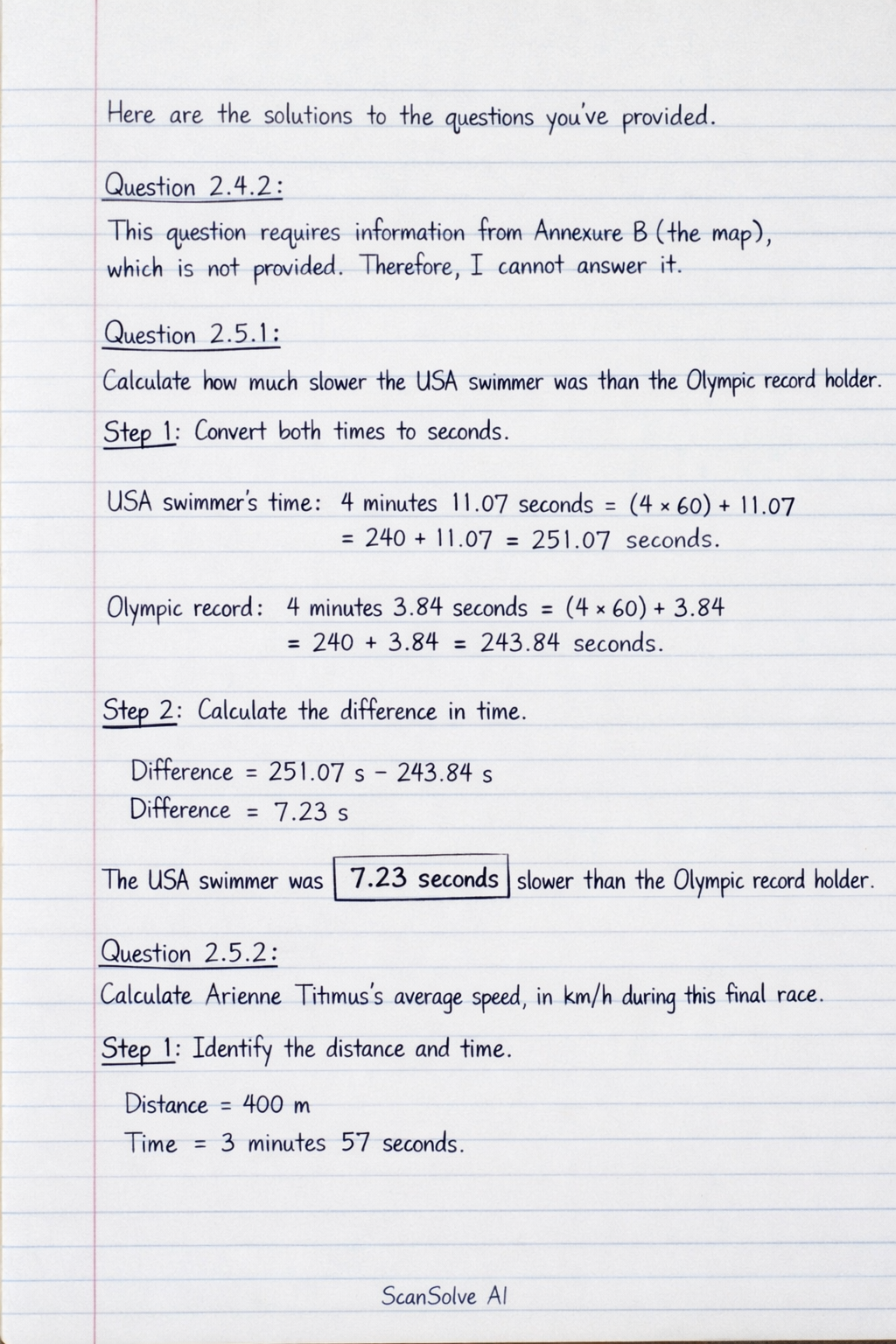
Here are the solutions to the questions you've provided.

Question 2.4.2:
This question requires information from Annexure B (the map), which is not provided. Therefore, I cannot answer it.

Question 2.5.1:
Calculate how much slower the USA swimmer was than the Olympic record holder.

  1. Convert both times to seconds.

    USA swimmer's time: 4 minutes 11.07 seconds=(4×60)+11.07=240+11.07=251.07 seconds4 \text{ minutes } 11.07 \text{ seconds} = (4 \times 60) + 11.07 = 240 + 11.07 = 251.07 \text{ seconds}.
    Olympic record: 4 minutes 3.84 seconds=(4×60)+3.84=240+3.84=243.84 seconds4 \text{ minutes } 3.84 \text{ seconds} = (4 \times 60) + 3.84 = 240 + 3.84 = 243.84 \text{ seconds}.

  2. Calculate the difference in time.

    Difference=251.07 s−243.84 s\text{Difference} = 251.07 \text{ s} - 243.84 \text{ s} Difference=7.23 s\text{Difference} = 7.23 \text{ s}

    The USA swimmer was 7.23 seconds\boxed{\text{7.23 seconds}} slower than the Olympic record holder.

    Question 2.5.2:
    Calculate Arienne Titmus's average speed, in km/h during this final race.

  3. Identify the distance and time.

    Distance = 400 m400 \text{ m}.
    Time = 3 minutes 57 seconds3 \text{ minutes } 57 \text{ seconds}.

  4. Convert time to hours and round to three decimal places.

    Time in seconds = (3×60)+57=180+57=237 seconds(3 \times 60) + 57 = 180 + 57 = 237 \text{ seconds}.
    Time in hours = 2373600 hours≈0.065833... hours\frac{237}{3600} \text{ hours} \approx 0.065833... \text{ hours}.
    Rounding to three decimal places: 0.066 hours0.066 \text{ hours}.

  5. Convert distance to kilometers.

    Distance = 400 m=4001000 km=0.4 km400 \text{ m} = \frac{400}{1000} \text{ km} = 0.4 \text{ km}.

  6. Calculate the average speed using the formula Speed=DistanceTime\text{Speed} = \frac{\text{Distance}}{\text{Time}}.

    Speed=0.4 km0.066 hours\text{Speed} = \frac{0.4 \text{ km}}{0.066 \text{ hours}} Speed≈6.060606... km/h\text{Speed} \approx 6.060606... \text{ km/h}
  7. Round the average speed to three decimal places.

    Speed≈6.061 km/h\text{Speed} \approx 6.061 \text{ km/h}

    Her average speed was 6.061 km/h\boxed{\text{6.061 km/h}}.

    Question 3.1.1:
    Convert the weight of the Olympic rings to kilograms.

  8. Identify the total weight and conversion factor.

    Total weight = 30 tonnes30 \text{ tonnes}.
    Conversion factor: 1 ton=1000 kg1 \text{ ton} = 1000 \text{ kg}.

  9. Convert tonnes to kilograms.

    Weight in kg=30 tonnes×1000kgtonne\text{Weight in kg} = 30 \text{ tonnes} \times 1000 \frac{\text{kg}}{\text{tonne}} Weight in kg=30000 kg\text{Weight in kg} = 30000 \text{ kg}

    The weight of the Olympic rings is 30000 kg\boxed{\text{30000 kg}}.

    Question 3.1.2:
    Show by means of calculations whether the tour guide's statement is correct.

  10. Calculate the circumference of one Olympic ring.

    Given diameter (dd) = 9 m9 \text{ m} and π=3.142\pi = 3.142.

    Circumference=π×d=3.142×9 m=28.278 m\text{Circumference} = \pi \times d = 3.142 \times 9 \text{ m} = 28.278 \text{ m}

    Rounding to two decimal places: 28.28 m28.28 \text{ m}.

  11. Calculate the sum of the distances around all five Olympic rings.

    There are 5 rings.

    Total distance=5×28.28 m=141.40 m\text{Total distance} = 5 \times 28.28 \text{ m} = 141.40 \text{ m}
  12. Calculate 40% of the height of the Eiffel Tower.

    Height of Eiffel Tower = 330 m330 \text{ m}.

    40% of height=0.40×330 m=132 m40\% \text{ of height} = 0.40 \times 330 \text{ m} = 132 \text{ m}
  13. Compare the total distance with 40% of the Eiffel Tower's height.

    The tour guide claims the total distance is less than 40% of the height.
    Total distance = 141.40 m141.40 \text{ m}.
    40% of height = 132 m132 \text{ m}.
    Since 141.40 m>132 m141.40 \text{ m} > 132 \text{ m}, the total distance is not less than 40% of the Eiffel Tower's height.

    The tour guide's statement is incorrect\boxed{\text{incorrect}}.

    I still need the text for questions 1.1, 1.2, 1.3, 1.4, 1.6, and Annexure B for other parts of Question 2.

Was this helpful?

Still stuck on this one?

Ask a follow-up, and the answer starts from this question.

Got a different question?Ask your own question
Handwritten step-by-step solution preview

Handwritten Step-by-Step Solution

Get this as a handwritten image on WhatsApp — like a tutor wrote it for you.

Try on WhatsApp