

This mathematics problem involves applying core mathematical principles and formulas. Below you will find a complete step-by-step solution with detailed explanations for each step, helping you understand not just the answer but the method behind it.
ScanSolve AI Answer
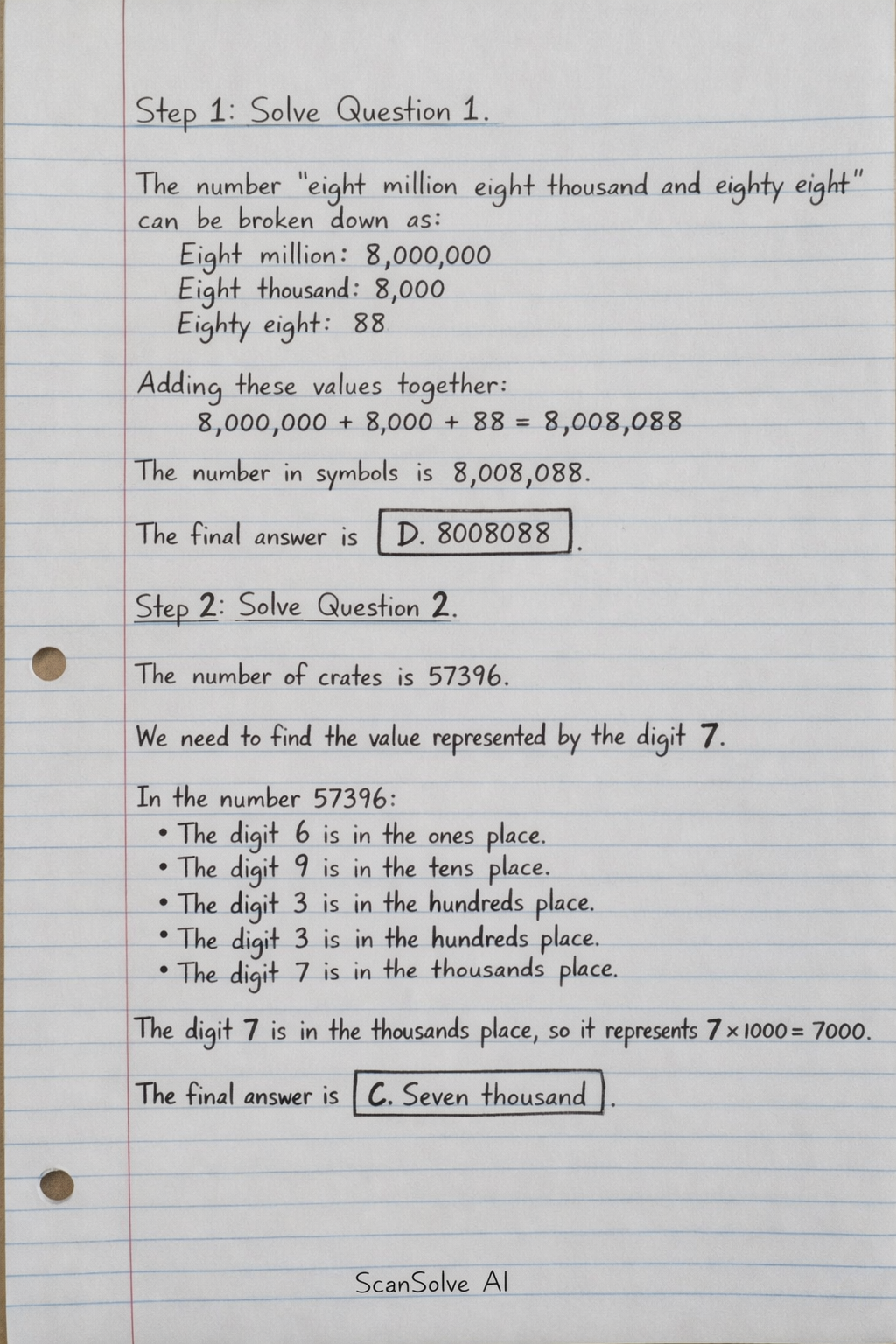
Step 1: Solve Question 1. The number "eight million eight thousand and eighty eight" can be broken down as: Eight million: 8,000,000 Eight thousand: 8,000 Eighty eight: 88 Adding these values together: 8,000,000 + 8,000 + 88 = 8,008,088 The number in symbols is 8,008,088. The final answer is D. 8008088. Step 2: Solve Question 2. The number of crates is 57396. We need to find the value represented by the digit 7. In the number 57396: • The digit 6 is in the ones place. • The digit 9 is in the tens place. • The digit 3 is in the hundreds place. • The digit 7 is in the thousands place. • The digit 5 is in the ten thousands place. The digit 7 is in the thousands place, so it represents 7 × 1000 = 7000. The final answer is C. Seven thousand. Step 3: Solve Question 3. Edith gave (1)/(2) of an apple to her son and (1)/(6) to her grandson. First, find the total fraction of the apple given away: (1)/(2) + (1)/(6) To add these fractions, find a common denominator, which is 6. (1)/(2) = (1 × 3)/(2 × 3) = (3)/(6) Now add the fractions: (3)/(6) + (1)/(6) = (3+1)/(6) = (4)/(6) This is the fraction given away. To find the fraction Edith remained with, subtract this from 1 (the whole apple): 1 - (4)/(6) = (6)/(6) - (4)/(6) = (2)/(6) Simplify the fraction: (2)/(6) = (1)/(3) Edith remained with (1)/(3) of the apple. The final answer is B. (1)/(3). Step 4: Solve Question 4. The total amount contributed was sh. 3610. There were 38 boys, and each contributed an equal amount. To find how much each boy contributed, divide the total amount by the number of boys: Amount per boy = Total amountNumber of boys Amount per boy = (3610)/(38) Perform the division: 3610 ÷ 38 = 95 Each boy contributed sh. 95. The final answer is D. sh. 95. Step 5: Solve Question 5. A butcher bought 44 kg of meat. Each customer bought (1)/(4) kg of meat. To find the number of customers, divide the total amount of meat by the amount each customer bought: Number of customers = Total meatMeat per customer Number of customers = (44)/(1)4 Dividing by a fraction is equivalent to multiplying by its reciprocal: Number of customers = 44 × 4 Number of customers = 176 There were 176 customers. The final answer is C. 176. Step 6: Solve Question 6. The perimeter of the rectangle is P = 74 cm. The width of the rectangle is w = 15 cm. The formula for the perimeter of a rectangle is P = 2(l + w), where l is the length and w is the width. Substitute the given values into the formula: 74 = 2(l + 15) Divide both sides by 2: (74)/(2) = l + 15 37 = l + 15 Subtract 15 from both sides to find l: l = 37 - 15 l = 22 cm The length of the rectangle is 22 cm. The final answer is D. 22cm. Step 7: Solve Question 7. We need to find the smallest number that can be arranged in groups of 12, 15, and 18 without a remainder. This is equivalent to finding the Least Common Multiple (LCM) of 12, 15, and 18. First, find the prime factorization of each number: 12 = 2 × 2 × 3 = 2^2 × 3^1 15 = 3 × 5 = 3^1 × 5^1 18 = 2 × 3 × 3 = 2^1 × 3^2 To find the LCM, take the highest power of each prime factor present in any of the numbers: • For prime factor 2: The highest power is 2^2 (from 12). • For prime factor 3: The highest power is 3^2 (from 18). • For prime factor 5: The highest power is 5^1 (from 15). Multiply these highest powers together to get the LCM: LCM(12, 15, 18) = 2^2 × 3^2 × 5^1 LCM = 4 × 9 × 5 LCM = 36 × 5 LCM = 180 The smallest number is 180. The final answer is A. 180. Step 8: Solve Question 8. We need to estimate the quotient of 6243 and 17 by first rounding off the numbers to the nearest tens. Round 6243 to the nearest tens: The digit in the ones place is 3, which is less than 5, so we round down. 6243 ≈ 6240 Round 17 to the nearest tens: The digit in the ones place is 7, which is 5 or greater, so we round up. 17 ≈ 20 Now, estimate the quotient: Quotient = (6240)/(20) Quotient = (624)/(2) Quotient = 312 The estimated quotient is 312. The final answer is B. 312. That's 2 down. 3 left today — send the next one.