
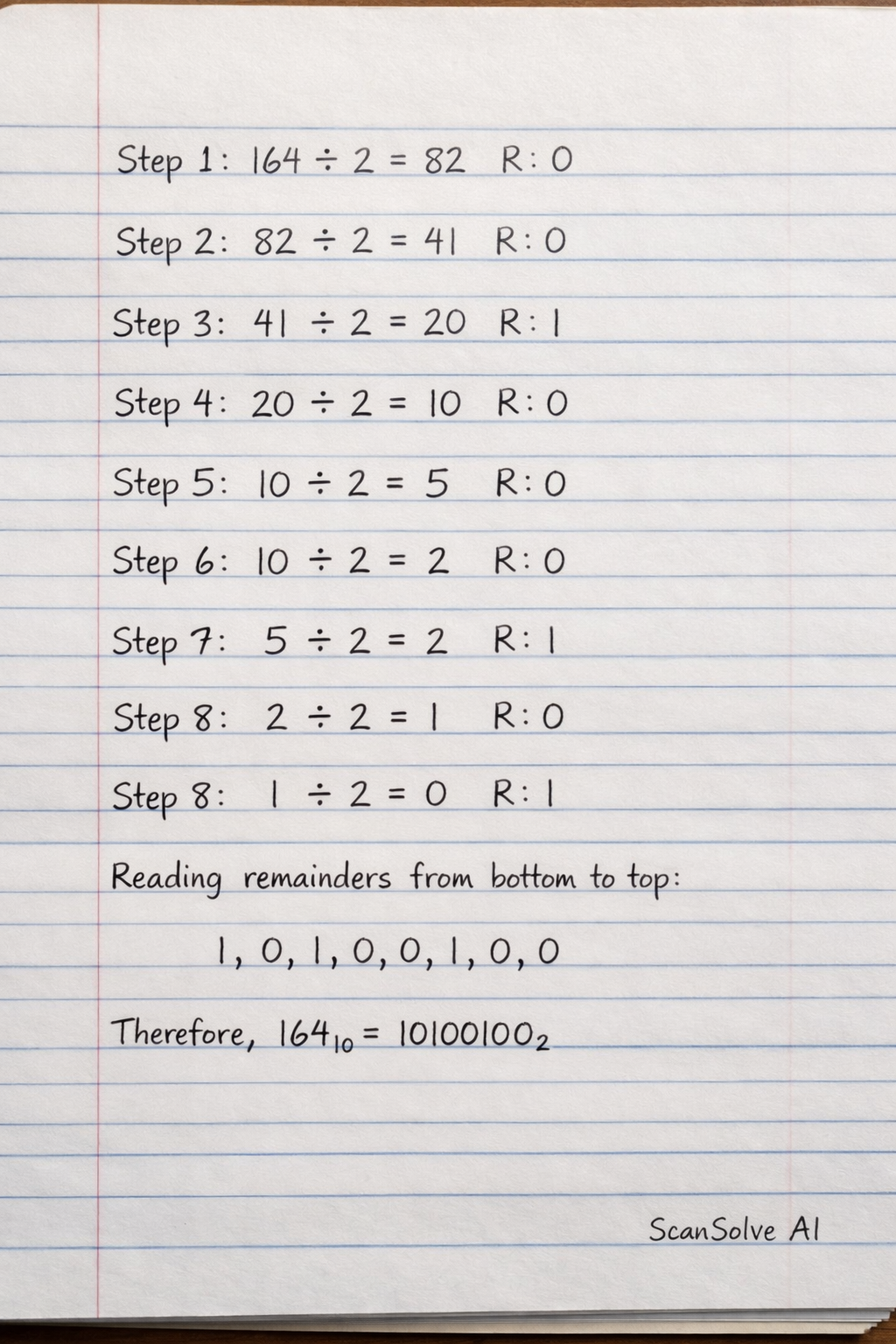
We read your photo as:
Decimal to Binary conversion of (164) 2
ScanSolve AI Answer
Answer
Step-by-step solution
8 stepsThe image shows the process of converting the decimal number to its binary equivalent using repeated division by 2.
Let's verify the steps shown in your work:
Divide 164 by 2.
with a remainder of 0. (Correct)
Divide 82 by 2.
with a remainder of 0. (Correct)
Divide 41 by 2.
with a remainder of 1. (Correct)
Divide 20 by 2.
with a remainder of 0. (Correct)
Divide 10 by 2.
with a remainder of 0. (Correct)
Divide 5 by 2.
with a remainder of 1. (Correct)
Divide 2 by 2.
with a remainder of 0. (Correct)
Divide 1 by 2.
with a remainder of 1. (Correct)
To obtain the binary number, you read the remainders from bottom to top.
The remainders are: .Therefore, the correct binary representation of is .
Your division steps are all correct. However, the final binary number you wrote on the right side of the page, , is incorrect. It seems you might have missed the leftmost '1' and reversed the order of some digits.
Try one yourself
A new problem that tests the same skill.
Still stuck on this one?
Ask a follow-up, and the answer starts from this question.
More Mathematics Questions
Handwritten Step-by-Step Solution
Get this as a handwritten image on WhatsApp — like a tutor wrote it for you.
Try on WhatsApp