
We read your photo as:
Calculate the diagonals of a parallelogram with sides 8 cm and 10 cm, and the angle between them is 130 degrees.
ScanSolve AI Answer
This answer stops before the end.
It was cut off when it was first written. Ask ScanSolve this question again for the full working.
Question 8:
Given a parallelogram with sides 8 cm and 10 cm, and the angle between them is . Let the parallelogram be ABCD, with AB = 8 cm, AD = 10 cm, and .
In a parallelogram, consecutive angles are supplementary, so .
a) Calculate the diagonals of the parallelogram.
Step 1: Calculate the length of diagonal AC using the cosine rule in .
Sides are AB = 8 cm, BC = AD = 10 cm, and .
Step 2: Calculate the length of diagonal BD using the cosine rule in .
Sides are AB = 8 cm, AD = 10 cm, and .
Still stuck on this one?
Ask a follow-up, and the answer starts from this question.
More Mathematics Questions
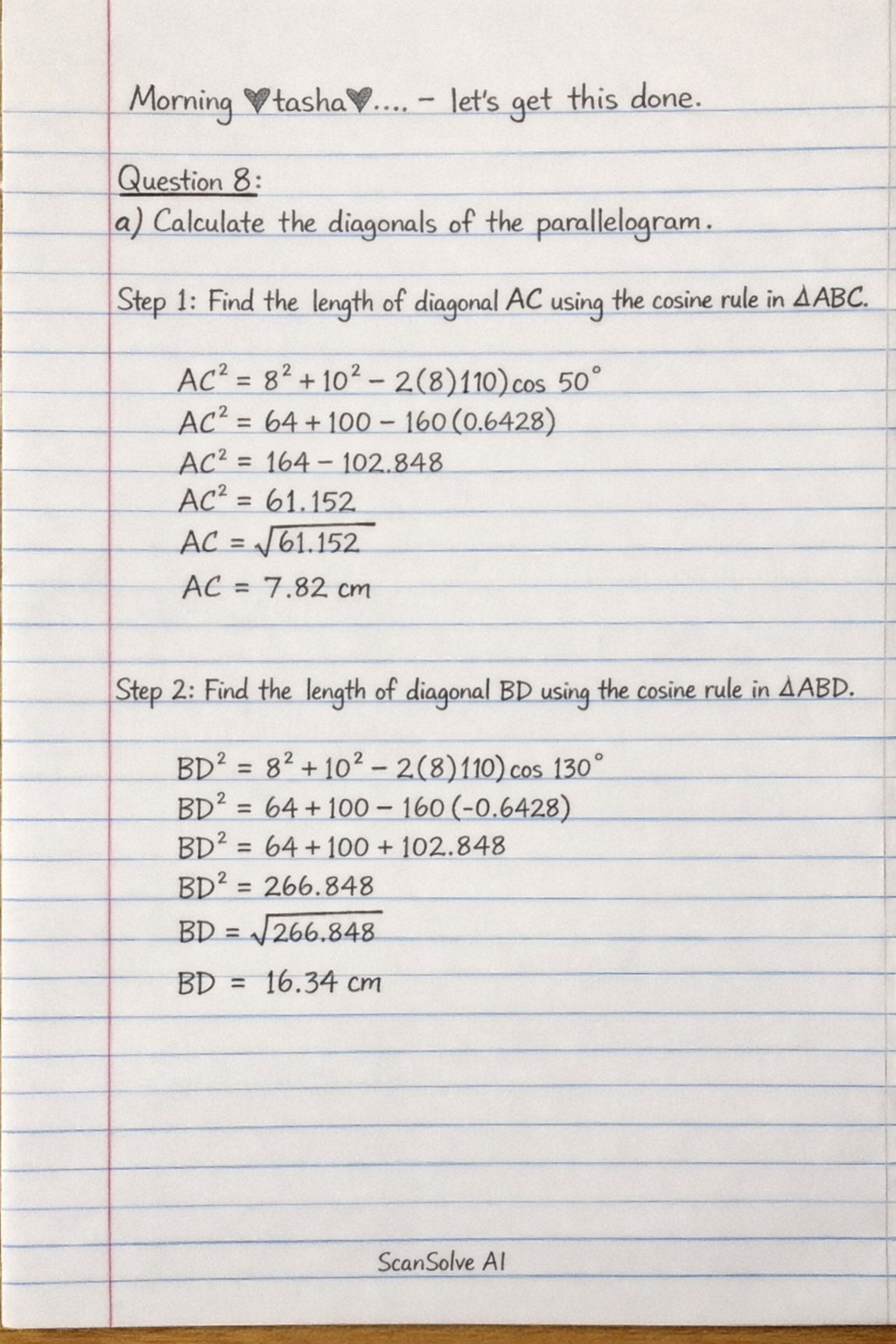
Handwritten Step-by-Step Solution
Get this as a handwritten image on WhatsApp — like a tutor wrote it for you.
Try on WhatsApp