
Where did you get 18
Mathematics
ScanSolve AI Answer
Step-by-step solution
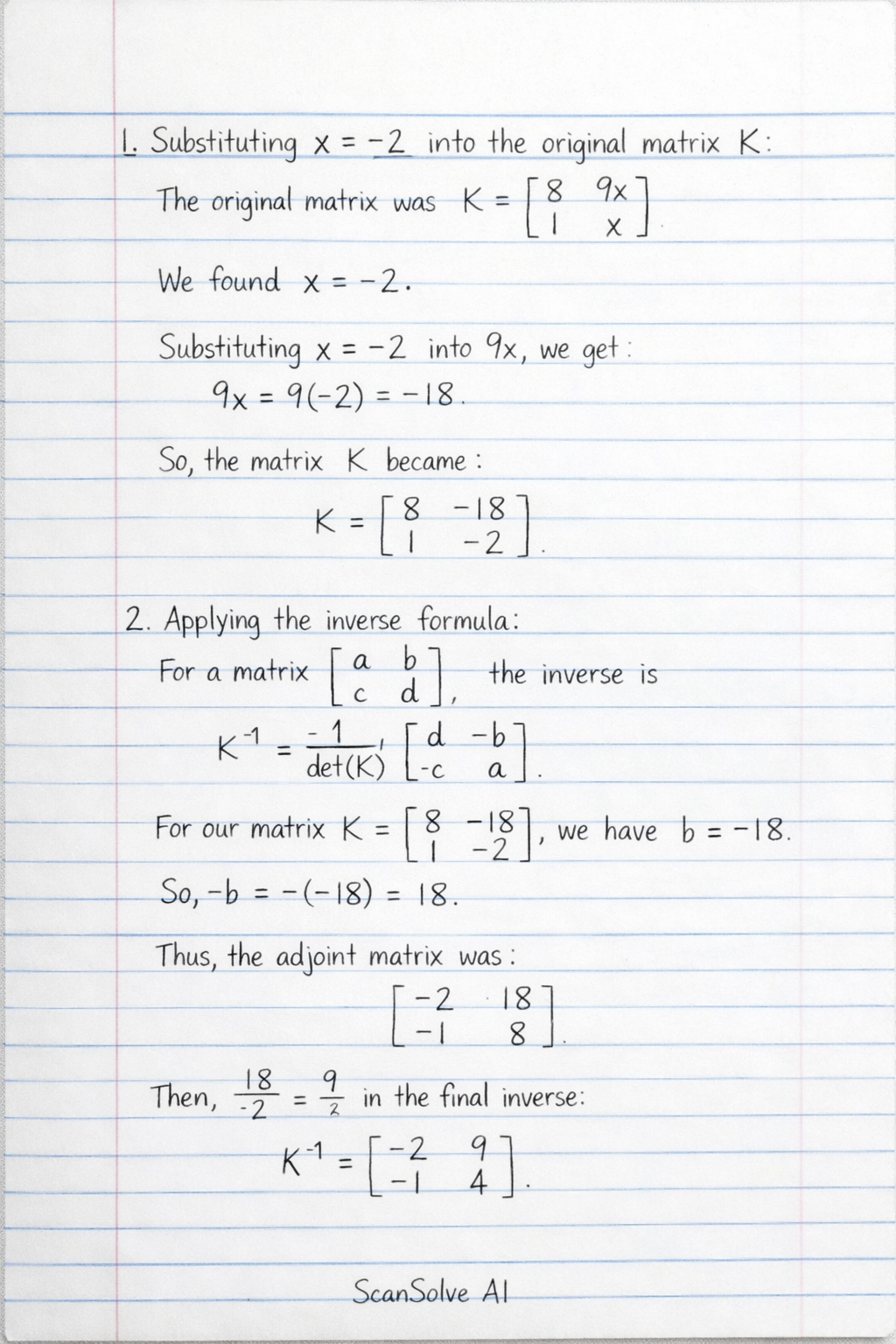
2 stepsThe 18 came from two steps in the calculation for part a) (ii):
Substituting into the original matrix
The original matrix was .
In part a) (i), we found .
When we substitute into the element , we get:So, the matrix became:
Applying the inverse formula
For a matrix , the inverse is .
From our matrix , we have .
Therefore, the term in the inverse formula becomes:This is why the adjoint matrix was .
Finally, this 18 was divided by the determinant (which was 2) to get 9 in the final inverse matrix.
Was this helpful?
Still stuck on this one?
Ask a follow-up, and the answer starts from this question.
Got a different question?Ask your own question
More Mathematics Questions
Handwritten Step-by-Step Solution
Get this as a handwritten image on WhatsApp — like a tutor wrote it for you.
Try on WhatsApp