This mathematics problem involves applying core mathematical principles and formulas. Below you will find a complete step-by-step solution with detailed explanations for each step, helping you understand not just the answer but the method behind it.
ScanSolve AI Answer
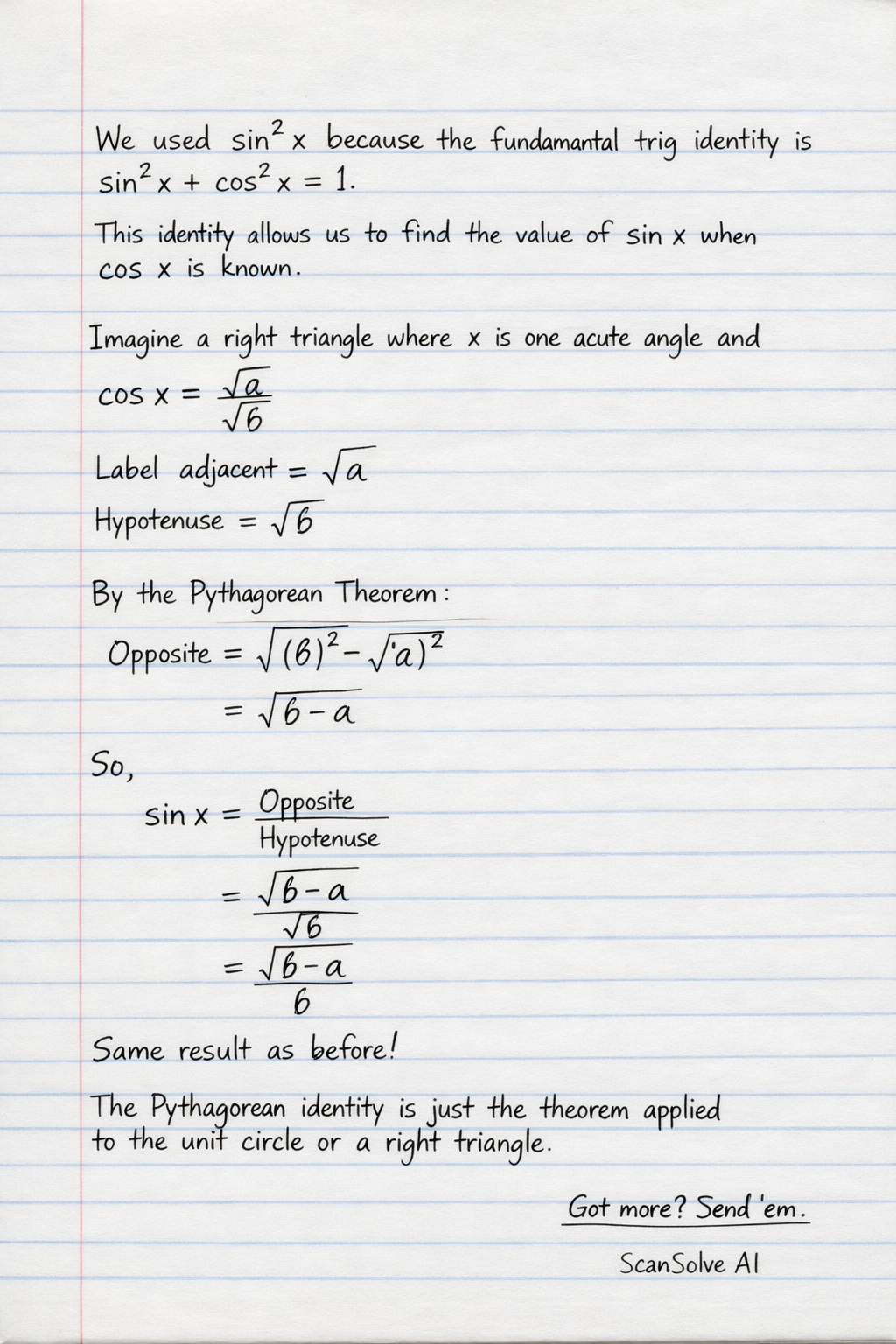
We used $\sin^2 x$ because the fundamental trigonometric identity relating sine and cosine is $\sin^2 x + \cos^2 x = 1$. This identity allows us to find the value of $\sin x$ when $\cos x$ is known.
You can use the Pythagorean theorem indirectly. If you imagine a right-angled triangle where $x$ is one of the acute angles, and $\cos x = \frac{\text{adjacent}}{\text{hypotenuse}} = \sqrt{\frac{a}{b}}$, you could label the adjacent side as $\sqrt{a}$ and the hypotenuse as $\sqrt{b}$. Then, using the Pythagorean theorem, the opposite side would be $\sqrt{(\sqrt{b})^2 - (\sqrt{a})^2} = \sqrt{b-a}$.
From this, $\sin x = \frac{\text{opposite}}{\text{hypotenuse}} = \frac{\sqrt{b-a}}{\sqrt{b}} = \sqrt{\frac{b-a}{b}}$.
This is the same result obtained using the identity. The Pythagorean identity is essentially a direct application of the Pythagorean theorem to the coordinates on a unit circle or the sides of a right triangle.
Got more? Send 'em.
Why did you use sine² And why can't you use Pythagoras theorem
|Mathematics
ScanSolve AI Answer
We used sin2x because the fundamental trigonometric identity relating sine and cosine is sin2x+cos2x=1. This identity allows us to find the value of sinx when cosx is known.
You can use the Pythagorean theorem indirectly. If you imagine a right-angled triangle where x is one of the acute angles, and cosx=hypotenuseadjacent=ba, you could label the adjacent side as a and the hypotenuse as b. Then, using the Pythagorean theorem, the opposite side would be (b)2−(a)2=b−a.
From this, sinx=hypotenuseopposite=bb−a=bb−a.
This is the same result obtained using the identity. The Pythagorean identity is essentially a direct application of the Pythagorean theorem to the coordinates on a unit circle or the sides of a right triangle.
Got more? Send 'em.
Need help with your own homework?
Get instant step-by-step solutions to any question. Free to start.