
This mathematics problem involves applying core mathematical principles and formulas. Below you will find a complete step-by-step solution with detailed explanations for each step, helping you understand not just the answer but the method behind it.
ScanSolve AI Answer
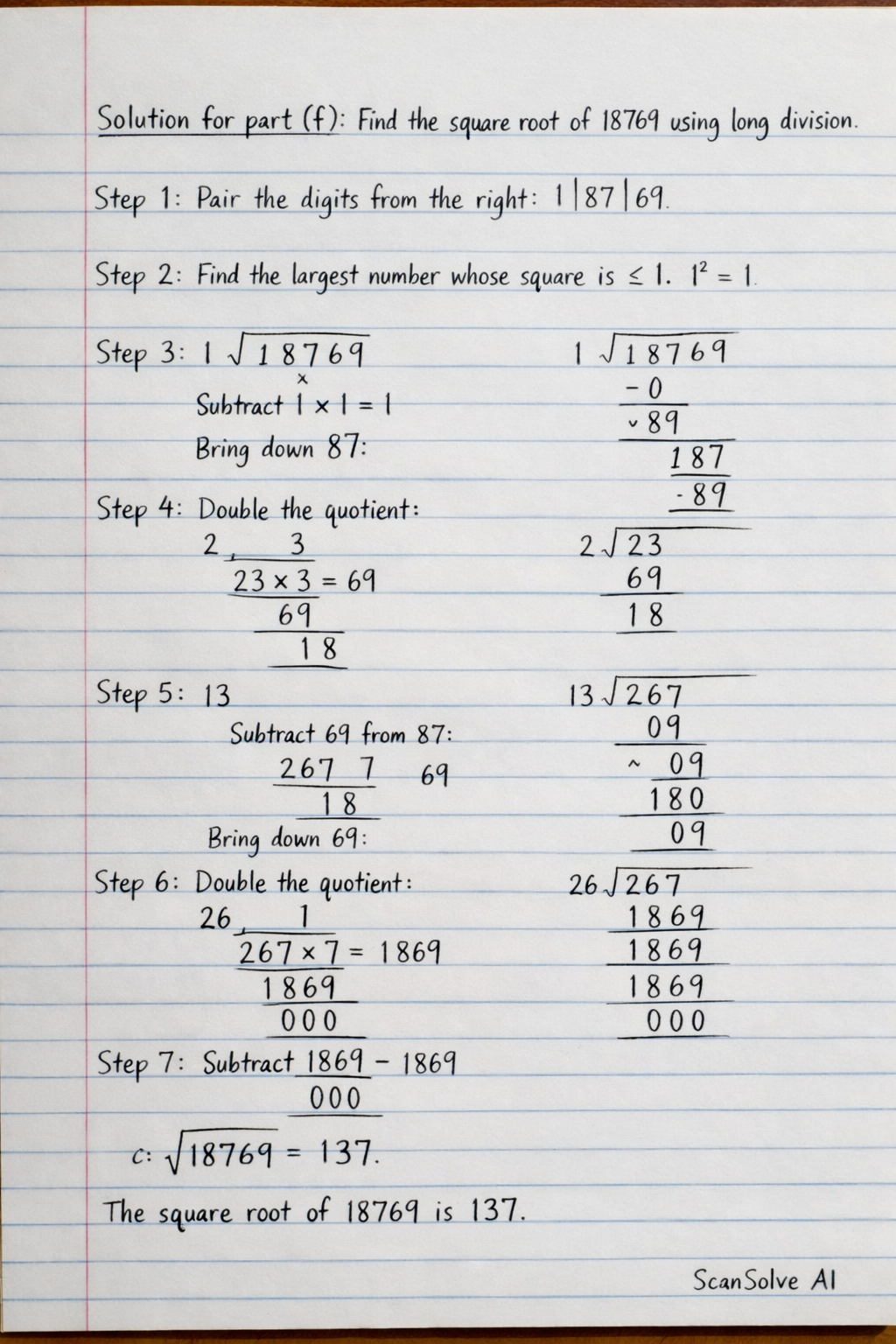
Here is the solution for part (f) using the long division method. f) Find the square root of 18769 Step 1: Pair the digits from the right: 1 \ 87 \ 69. Step 2: Find the largest number whose square is less than or equal to 1. This is 1, since 1^2 = 1. Step 3: Write 1 as the first digit of the quotient. Subtract 1 from 1 to get 0. Bring down the next pair, 87, to make the new dividend 87. Step 4: Double the current quotient (1) to get 2. Now, find a digit 'x' such that 2x × x 87. If x=3, then 23 × 3 = 69. Step 5: Write 3 as the next digit in the quotient. Subtract 69 from 87 to get 18. Bring down the next pair, 69, to make the new dividend 1869. Step 6: Double the current quotient (13) to get 26. Now, find a digit 'x' such that 26x × x 1869. If x=7, then 267 × 7 = 1869. Step 7: Write 7 as the next digit in the quotient. Subtract 1869 from 1869 to get 0. The square root of 18769 is 137. sqrt(18769) = 137 3 done, 2 left today. You're making progress.