
We read your photo as:
Draw a scale of 1:50 to read meters and decimeters.
Mathematics
ScanSolve AI Answer
Step-by-step solution
3 stepsTo draw a simple scale with R.F. 1:50 to read meters and decimeters, follow these steps:
Calculate the Length of the Scale (LOS).
We assume a convenient maximum length to be measured, for example, 5 meters.
The formula for the Length of the Scale (LOS) is:Given R.F. = and Maximum length = .
Convert meters to centimeters for drawing: .So, the total length of the scale to be drawn on paper will be .
Determine primary and secondary divisions.
The line represents .
- Primary Divisions (for meters): Divide the line into 5 equal parts. Each part will represent . Length of each primary division = .
- Secondary Divisions (for decimeters): The leftmost primary division represents . Since , this segment needs to be divided into 10 equal parts. Length of each secondary division = . Each of these will represent .
Instructions for drawing the scale.
- Draw a horizontal line segment long.
- Divide this line into 5 equal main parts, each long.
- Mark the main divisions starting from the second mark from the left as . The first main division (to the left of 0) is reserved for decimeters.
- Divide the leftmost main division (the segment to the left of 0) into 10 equal sub-parts, each long.
- Mark these sub-divisions as (or if space allows).
- Draw a rectangle around the scale and add text labels: "R.F. = 1:50", "Meters" below the main divisions, and "Decimeters" below the sub-divisions.
The final scale will be a line representing , with main divisions of for meters and sub-divisions of for decimeters.
Was this helpful?
Still stuck on this one?
Ask a follow-up, and the answer starts from this question.
Got a different question?Ask your own question
More Mathematics Questions
QHow to read measurements on a drawing with a 2:1 scale, showing cm, mm, and 0.1mm increments?QDraw a diagonal scale showing a single direct vernier to read centimetres. The scale is to represent…QHow to read 57 mm on a constructed scale with decimeter and centimeter markings?QConstruct a diagonal scale of 30mm = 1km to read up to 6km in divisions of 100m.QExplain bar scales and number scales, and calculate the actual dimensions of objects given their…
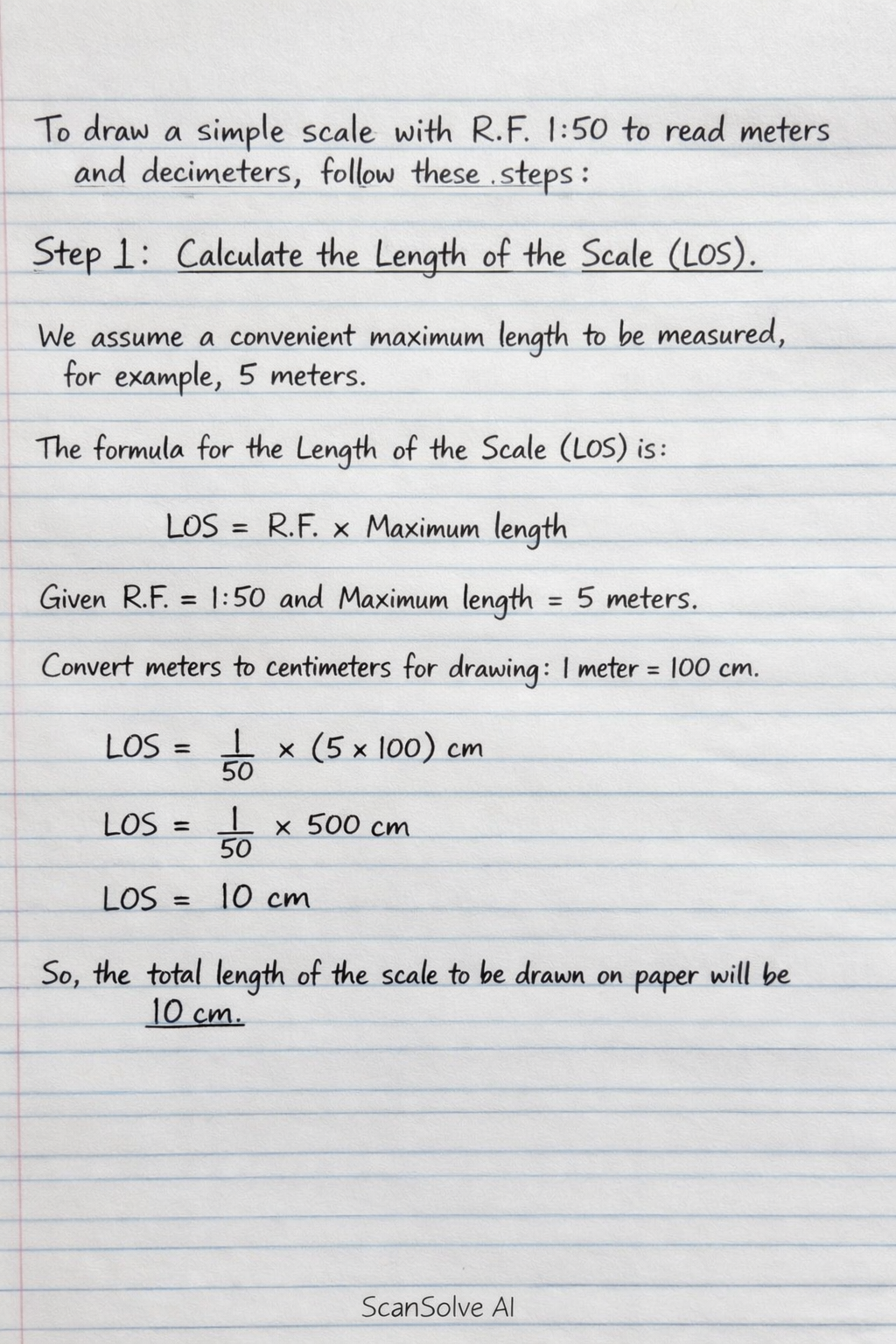
Handwritten Step-by-Step Solution
Get this as a handwritten image on WhatsApp — like a tutor wrote it for you.
Try on WhatsApp