

This mathematics problem involves applying core mathematical principles and formulas. Below you will find a complete step-by-step solution with detailed explanations for each step, helping you understand not just the answer but the method behind it.
ScanSolve AI Answer
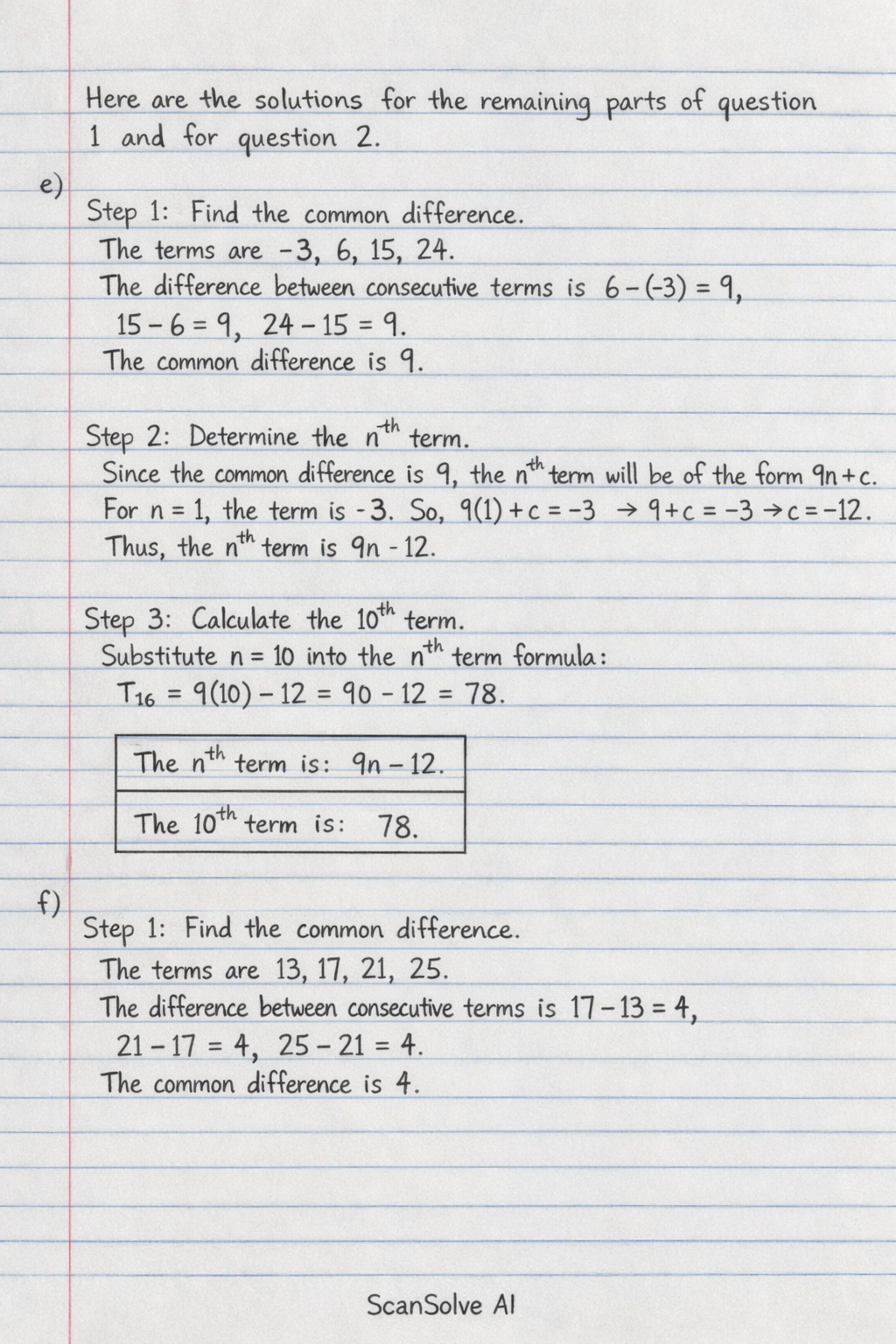
Here are the solutions for the remaining parts of question 1 and for question 2. e) Step 1: Find the common difference. The terms are -3, 6, 15, 24. The difference between consecutive terms is 6 - (-3) = 9, 15 - 6 = 9, 24 - 15 = 9. The common difference is 9. Step 2: Determine the n^th term. Since the common difference is 9, the n^th term will be of the form 9n + c. For n=1, the term is -3. So, 9(1) + c = -3 9 + c = -3 c = -12. Thus, the n^th term is 9n - 12. Step 3: Calculate the 10^th term. Substitute n=10 into the n^th term formula: T_10 = 9(10) - 12 = 90 - 12 = 78. The n^th term is: 9n - 12 The 10^th term is: 78 f) Step 1: Find the common difference. The terms are 13, 17, 21, 25. The difference between consecutive terms is 17 - 13 = 4, 21 - 17 = 4, 25 - 21 = 4. The common difference is 4. Step 2: Determine the n^th term. Since the common difference is 4, the n^th term will be of the form 4n + c. For n=1, the term is 13. So, 4(1) + c = 13 4 + c = 13 c = 9. Thus, the n^th term is 4n + 9. Step 3: Calculate the 10^th term. Substitute n=10 into the n^th term formula: T_10 = 4(10) + 9 = 40 + 9 = 49. The n^th term is: 4n + 9 The 10^th term is: 49 g) Step 1: Find the common difference. The terms are -6, 10, 26, 42. The difference between consecutive terms is 10 - (-6) = 16, 26 - 10 = 16, 42 - 26 = 16. The common difference is 16. Step 2: Determine the n^th term. Since the common difference is 16, the n^th term will be of the form 16n + c. For n=1, the term is -6. So, 16(1) + c = -6 16 + c = -6 c = -22. Thus, the n^th term is 16n - 22. Step 3: Calculate the 10^th term. Substitute n=10 into the n^th term formula: T_10 = 16(10) - 22 = 160 - 22 = 138. The n^th term is: 16n - 22 The 10^th term is: 138 Problem solving - First sequence The given terms are T_3 = 13, T_6 = 40, T_9 = 85, T_12 = 148. Step 1: Determine the type of sequence. Let the n^th term be T_n = an^2 + bn + c. Using the given terms: For n=3: 9a + 3b + c = 13 (Eq 1) For n=6: 36a + 6b + c = 40 (Eq 2) For n=9: 81a + 9b + c = 85 (Eq 3) Step 2: Solve the system of equations. Subtract (Eq 1) from (Eq 2): 27a + 3b = 27 (Eq 4) Subtract (Eq 2) from (Eq 3): 45a + 3b = 45 (Eq 5) Subtract (Eq 4) from (Eq 5): 18a = 18 a = 1. Substitute a=1 into (Eq 4): 27(1) + 3b = 27 3b = 0 b = 0. Substitute a=1, b=0 into (Eq 1): 9(1) + 3(0) + c = 13 9 + c = 13 c = 4. Step 3: Determine the n^th term. The n^th term is T_n = 1n^2 + 0n + 4 = n^2 + 4. Step 4: Calculate the 10^th term. Substitute n=10 into the n^th term formula: T_10 = 10^2 + 4 = 100 + 4 = 104. The n^th term is: n^2 + 4 The 10^th term is: 104 Problem solving - Second sequence The given terms are T_6 = 199, T_12 = 1711, T_18 = 5815. We need to find T_10. Step 1: Determine the type of sequence. Let the n^th term be T_n = an^2 + bn + c. Using the given terms: For n=6: 36a + 6b + c = 199 (Eq 1) For n=12: 144a + 12b + c = 1711 (Eq 2) For n=18: 324a + 18b + c = 5815 (Eq 3) Step 2: Solve the system of equations. Subtract (Eq 1) from (Eq 2): 108a + 6b = 1512 (Eq 4) Subtract (Eq 2) from (Eq 3): 180a + 6b = 4104 (Eq 5) Subtract (Eq 4) from (Eq 5): 72a = 2592 a = 36. Substitute a=36 into (Eq 4): 108(36) + 6b = 1512 3888 + 6b = 1512 6b = -2376 b = -396. Substitute a=36, b=-396 into (Eq 1): 36(36) + 6(-396) + c = 199 1296 - 2376 + c = 199 -1080 + c = 199 c = 1279. Step 3: Determine the n^th term. The n^th term is T_n = 36n^2 - 396n + 1279. Step 4: Calculate the 10^th term. Substitute n=10 into the n^th term formula: T_10 = 36(10^2) - 396(10) + 1279 T_10 = 36(100) - 3960 + 1279 T_10 = 3600 - 3960 + 1279 T_10 = -360 + 1279 = 919. The n^th term is: 36n^2 - 396n + 1279 The 10^th term is: 919 2. Make notes on how you solved the sequences. For arithmetic sequences (like parts a-g), I found the common difference (d) between consecutive terms. The n^th term was then determined using the formula T_n = a + (n-1)d, where a is the first term. For quadratic sequences (like the "Problem solving" sections), I used the general form T_n = an^2 + bn + c. By substituting the given term positions (n) and their values (T_n), I created a system of simultaneous equations to solve for the coefficients a, b, and c. That's 2 down. 3 left today — send the next one.