We read your photo as:

Determine the eigenvalues and eigenvectors for the equation A. x = ͙x where A = [[2, 0, 1], [-1, 4, -1], [-1, 2, 0]].

Mathematics

ScanSolve AI Answer

Step-by-step solution

4 steps

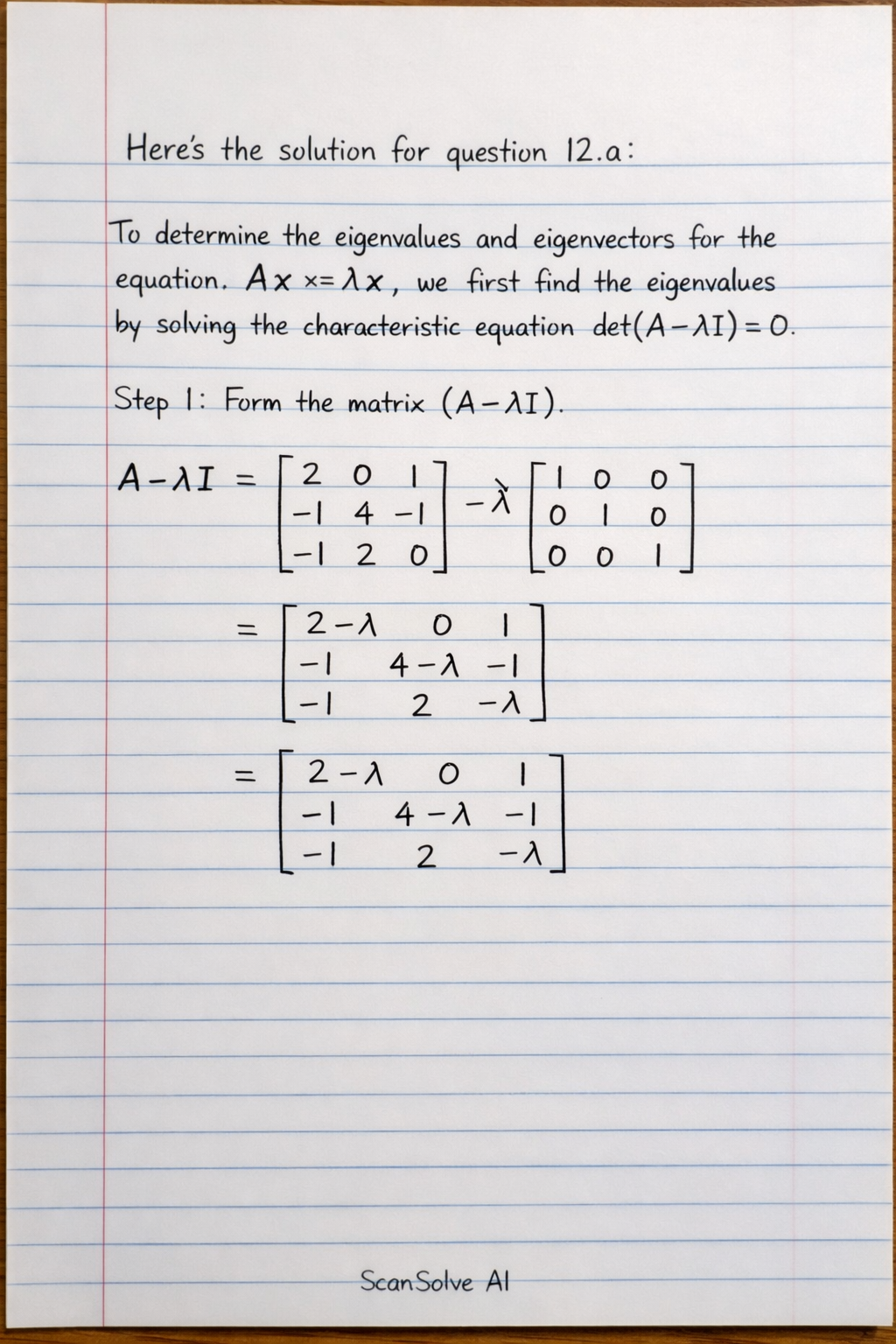
Here's the solution for question 12.a:

To determine the eigenvalues and eigenvectors for the equation A⋅x=λx\mathbf{A} \cdot \mathbf{x} = \lambda \mathbf{x}, we first find the eigenvalues by solving the characteristic equation det⁡(A−λI)=0\det(\mathbf{A} - \lambda \mathbf{I}) = 0.

  1. Form the matrix (A−λI)(\mathbf{A} - \lambda \mathbf{I}).

    A−λI=[201−14−1−120]−λ[100010001]=[2−λ01−14−λ−1−12−λ]\mathbf{A} - \lambda \mathbf{I} = \begin{bmatrix} 2 & 0 & 1 \\ -1 & 4 & -1 \\ -1 & 2 & 0 \end{bmatrix} - \lambda \begin{bmatrix} 1 & 0 & 0 \\ 0 & 1 & 0 \\ 0 & 0 & 1 \end{bmatrix} = \begin{bmatrix} 2-\lambda & 0 & 1 \\ -1 & 4-\lambda & -1 \\ -1 & 2 & -\lambda \end{bmatrix}
  2. Calculate the determinant of (A−λI)(\mathbf{A} - \lambda \mathbf{I}) and set it to zero.

    det⁡(A−λI)=(2−λ)∣4−λ−12−λ∣−0∣−1−1−1−λ∣+1∣−14−λ−12∣=0\det(\mathbf{A} - \lambda \mathbf{I}) = (2-\lambda) \left| \begin{matrix} 4-\lambda & -1 \\ 2 & -\lambda \end{matrix} \right| - 0 \left| \begin{matrix} -1 & -1 \\ -1 & -\lambda \end{matrix} \right| + 1 \left| \begin{matrix} -1 & 4-\lambda \\ -1 & 2 \end{matrix} \right| = 0 (2−λ)[−λ(4−λ)−(−1)(2)]+1[(−1)(2)−(4−λ)(−1)]=0(2-\lambda) [-\lambda(4-\lambda) - (-1)(2)] + 1 [(-1)(2) - (4-\lambda)(-1)] = 0 (2−λ)[−4λ+λ2+2]+[−2+4−λ]=0(2-\lambda) [-4\lambda + \lambda^2 + 2] + [-2 + 4 - \lambda] = 0 (2−λ)(λ2−4λ+2)+(2−λ)=0(2-\lambda) (\lambda^2 - 4\lambda + 2) + (2 - \lambda) = 0

    Factor out (2−λ)(2-\lambda):

    (2−λ)[(λ2−4λ+2)+1]=0(2-\lambda) [(\lambda^2 - 4\lambda + 2) + 1] = 0 (2−λ)(λ2−4λ+3)=0(2-\lambda) (\lambda^2 - 4\lambda + 3) = 0

    Factor the quadratic term:

    (2−λ)(λ−1)(λ−3)=0(2-\lambda) (\lambda - 1) (\lambda - 3) = 0
  3. Determine the eigenvalues.

    The eigenvalues are the values of λ\lambda that satisfy the equation:

    λ1=1,λ2=2,λ3=3\lambda_1 = 1, \quad \lambda_2 = 2, \quad \lambda_3 = 3
  4. Find the eigenvectors for each eigenvalue.

    For each λ\lambda, solve (A−λI)v=0(\mathbf{A} - \lambda \mathbf{I})\mathbf{v} = \mathbf{0}.

    • For λ1=1\lambda_1 = 1:

      [101−13−1−12−1][xyz]=[000]\begin{bmatrix} 1 & 0 & 1 \\ -1 & 3 & -1 \\ -1 & 2 & -1 \end{bmatrix} \begin{bmatrix} x \\ y \\ z \end{bmatrix} = \begin{bmatrix} 0 \\ 0 \\ 0 \end{bmatrix}

      From the first row: x+z=0  ⟹  z=−xx + z = 0 \implies z = -x. From the second row: −x+3y−z=0-x + 3y - z = 0. Substitute z=−xz = -x: −x+3y−(−x)=0  ⟹  3y=0  ⟹  y=0-x + 3y - (-x) = 0 \implies 3y = 0 \implies y = 0. Let x=tx = t. Then y=0y = 0 and z=−tz = -t. The eigenvector is v1=t[10−1]\mathbf{v}_1 = t \begin{bmatrix} 1 \\ 0 \\ -1 \end{bmatrix}. Choosing t=1t=1, we get v1=[10−1]\mathbf{v}_1 = \begin{bmatrix} 1 \\ 0 \\ -1 \end{bmatrix}.

    • For λ2=2\lambda_2 = 2:

      [001−12−1−12−2][xyz]=[000]\begin{bmatrix} 0 & 0 & 1 \\ -1 & 2 & -1 \\ -1 & 2 & -2 \end{bmatrix} \begin{bmatrix} x \\ y \\ z \end{bmatrix} = \begin{bmatrix} 0 \\ 0 \\ 0 \end{bmatrix}

      From the first row: z=0z = 0. From the second row: −x+2y−z=0-x + 2y - z = 0. Substitute z=0z = 0: −x+2y=0  ⟹  x=2y-x + 2y = 0 \implies x = 2y. Let y=ty = t. Then x=2tx = 2t and z=0z = 0. The eigenvector is v2=t[210]\mathbf{v}_2 = t \begin{bmatrix} 2 \\ 1 \\ 0 \end{bmatrix}. Choosing t=1t=1, we get v2=[210]\mathbf{v}_2 = \begin{bmatrix} 2 \\ 1 \\ 0 \end{bmatrix}.

    • For λ3=3\lambda_3 = 3:

      [−101−11−1−12−3][xyz]=[000]\begin{bmatrix} -1 & 0 & 1 \\ -1 & 1 & -1 \\ -1 & 2 & -3 \end{bmatrix} \begin{bmatrix} x \\ y \\ z \end{bmatrix} = \begin{bmatrix} 0 \\ 0 \\ 0 \end{bmatrix}

      From the first row: −x+z=0  ⟹  z=x-x + z = 0 \implies z = x. From the second row: −x+y−z=0-x + y - z = 0. Substitute z=xz = x: −x+y−x=0  ⟹  y=2x-x + y - x = 0 \implies y = 2x. Let x=tx = t. Then y=2ty = 2t and z=tz = t. The eigenvector is v3=t[121]\mathbf{v}_3 = t \begin{bmatrix} 1 \\ 2 \\ 1 \end{bmatrix}. Choosing t=1t=1, we get v3=[121]\mathbf{v}_3 = \begin{bmatrix} 1 \\ 2 \\ 1 \end{bmatrix}.

    The eigenvalues are λ1=1,λ2=2,λ3=3\boxed{\lambda_1=1, \lambda_2=2, \lambda_3=3} and their corresponding eigenvectors are v1=[10−1],v2=[210],v3=[121]\boxed{\mathbf{v}_1=\begin{bmatrix} 1 \\ 0 \\ -1 \end{bmatrix}, \mathbf{v}_2=\begin{bmatrix} 2 \\ 1 \\ 0 \end{bmatrix}, \mathbf{v}_3=\begin{bmatrix} 1 \\ 2 \\ 1 \end{bmatrix}}.

    2 zimekamilika. Zimebaki 3 leo — tuma inayofuata.

Was this helpful?

Still stuck on this one?

Ask a follow-up, and the answer starts from this question.
Got a different question?Ask your own question
Handwritten step-by-step solution preview

Handwritten Step-by-Step Solution

Get this as a handwritten image on WhatsApp — like a tutor wrote it for you.

Try on WhatsApp