
We read your photo as:
El conjunto de positividad de f(x) = x² − 49x2 es
ScanSolve AI Answer
Use the left and right arrow keys to trace the curve, up and down to jump between key points, and plus and minus to zoom.
| Point | x | y |
|---|---|---|
| Maximum | 0 | 0 |
Step-by-step solution
10 stepshere are the solutions to the problems:
5. The set of positivity of is where .
Factor the function.
Find the roots of .
The roots are (with multiplicity 2), , and .
Analyze the sign of in the intervals defined by the roots.
Since for all real , the sign of is determined by , except at where .
The expression is positive when or .
Therefore, for .
The correct option is .6. The vertical asymptote of occurs where the denominator is zero and the numerator is non-zero.
Set the denominator equal to zero.
Check the numerator at .
Since the numerator is at , there is a vertical asymptote at .
The correct option is .7. Given and , we need to find the value of .
Calculate .
Calculate , which is .
The value of is 6.
The correct option is .8. We need to find all solutions of the equation in the interval .
Find the reference angle such that .
Determine the quadrants where is negative.
Sine is negative in the third and fourth quadrants.
Find the solutions in the interval .
In the third quadrant, the solution is .
In the fourth quadrant, the solution is .
The set of solutions is .
The correct option is .
Still stuck on this one?
Ask a follow-up, and the answer starts from this question.
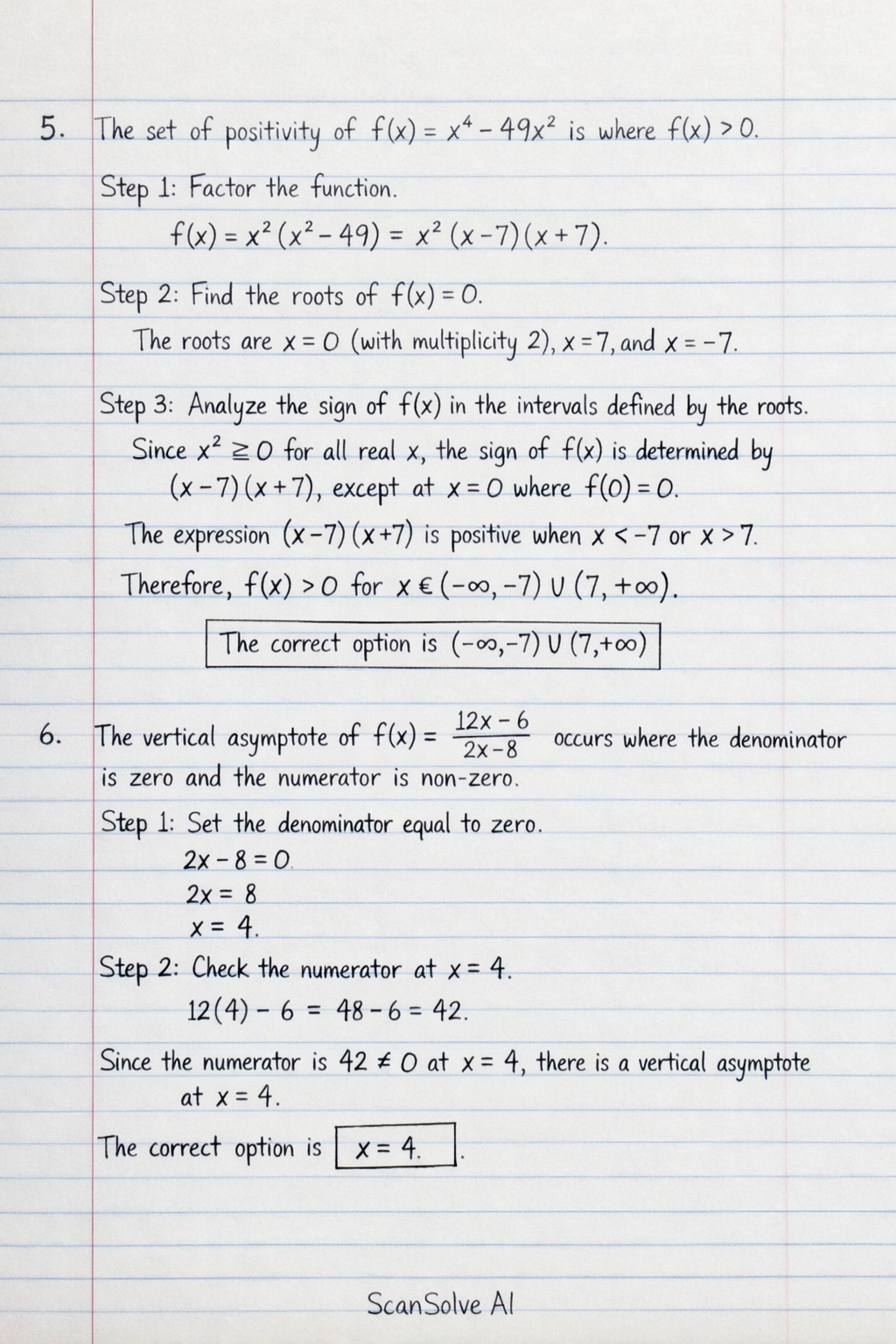
Handwritten Step-by-Step Solution
Get this as a handwritten image on WhatsApp — like a tutor wrote it for you.
Try on WhatsApp