We read your photo as:

Solve the equation: (4r-3)/(6r+1) = (2r−1)/(3r+4)

Mathematics

ScanSolve AI Answer

Answer

r=1r=1

Step-by-step solution

4 steps
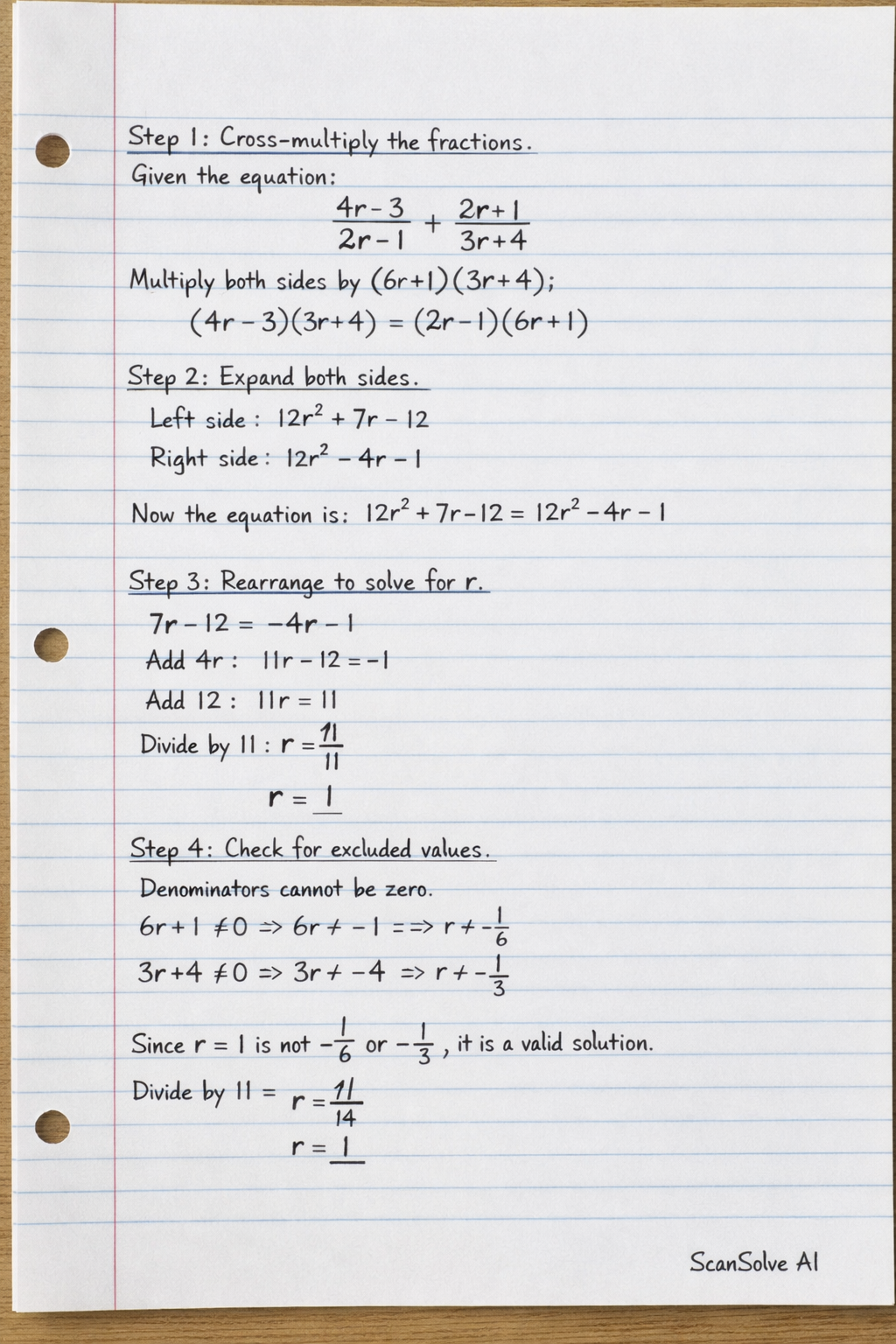
  1. Cross-multiply the fractions.

    Given the equation:

    4r−36r+1=2r−13r+4\frac{4r-3}{6r+1} = \frac{2r-1}{3r+4}

    Multiply both sides by (6r+1)(3r+4)(6r+1)(3r+4) to eliminate the denominators:

    (4r−3)(3r+4)=(2r−1)(6r+1)(4r-3)(3r+4) = (2r-1)(6r+1)
  2. Expand both sides of the equation.

    Expand the left side:

    4r(3r)+4r(4)−3(3r)−3(4)=12r2+16r−9r−12=12r2+7r−124r(3r) + 4r(4) - 3(3r) - 3(4) = 12r^2 + 16r - 9r - 12 = 12r^2 + 7r - 12

    Expand the right side:

    2r(6r)+2r(1)−1(6r)−1(1)=12r2+2r−6r−1=12r2−4r−12r(6r) + 2r(1) - 1(6r) - 1(1) = 12r^2 + 2r - 6r - 1 = 12r^2 - 4r - 1

    Now the equation is:

    12r2+7r−12=12r2−4r−112r^2 + 7r - 12 = 12r^2 - 4r - 1
  3. Rearrange the terms to solve for rr.

    Subtract 12r212r^2 from both sides:

    7r−12=−4r−17r - 12 = -4r - 1

    Add 4r4r to both sides:

    7r+4r−12=−17r + 4r - 12 = -1 11r−12=−111r - 12 = -1

    Add 12 to both sides:

    11r=−1+1211r = -1 + 12 11r=1111r = 11

    Divide by 11:

    r=1111r = \frac{11}{11} r=1r = 1
  4. Check for excluded values.

    The denominators cannot be zero.
    6r+1≠0  ⟹  6r≠−1  ⟹  r≠−166r+1 \neq 0 \implies 6r \neq -1 \implies r \neq -\frac{1}{6}
    3r+4≠0  ⟹  3r≠−4  ⟹  r≠−433r+4 \neq 0 \implies 3r \neq -4 \implies r \neq -\frac{4}{3}
    Since r=1r=1 is not equal to −16-\frac{1}{6} or −43-\frac{4}{3}, it is a valid solution.

Was this helpful?

Try one yourself

A new problem that tests the same skill.

Still stuck on this one?

Ask a follow-up, and the answer starts from this question.

Got a different question?Ask your own question
Handwritten step-by-step solution preview

Handwritten Step-by-Step Solution

Get this as a handwritten image on WhatsApp — like a tutor wrote it for you.

Try on WhatsApp