

This mathematics problem involves applying core mathematical principles and formulas. Below you will find a complete step-by-step solution with detailed explanations for each step, helping you understand not just the answer but the method behind it.
ScanSolve AI Answer
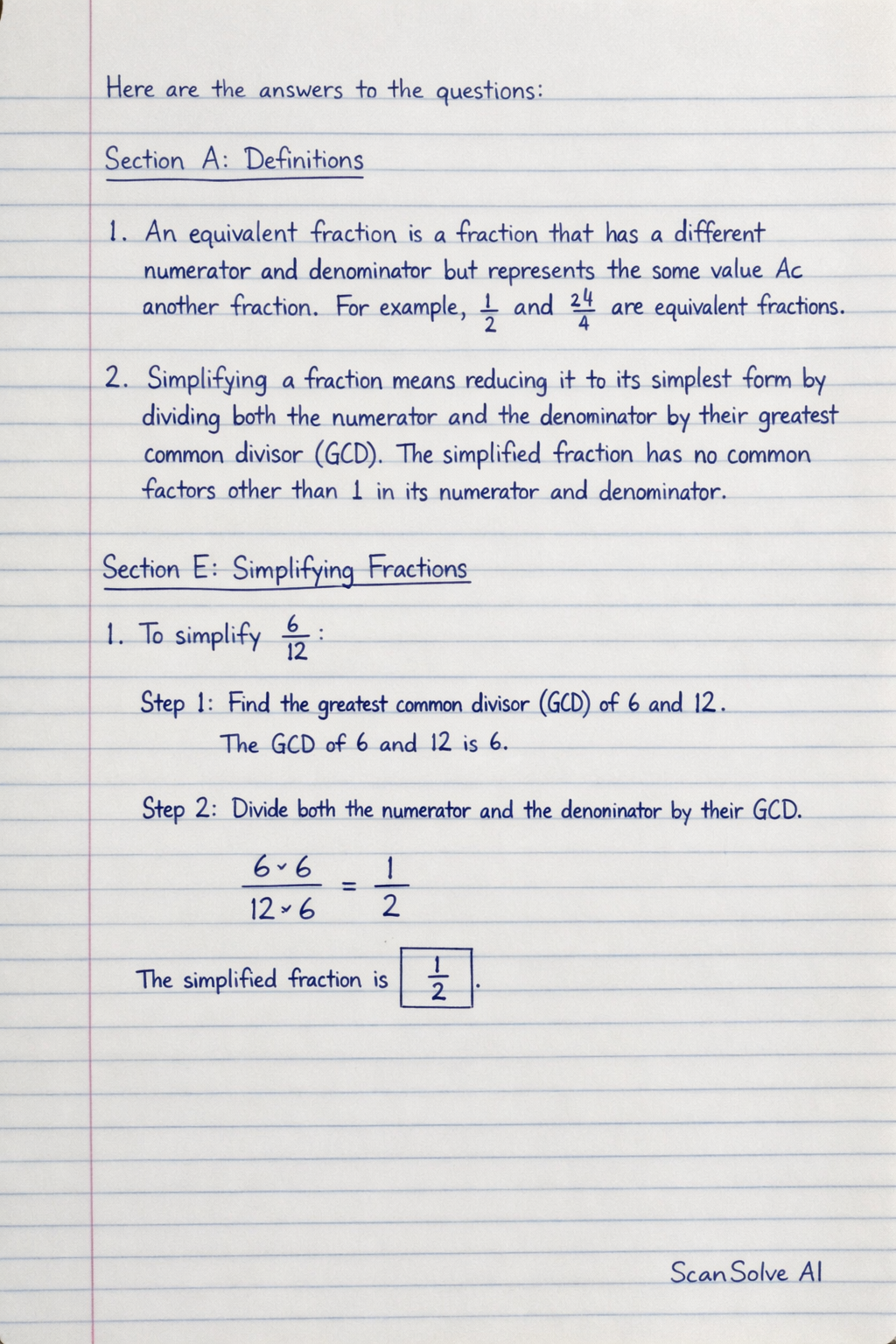
Here are the answers to the questions: Section A: Definitions 1. An equivalent fraction is a fraction that has a different numerator and denominator but represents the same value as another fraction. For example, (1)/(2) and (2)/(4) are equivalent fractions. 2. Simplifying a fraction means reducing it to its simplest form by dividing both the numerator and the denominator by their greatest common divisor (GCD). The simplified fraction has no common factors other than 1 in its numerator and denominator. Section E: Simplifying Fractions 1. To simplify (6)/(12): Step 1: Find the greatest common divisor (GCD) of 6 and 12. The GCD of 6 and 12 is 6. Step 2: Divide both the numerator and the denominator by their GCD. (6 ÷ 6)/(12 ÷ 6) = (1)/(2) The simplified fraction is (1)/(2). 2. To simplify (8)/(16): Step 1: Find the greatest common divisor (GCD) of 8 and 16. The GCD of 8 and 16 is 8. Step 2: Divide both the numerator and the denominator by their GCD. (8 ÷ 8)/(16 ÷ 8) = (1)/(2) The simplified fraction is (1)/(2). 3. To simplify (10)/(20): Step 1: Find the greatest common divisor (GCD) of 10 and 20. The GCD of 10 and 20 is 10. Step 2: Divide both the numerator and the denominator by their GCD. (10 ÷ 10)/(20 ÷ 10) = (1)/(2) The simplified fraction is (1)/(2). That's 2 down. 3 left today — send the next one.