We read your photo as:

Estimate sums and differences by rounding to the nearest 10 and 100. Also, solve an addition problem by decomposing and regrouping numbers.

Mathematics

ScanSolve AI Answer

Step-by-step solution

20 steps

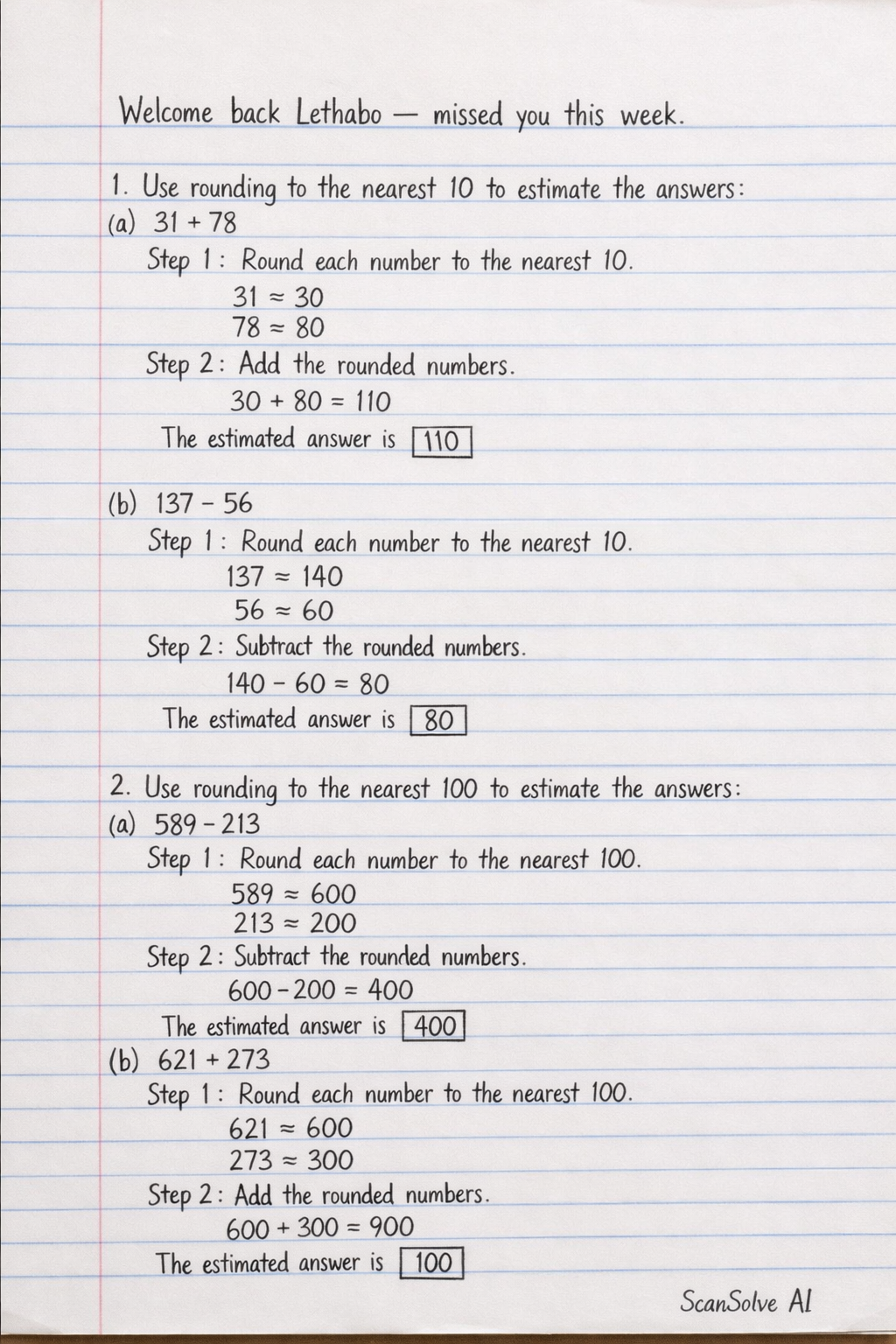
1. Use rounding to the nearest 10 to estimate the answers:

a) 31+7831 + 78

  1. Round each number to the nearest 10.

    31≈3031 \approx 30 78≈8078 \approx 80
  2. Add the rounded numbers.

    30+80=11030 + 80 = 110

    The estimated answer is 110\boxed{\text{110}}.

    b) 137−56137 - 56

  3. Round each number to the nearest 10.

    137≈140137 \approx 140 56≈6056 \approx 60
  4. Subtract the rounded numbers.

    140−60=80140 - 60 = 80

    The estimated answer is 80\boxed{\text{80}}.

    2. Use rounding to the nearest 100 to estimate the answers:

    a) 589−213589 - 213

  5. Round each number to the nearest 100.

    589≈600589 \approx 600 213≈200213 \approx 200
  6. Subtract the rounded numbers.

    600−200=400600 - 200 = 400

    The estimated answer is 400\boxed{\text{400}}.

    b) 621+273621 + 273

  7. Round each number to the nearest 100.

    621≈600621 \approx 600 273≈300273 \approx 300
  8. Add the rounded numbers.

    600+300=900600 + 300 = 900

    The estimated answer is 900\boxed{\text{900}}.

    3. Anna must add 583 and 294. Help her by filling in the missing numbers:

  9. Decompose the numbers into hundreds, tens, and ones.

    583+294=500+80+3+200+90+4583 + 294 = 500 + 80 + 3 + 200 + 90 + 4
  10. Group the hundreds, tens, and ones together.

    =500+200+80+90+3+4= 500 + 200 + 80 + 90 + 3 + 4
  11. Add the grouped numbers.

    =700+170+7= 700 + 170 + 7
  12. Add the results.

    =877= 877

    The completed calculation is:

    583+294=500+80+3+200+90+4583 + 294 = 500 + \boxed{80} + 3 + 200 + 90 + \boxed{4} =500+200+80+90+3+4= 500 + 200 + \boxed{80} + 90 + 3 + \boxed{4} =700+170+7= 700 + \boxed{170} + \boxed{7} =877= \boxed{877}

    4. Calculate the answers, then use the opposite operation to check:

    a) 189−47189 - 47

  13. Calculate the difference.

    189−47=142189 - 47 = 142
  14. Check using the opposite operation (addition).

    142+47=189142 + 47 = 189

    The answer is 142\boxed{\text{142}}.

    b) 632+179632 + 179

  15. Calculate the sum.

    632+179=811632 + 179 = 811
  16. Check using the opposite operation (subtraction).

    811−179=632811 - 179 = 632

    The answer is 811\boxed{\text{811}}.

    5. Mrs Mafaya's eggs:

  17. Calculate the total number of eggs Mrs Mafaya had initially.

    103 (white eggs)+58 (brown eggs)=161 eggs103 \text{ (white eggs)} + 58 \text{ (brown eggs)} = 161 \text{ eggs}
  18. Subtract the number of eggs left from the total initial eggs to find how many were given away.

    161 (total eggs)−49 (eggs left)=112 eggs161 \text{ (total eggs)} - 49 \text{ (eggs left)} = 112 \text{ eggs}

    Mrs Mafaya gave away 112 eggs\boxed{\text{112 eggs}}.

    6. Flow diagram:
    The flow diagram shows: Input →×5→Output→+3→Final Output\rightarrow \times 5 \rightarrow \text{Output} \rightarrow +3 \rightarrow \text{Final Output}
    The question implies the rule is ×5\times 5 then +3+3.

    a) Write the rule for this flow diagram in words.
    The rule is: Multiply the input number by 5, then add 3.

    b) Use the flow diagram to fill in the missing values in the table:

  19. Apply the rule (n×5)+3(n \times 5) + 3 for each input number.

    • For input 1: (1×5)+3=5+3=8(1 \times 5) + 3 = 5 + 3 = 8
    • For input 2: (2×5)+3=10+3=13(2 \times 5) + 3 = 10 + 3 = 13
    • For input 3: (3×5)+3=15+3=18(3 \times 5) + 3 = 15 + 3 = 18
    • For input 4: (4×5)+3=20+3=23(4 \times 5) + 3 = 20 + 3 = 23
    • For input 5: (5×5)+3=25+3=28(5 \times 5) + 3 = 25 + 3 = 28 The completed table is: Input number: 1, 2, 3, 4, 5 Output number: 8\boxed{\text{8}}, 13\boxed{\text{13}}, 18\boxed{\text{18}}, 23\boxed{\text{23}}, 28\boxed{\text{28}}

    7. Fill in the missing numbers in the spidergram:
    The rule is: Add 2, then multiply by 3. So, (n+2)×3(n + 2) \times 3.

  20. Apply the rule for each input number.

    • For input 1: (1+2)×3=3×3=9(1 + 2) \times 3 = 3 \times 3 = 9
    • For input 2: (2+2)×3=4×3=12(2 + 2) \times 3 = 4 \times 3 = 12
    • For input 3: (3+2)×3=5×3=15(3 + 2) \times 3 = 5 \times 3 = 15
    • For input 5: (5+2)×3=7×3=21(5 + 2) \times 3 = 7 \times 3 = 21
    • For input 10: (10+2)×3=12×3=36(10 + 2) \times 3 = 12 \times 3 = 36 The missing numbers are 9\boxed{\text{9}}, 12\boxed{\text{12}}, 15\boxed{\text{15}}, 21\boxed{\text{21}}, 36\boxed{\text{36}}.
Was this helpful?

Still stuck on this one?

Ask a follow-up, and the answer starts from this question.

Got a different question?Ask your own question
Handwritten step-by-step solution preview

Handwritten Step-by-Step Solution

Get this as a handwritten image on WhatsApp — like a tutor wrote it for you.

Try on WhatsApp