We read your photo as:

Evaluate: (23 * 32), [3]343, sqrt(58) to 3 decimal places, and 0.0000821 in standard form.

Mathematics

ScanSolve AI Answer

Step-by-step solution

43 steps

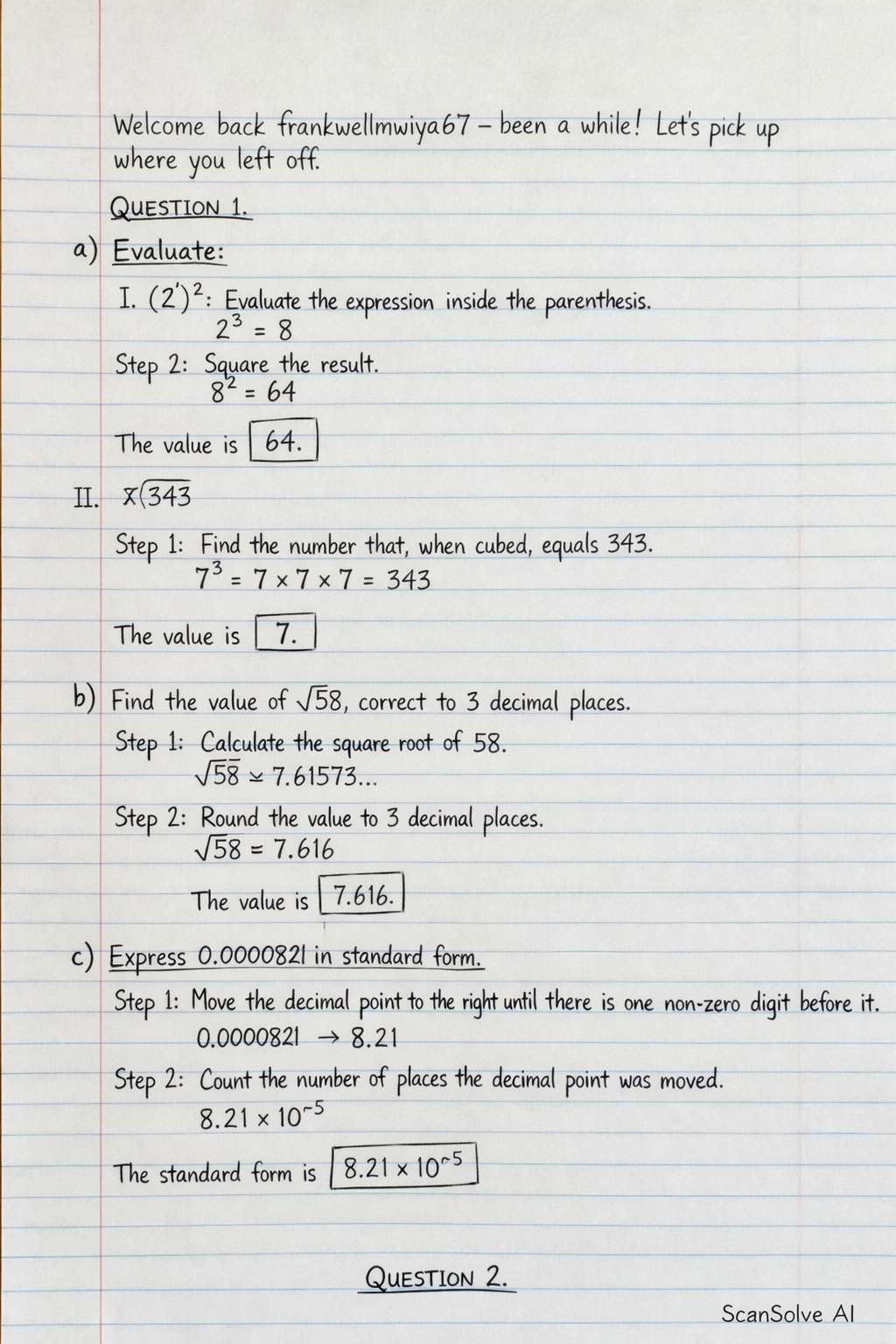
QUESTION 1

a) Evaluate:

I. (23)2(2^3)^2

  1. Evaluate the expression inside the parenthesis.

    23=82^3 = 8
  2. Square the result.

    82=648^2 = 64

    The value is 64\boxed{\text{64}}.

    II. 3433\sqrt[3]{343}

  3. Find the number that, when cubed, equals 343.

    73=7×7×7=3437^3 = 7 \times 7 \times 7 = 343

    The value is 7\boxed{\text{7}}.

    b) Find the value of 58\sqrt{58}, correct to 3 decimal places.

  4. Calculate the square root of 58.

    58≈7.615773...\sqrt{58} \approx 7.615773...
  5. Round the value to 3 decimal places.

    58≈7.616\sqrt{58} \approx 7.616

    The value is 7.616\boxed{\text{7.616}}.

    c) Express 0.0000821 in standard form.

  6. Move the decimal point to the right until there is one non-zero digit before it.

    0.0000821→8.210.0000821 \to 8.21
  7. Count the number of places the decimal point was moved.

    Since it was moved 5 places to the right, the exponent of 10 is -5.

    8.21×10−58.21 \times 10^{-5}

    The standard form is 8.21×10⁻⁵\boxed{8.21 \times 10^{-5}}.

    QUESTION 2

    Express 0.00542 in standard form.

  8. Move the decimal point to the right until there is one non-zero digit before it.

    0.00542→5.420.00542 \to 5.42
  9. Count the number of places the decimal point was moved.

    Since it was moved 3 places to the right, the exponent of 10 is -3.

    5.42×10−35.42 \times 10^{-3}

    The standard form is 5.42×10⁻³\boxed{5.42 \times 10^{-3}}.

    Solve for x:3x2+5x−2=0x: 3x^2+5x-2=0, using the quadratic formula.
    The quadratic formula is x=−b±b2−4ac2ax = \frac{-b \pm \sqrt{b^2 - 4ac}}{2a}. For 3x2+5x−2=03x^2+5x-2=0, we have a=3a=3, b=5b=5, c=−2c=-2.

  10. Substitute the values into the quadratic formula.

    x=−5±52−4(3)(−2)2(3)x = \frac{-5 \pm \sqrt{5^2 - 4(3)(-2)}}{2(3)}
  11. Simplify the expression under the square root.

    x=−5±25−(−24)6=−5±496x = \frac{-5 \pm \sqrt{25 - (-24)}}{6} = \frac{-5 \pm \sqrt{49}}{6}
  12. Calculate the square root.

    x=−5±76x = \frac{-5 \pm 7}{6}
  13. Calculate the two possible values for xx.

    x1=−5+76=26=13x_1 = \frac{-5 + 7}{6} = \frac{2}{6} = \frac{1}{3} x2=−5−76=−126=−2x_2 = \frac{-5 - 7}{6} = \frac{-12}{6} = -2

    The solutions are x=13 or x=−2\boxed{x = \frac{1}{3} \text{ or } x = -2}.

    QUESTION 3

    a) In triangle ABC, AB = 12 cm, AC = 9 cm, and angle BAC = 58°. Calculate the length of BC.
    We use the Cosine Rule: a2=b2+c2−2bccos⁡Aa^2 = b^2 + c^2 - 2bc \cos A. Here, a=BCa=BC, b=AC=9b=AC=9, c=AB=12c=AB=12, and A=58∘A=58^\circ.

  14. Substitute the given values into the Cosine Rule.

    BC2=92+122−2(9)(12)cos⁡(58∘)BC^2 = 9^2 + 12^2 - 2(9)(12) \cos(58^\circ)
  15. Calculate the squares and the product.

    BC2=81+144−216cos⁡(58∘)BC^2 = 81 + 144 - 216 \cos(58^\circ) BC2=225−216cos⁡(58∘)BC^2 = 225 - 216 \cos(58^\circ)
  16. Calculate cos⁡(58∘)\cos(58^\circ) and perform the multiplication.

    BC2=225−216(0.529919...)BC^2 = 225 - 216(0.529919...) BC2=225−114.4625...BC^2 = 225 - 114.4625... BC2=110.5375...BC^2 = 110.5375...
  17. Take the square root and round to two decimal places.

    BC=110.5375...≈10.51368...BC = \sqrt{110.5375...} \approx 10.51368... BC≈10.51 cmBC \approx 10.51 \text{ cm}

    The length of BC is approximately 10.51 cm\boxed{10.51 \text{ cm}}.

    b) In triangle XYZ, angle X = 40°, angle Y = 65°, and side XY = 11 cm. Calculate the length of side YZ.
    We use the Sine Rule: asin⁡A=bsin⁡B=csin⁡C\frac{a}{\sin A} = \frac{b}{\sin B} = \frac{c}{\sin C}. Here, we want to find side YZ (opposite angle X), and we know side XY (opposite angle Z).

  18. Find angle Z using the sum of angles in a triangle.

    ∠Z=180∘−∠X−∠Y=180∘−40∘−65∘=75∘\angle Z = 180^\circ - \angle X - \angle Y = 180^\circ - 40^\circ - 65^\circ = 75^\circ
  19. Apply the Sine Rule.

    YZsin⁡X=XYsin⁡Z\frac{YZ}{\sin X} = \frac{XY}{\sin Z} YZsin⁡40∘=11sin⁡75∘\frac{YZ}{\sin 40^\circ} = \frac{11}{\sin 75^\circ}
  20. Solve for YZ.

    YZ=11sin⁡40∘sin⁡75∘YZ = \frac{11 \sin 40^\circ}{\sin 75^\circ}
  21. Calculate the values and round to two decimal places.

    YZ=11×0.642788...0.965926...=7.070668...0.965926...≈7.3209...YZ = \frac{11 \times 0.642788...}{0.965926...} = \frac{7.070668...}{0.965926...} \approx 7.3209... YZ≈7.32 cmYZ \approx 7.32 \text{ cm}

    The length of YZ is approximately 7.32 cm\boxed{7.32 \text{ cm}}.

    QUESTION 4

    a) Simplify log⁡45+log⁡8−log⁡6\log 45 + \log 8 - \log 6, giving your answer as a single logarithm, then evaluate it.

  22. Use the logarithm properties log⁡a+log⁡b=log⁡(ab)\log a + \log b = \log(ab) and log⁡a−log⁡b=log⁡(ab)\log a - \log b = \log(\frac{a}{b}).

    log⁡45+log⁡8−log⁡6=log⁡(45×8)−log⁡6\log 45 + \log 8 - \log 6 = \log(45 \times 8) - \log 6 =log⁡(360)−log⁡6= \log(360) - \log 6
  23. Combine the remaining logarithms.

    =log⁡(3606)=log⁡(60)= \log\left(\frac{360}{6}\right) = \log(60)
  24. Evaluate log⁡(60)\log(60) (assuming base 10).

    log⁡(60)≈1.77815\log(60) \approx 1.77815

    The single logarithm is log⁡(60)\boxed{\log(60)} and its value is approximately 1.778\boxed{1.778}.

    b) Solve for x:log⁡3(x)=4x: \log_3(x) = 4.

  25. Convert the logarithmic equation to an exponential equation.

    x=34x = 3^4
  26. Calculate the value.

    x=3×3×3×3=81x = 3 \times 3 \times 3 \times 3 = 81

    The solution is x=81\boxed{x = 81}.

    c) Simplify 53×51÷525^3 \times 5^1 \div 5^2, giving your answer as a single power of 5.

  27. Apply the multiplication rule am×an=am+na^m \times a^n = a^{m+n}.

    53×51=53+1=545^3 \times 5^1 = 5^{3+1} = 5^4
  28. Apply the division rule am÷an=am−na^m \div a^n = a^{m-n}.

    54÷52=54−2=525^4 \div 5^2 = 5^{4-2} = 5^2

    The simplified expression is 52\boxed{5^2}.

    d) Solve for x:2x+1=32x: 2^{x+1} = 32.

  29. Express 32 as a power of 2.

    32=2532 = 2^5
  30. Equate the exponents since the bases are the same.

    2x+1=25  ⟹  x+1=52^{x+1} = 2^5 \implies x+1 = 5
  31. Solve for x.

    x=5−1x = 5 - 1 x=4x = 4

    The solution is x=4\boxed{x = 4}.

    QUESTION 5

    a) Given that (a−b)(a+b)=40(a - b)(a + b) = 40 and ab=9ab = 9, determine the value of (a2+b2)(a^2 + b^2).

  32. Use the difference of squares identity to simplify the first given equation.

    (a−b)(a+b)=a2−b2(a-b)(a+b) = a^2 - b^2

    So, a2−b2=40a^2 - b^2 = 40.

  33. Use the algebraic identity (a2+b2)2=(a2−b2)2+4(ab)2(a^2+b^2)^2 = (a^2-b^2)^2 + 4(ab)^2.

  34. Substitute the given values into the identity.

    (a2+b2)2=(40)2+4(9)2(a^2+b^2)^2 = (40)^2 + 4(9)^2
  35. Calculate the squares.

    (a2+b2)2=1600+4(81)(a^2+b^2)^2 = 1600 + 4(81) (a2+b2)2=1600+324(a^2+b^2)^2 = 1600 + 324 (a2+b2)2=1924(a^2+b^2)^2 = 1924
  36. Take the square root.

    a2+b2=1924=4×481=2481a^2+b^2 = \sqrt{1924} = \sqrt{4 \times 481} = 2\sqrt{481}

    The value of (a2+b2)(a^2 + b^2) is 2481\boxed{2\sqrt{481}}.

    b) Solve the equation: 2x−13−x+24=1\frac{2x-1}{3} - \frac{x+2}{4} = 1.

  37. Multiply the entire equation by the least common multiple of the denominators (3 and 4), which is 12.

    12(2x−13)−12(x+24)=12(1)12 \left(\frac{2x-1}{3}\right) - 12 \left(\frac{x+2}{4}\right) = 12(1) 4(2x−1)−3(x+2)=124(2x-1) - 3(x+2) = 12
  38. Distribute the numbers into the parentheses.

    8x−4−(3x+6)=128x - 4 - (3x + 6) = 12 8x−4−3x−6=128x - 4 - 3x - 6 = 12
  39. Combine like terms on the left side.

    5x−10=125x - 10 = 12
  40. Add 10 to both sides of the equation.

    5x=12+105x = 12 + 10 5x=225x = 22
  41. Divide by 5 to solve for x.

    x=225x = \frac{22}{5}

    The solution is x=225 or x=4.4\boxed{x = \frac{22}{5} \text{ or } x = 4.4}.

    QUESTION 6

    a) Calculate the length of an arc and the area of a sector of a circle which subtends an angle of 120° at the centre, if its radius is 9 cm.
    Given: Angle θ=120∘\theta = 120^\circ, Radius r=9r = 9 cm.
    Formulas: Arc length L=θ360∘×2πrL = \frac{\theta}{360^\circ} \times 2\pi r, Area of sector A=θ360∘×πr2A = \frac{\theta}{360^\circ} \times \pi r^2.

  42. Calculate the length of the arc.

    L=120∘360∘×2π(9)L = \frac{120^\circ}{360^\circ} \times 2\pi (9) L=13×18πL = \frac{1}{3} \times 18\pi L=6π cmL = 6\pi \text{ cm}
  43. Calculate the area of the sector.

    A=120∘360∘×π(9)2A = \frac{120^\circ}{360^\circ} \times \pi (9)^2 A=13×π(81)A = \frac{1}{3} \times \pi (81) A=27π cm2A = 27\pi \text{ cm}^2

    The length of the arc is 6π cm\boxed{6\pi \text{ cm}} (approximately 18.85 cm18.85 \text{ cm}) and the area of the sector is 27π cm2\boxed{27\pi \text{ cm}^2} (approximately 84.82 cm284.82 \text{ cm}^2).

Was this helpful?

Still stuck on this one?

Ask a follow-up, and the answer starts from this question.

Got a different question?Ask your own question
Handwritten step-by-step solution preview

Handwritten Step-by-Step Solution

Get this as a handwritten image on WhatsApp — like a tutor wrote it for you.

Try on WhatsApp