We read your photo as:

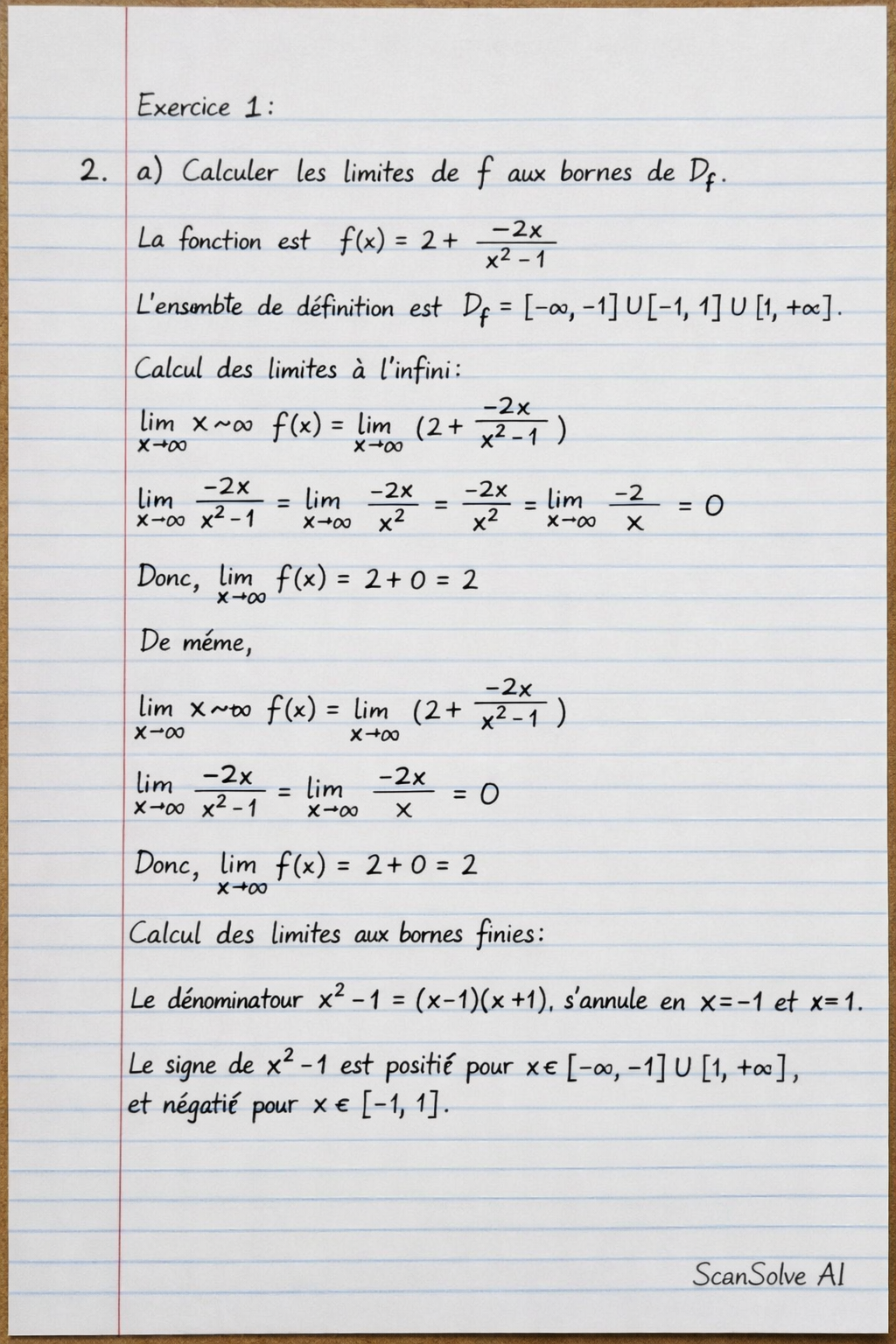
Exercice 1. 2. a) Calculer les limites de f aux bornes de Df. f(x) = 2 + (-2x)/(x2 - 1). Df = ]-inf, -1[ U ]-1, 1[ U ]1, +inf[.

Mathematics

ScanSolve AI Answer

Graph of f(x) = 2 + (−2x)/(x² − 1)

Use the left and right arrow keys to trace the curve, up and down to jump between key points, and plus and minus to zoom.

Key points of f(x) = 2 + (−2x)/(x² − 1)
Pointxy
x-intercept−0.620
y-intercept02
x-intercept1.620

Exercice 1:

  1. a) Calculer les limites de ff aux bornes de DfD_f.

    La fonction est f(x)=2+−2xx2−1f(x) = 2 + \frac{-2x}{x^2 - 1}. L'ensemble de définition est Df=]−∞,−1[∪]−1,1[∪]1,+∞[D_f = ]-\infty, -1[ \cup ]-1, 1[ \cup ]1, +\infty[.

    Calcul des limites à l'infini:

    lim⁡x→−∞f(x)=lim⁡x→−∞(2+−2xx2−1)\lim_{x \to -\infty} f(x) = \lim_{x \to -\infty} \left(2 + \frac{-2x}{x^2 - 1}\right)

    Pour la fraction, on considère les termes de plus haut degré:

    lim⁡x→−∞−2xx2−1=lim⁡x→−∞−2xx2=lim⁡x→−∞−2x=0\lim_{x \to -\infty} \frac{-2x}{x^2 - 1} = \lim_{x \to -\infty} \frac{-2x}{x^2} = \lim_{x \to -\infty} \frac{-2}{x} = 0

    Donc,

    lim⁡x→−∞f(x)=2+0=2\lim_{x \to -\infty} f(x) = 2 + 0 = 2

    De même,

    lim⁡x→+∞f(x)=lim⁡x→+∞(2+−2xx2−1)\lim_{x \to +\infty} f(x) = \lim_{x \to +\infty} \left(2 + \frac{-2x}{x^2 - 1}\right) lim⁡x→+∞−2xx2−1=lim⁡x→+∞−2x=0\lim_{x \to +\infty} \frac{-2x}{x^2 - 1} = \lim_{x \to +\infty} \frac{-2}{x} = 0

    Donc,

    lim⁡x→+∞f(x)=2+0=2\lim_{x \to +\infty} f(x) = 2 + 0 = 2

    Calcul des limites aux bornes finies:
    Le dénominateur x2−1=(x−1)(x+1)x^2 - 1 = (x-1)(x+1) s'annule en x=−1x=-1 et x=1x=1.
    Le signe de x2−1x^2 - 1 est positif pour x∈]−∞,−1[∪]1,+∞[x \in ]-\infty, -1[ \cup ]1, +\infty[ et négatif pour x∈]−1,1[x \in ]-1, 1[.

    Pour x→−1x \to -1:
    Le numérateur −2x→−2(−1)=2-2x \to -2(-1) = 2.

    lim⁡x→−1−f(x)=lim⁡x→−1−(2+−2xx2−1)=2+20+=2+(+∞)=+∞\lim_{x \to -1^-} f(x) = \lim_{x \to -1^-} \left(2 + \frac{-2x}{x^2 - 1}\right) = 2 + \frac{2}{0^+} = 2 + (+\infty) = +\infty lim⁡x→−1+f(x)=lim⁡x→−1+(2+−2xx2−1)=2+20−=2+(−∞)=−∞\lim_{x \to -1^+} f(x) = \lim_{x \to -1^+} \left(2 + \frac{-2x}{x^2 - 1}\right) = 2 + \frac{2}{0^-} = 2 + (-\infty) = -\infty

    Pour x→1x \to 1:
    Le numérateur −2x→−2(1)=−2-2x \to -2(1) = -2.

    lim⁡x→1−f(x)=lim⁡x→1−(2+−2xx2−1)=2+−20−=2+(+∞)=+∞\lim_{x \to 1^-} f(x) = \lim_{x \to 1^-} \left(2 + \frac{-2x}{x^2 - 1}\right) = 2 + \frac{-2}{0^-} = 2 + (+\infty) = +\infty lim⁡x→1+f(x)=lim⁡x→1+(2+−2xx2−1)=2+−20+=2+(−∞)=−∞\lim_{x \to 1^+} f(x) = \lim_{x \to 1^+} \left(2 + \frac{-2x}{x^2 - 1}\right) = 2 + \frac{-2}{0^+} = 2 + (-\infty) = -\infty

    Les limites sont:
    lim⁡x→−∞f(x)=2\boxed{\lim_{x \to -\infty} f(x) = 2}
    lim⁡x→+∞f(x)=2\boxed{\lim_{x \to +\infty} f(x) = 2}
    lim⁡x→−1−f(x)=+∞\boxed{\lim_{x \to -1^-} f(x) = +\infty}
    lim⁡x→−1+f(x)=−∞\boxed{\lim_{x \to -1^+} f(x) = -\infty}
    lim⁡x→1−f(x)=+∞\boxed{\lim_{x \to 1^-} f(x) = +\infty}
    lim⁡x→1+f(x)=−∞\boxed{\lim_{x \to 1^+} f(x) = -\infty}

  2. b) Déduire les asymptotes de la courbe représentative de ff.

    • Puisque lim⁡x→−∞f(x)=2\lim_{x \to -\infty} f(x) = 2 et lim⁡x→+∞f(x)=2\lim_{x \to +\infty} f(x) = 2, la droite d'équation y=2\boxed{y=2} est une asymptote horizontale à la courbe de ff en −∞-\infty et en +∞+\infty.
    • Puisque lim⁡x→−1−f(x)=+∞\lim_{x \to -1^-} f(x) = +\infty et lim⁡x→−1+f(x)=−∞\lim_{x \to -1^+} f(x) = -\infty, la droite d'équation x=−1\boxed{x=-1} est une asymptote verticale à la courbe de ff.
    • Puisque lim⁡x→1−f(x)=+∞\lim_{x \to 1^-} f(x) = +\infty et lim⁡x→1+f(x)=−∞\lim_{x \to 1^+} f(x) = -\infty, la droite d'équation x=1\boxed{x=1} est une asymptote verticale à la courbe de ff.
Was this helpful?

Still stuck on this one?

Ask a follow-up, and the answer starts from this question.

Got a different question?Ask your own question
Handwritten step-by-step solution preview

Handwritten Step-by-Step Solution

Get this as a handwritten image on WhatsApp — like a tutor wrote it for you.

Try on WhatsApp