
We read your photo as:
Exercise: Find the Ratio x : y
ScanSolve AI Answer
Step-by-step solution
42 stepsHere are the solutions for finding the ratio for each problem.
1.
Divide the entire equation by (assuming ).
Let .
Substitute into the equation and solve the quadratic.
Solve for .
Substitute back and express as a ratio.
The ratio is .
2.
Divide the entire equation by (assuming ).
Let .
Substitute into the equation and solve the quadratic.
Solve for .
Substitute back and express as a ratio.
The ratio is .
3.
Divide the entire equation by (assuming ).
Let .
Substitute into the equation and solve the quadratic.
Solve for .
Substitute back and express as a ratio.
The ratio is .
4.
Separate the fraction on the left side (assuming ).
Isolate .
Solve for and then find .
Express as a ratio.
The ratio is .
5.
Separate the fraction on the left side (assuming ).
Isolate .
Solve for .
Express as a ratio.
The ratio is .
6.
Let .
Then . Substitute these into the equation (assuming ).
Multiply the entire equation by to eliminate the denominator.
Rearrange into a quadratic equation and solve for .
Solve for .
Substitute back and express as a ratio.
The ratio is .
7.
Recognize the equation as a perfect square trinomial.
Take the square root of both sides.
Isolate .
Express as a ratio.
The ratio is .
8.
Multiply both sides by (assuming ).
Isolate and terms.
Solve for .
Express as a ratio.
The ratio is .
9.
Let .
Then and . Substitute these into the equation (assuming ).
Multiply the entire equation by $2k$ to eliminate the denominators.
Rearrange into a quadratic equation and solve for .
Solve for .
Substitute back and express as a ratio.
The ratio is .
10.
Divide the entire equation by (assuming ).
Let .
Substitute into the equation and solve the quadratic.
Solve for .
Substitute back and express as a ratio.
The ratio is .
Still stuck on this one?
Ask a follow-up, and the answer starts from this question.
More Mathematics Questions
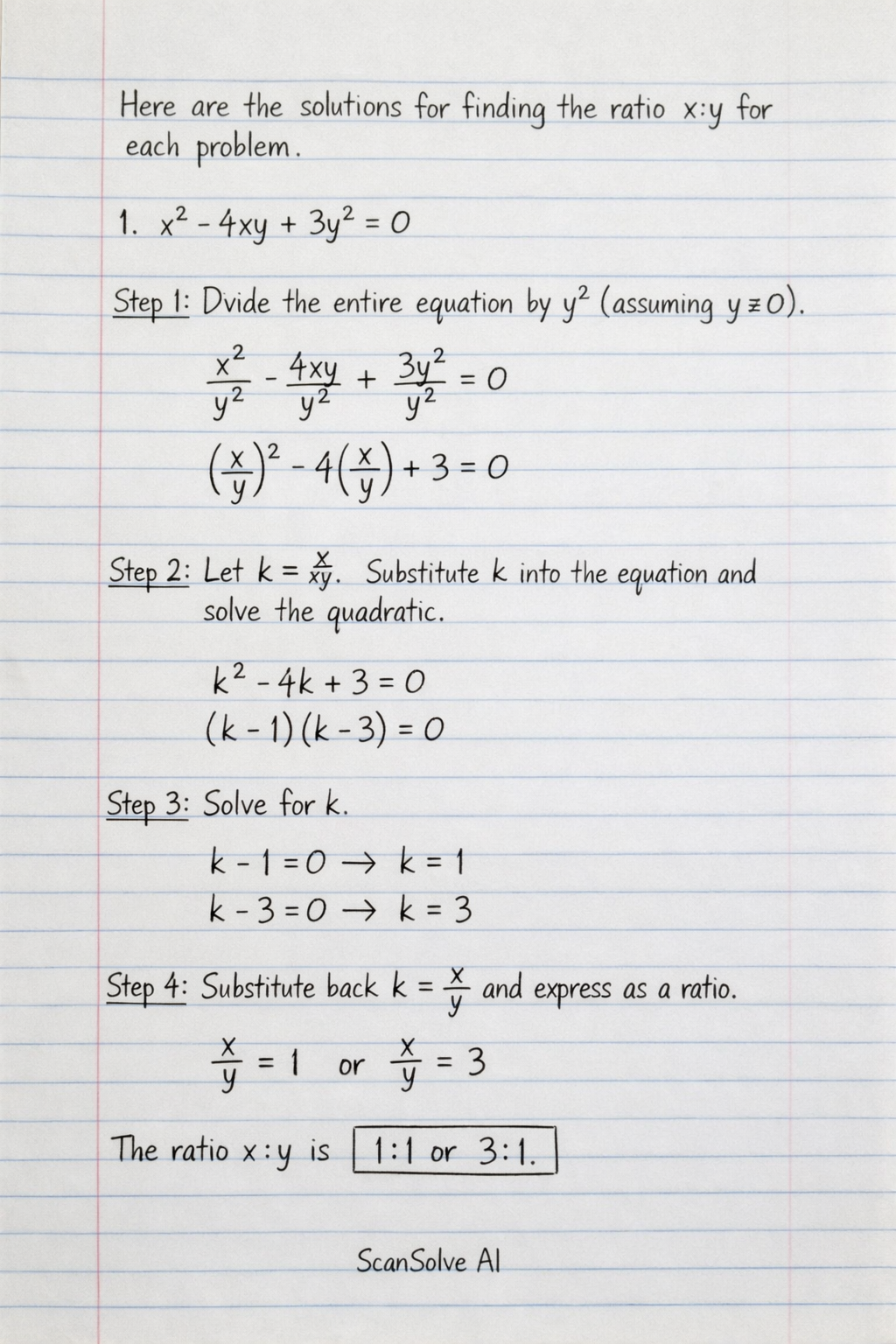
Handwritten Step-by-Step Solution
Get this as a handwritten image on WhatsApp — like a tutor wrote it for you.
Try on WhatsApp