We read your photo as:

Expand R (x + alpha) using the angle addition formula.

Mathematics

ScanSolve AI Answer

Answers

3 parts
a

5sin⁡(x+53.13∘)5 \sin(x + 53.13^\circ)

b

x=36.87∘x = 36.87^\circ

c

−cos⁡(2x)-\cos(2x)

Step-by-step solution

11 steps

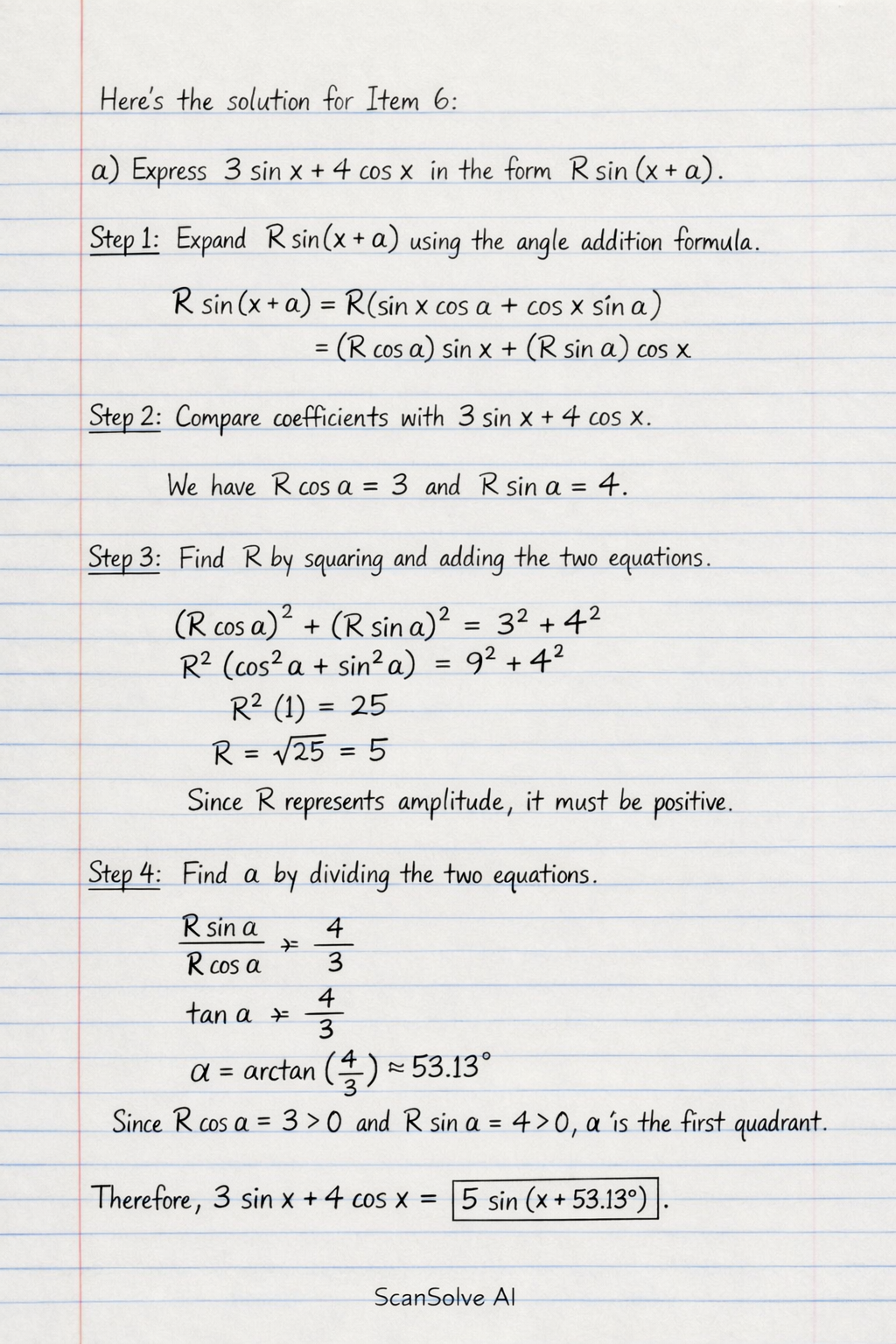
Here's the solution for Item 6:

Part a· 4 steps

Express 3sin⁡x+4cos⁡x3 \sin x + 4 \cos x in the form Rsin⁡(x+α)R \sin(x + \alpha).

  1. Expand Rsin⁡(x+α)R \sin(x + \alpha) using the angle addition formula.

    Rsin⁡(x+α)=R(sin⁡xcos⁡α+cos⁡xsin⁡α)=(Rcos⁡α)sin⁡x+(Rsin⁡α)cos⁡xR \sin(x + \alpha) = R(\sin x \cos \alpha + \cos x \sin \alpha) = (R \cos \alpha) \sin x + (R \sin \alpha) \cos x
  2. Compare coefficients with 3sin⁡x+4cos⁡x3 \sin x + 4 \cos x.

    We have Rcos⁡α=3R \cos \alpha = 3 and Rsin⁡α=4R \sin \alpha = 4.

  3. Find RR by squaring and adding the two equations.

    (Rcos⁡α)2+(Rsin⁡α)2=32+42(R \cos \alpha)^2 + (R \sin \alpha)^2 = 3^2 + 4^2 R2(cos⁡2α+sin⁡2α)=9+16R^2 (\cos^2 \alpha + \sin^2 \alpha) = 9 + 16 R2(1)=25R^2 (1) = 25 R=25=5R = \sqrt{25} = 5

    Since RR represents amplitude, it must be positive.

  4. Find α\alpha by dividing the two equations.

    Rsin⁡αRcos⁡α=43\frac{R \sin \alpha}{R \cos \alpha} = \frac{4}{3} tan⁡α=43\tan \alpha = \frac{4}{3} α=arctan⁡(43)≈53.13∘\alpha = \arctan\left(\frac{4}{3}\right) \approx 53.13^\circ

    Since Rcos⁡α=3>0R \cos \alpha = 3 > 0 and Rsin⁡α=4>0R \sin \alpha = 4 > 0, α\alpha is in the first quadrant.

    Therefore, 3sin⁡x+4cos⁡x=5sin⁡(x+53.13∘)3 \sin x + 4 \cos x = \boxed{5 \sin(x + 53.13^\circ)}.

Part b

x=36.87∘x = 36.87^\circ

Hence solve the equation 3sin⁡x+4cos⁡x=53 \sin x + 4 \cos x = 5 for 0∘≤x≤360∘0^\circ \leq x \leq 360^\circ.

  1. Substitute the result from part (a) into the equation.

    5sin⁡(x+53.13∘)=55 \sin(x + 53.13^\circ) = 5
  2. Isolate the sine function.

    sin⁡(x+53.13∘)=1\sin(x + 53.13^\circ) = 1
  3. Find the principal value for x+53.13∘x + 53.13^\circ.

    The general solution for sin⁡θ=1\sin \theta = 1 is θ=90∘+n⋅360∘\theta = 90^\circ + n \cdot 360^\circ, where nn is an integer.
    So, x+53.13∘=90∘x + 53.13^\circ = 90^\circ.

  4. Solve for xx.

    x=90∘−53.13∘x = 90^\circ - 53.13^\circ x=36.87∘x = 36.87^\circ

    To check for other solutions within 0∘≤x≤360∘0^\circ \leq x \leq 360^\circ, consider x+53.13∘=90∘+360∘=450∘x + 53.13^\circ = 90^\circ + 360^\circ = 450^\circ.
    Then x=450∘−53.13∘=396.87∘x = 450^\circ - 53.13^\circ = 396.87^\circ, which is outside the given range.

    The only solution in the given range is x=36.87∘\boxed{x = 36.87^\circ}.

Part c

−cos⁡(2x)-\cos(2x)

Using double angle identities, simplify 2sin⁡2x−12 \sin^2 x - 1.

  1. Recall the double angle identity for cosine.

    cos⁡(2x)=cos⁡2x−sin⁡2x\cos(2x) = \cos^2 x - \sin^2 x
  2. Use the Pythagorean identity cos⁡2x=1−sin⁡2x\cos^2 x = 1 - \sin^2 x.

    Substitute this into the double angle identity:

    cos⁡(2x)=(1−sin⁡2x)−sin⁡2x\cos(2x) = (1 - \sin^2 x) - \sin^2 x cos⁡(2x)=1−2sin⁡2x\cos(2x) = 1 - 2 \sin^2 x
  3. Rearrange to match the given expression.

    The expression to simplify is 2sin⁡2x−12 \sin^2 x - 1. This is the negative of 1−2sin⁡2x1 - 2 \sin^2 x.

    2sin⁡2x−1=−(1−2sin⁡2x)2 \sin^2 x - 1 = -(1 - 2 \sin^2 x) 2sin⁡2x−1=−cos⁡(2x)2 \sin^2 x - 1 = \boxed{-\cos(2x)}

Part d

Explain how such transformations are useful in analysing oscillatory systems.

Transforming an expression like asin⁡x+bcos⁡xa \sin x + b \cos x into the form Rsin⁡(x+α)R \sin(x + \alpha) (or Rcos⁡(x−α)R \cos(x - \alpha)) is crucial for analyzing oscillatory systems because it directly reveals the amplitude (RR) and phase shift (α\alpha) of the oscillation. The amplitude RR represents the maximum displacement or intensity of the wave, while the phase shift α\alpha indicates the horizontal shift of the wave relative to a standard sine or cosine function. This simplified form makes it easier to understand the overall behavior, predict maximum and minimum values, and analyze the timing of the oscillation, which is vital in fields like physics and engineering.

Was this helpful?

Still stuck on this one?

Ask a follow-up, and the answer starts from this question.

Got a different question?Ask your own question
Handwritten step-by-step solution preview

Handwritten Step-by-Step Solution

Get this as a handwritten image on WhatsApp — like a tutor wrote it for you.

Try on WhatsApp