
We read your photo as:
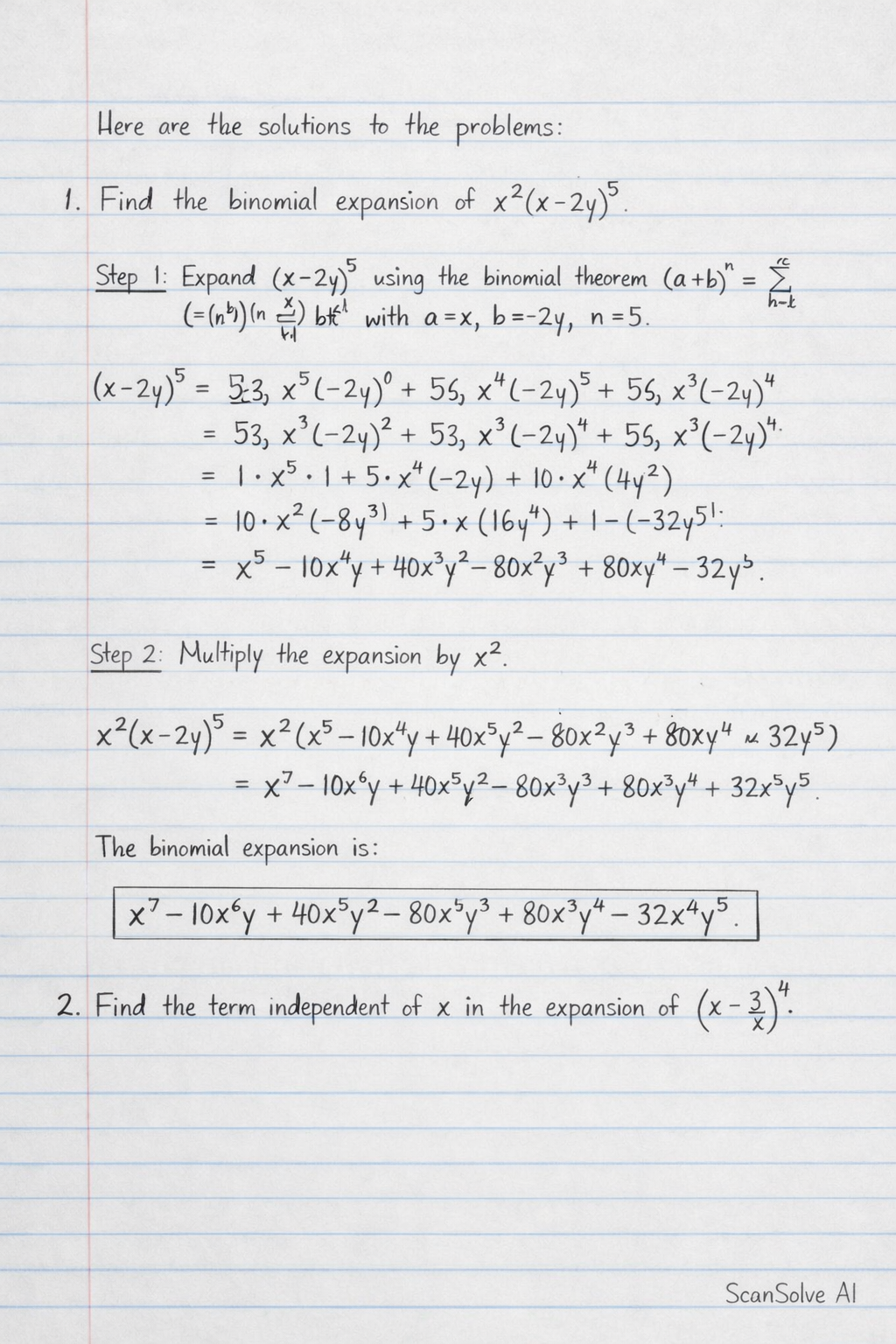
Expand (x-2y)⁵ using the binomial theorem (a+b)ⁿ = sum_k=0ⁿ nk aⁿ-k b^k with a=x, b=-2y, and n=5.
ScanSolve AI Answer
Step-by-step solution
8 stepsHere are the solutions to the problems:
1. Find the binomial expansion of .
Expand using the binomial theorem with , , and .
Multiply the expansion by .
The binomial expansion is:
2. Find the term independent of in the expansion of .
Write the general term for the binomial expansion .
Here, , , and .
For the term independent of , the power of must be 0.
Substitute into the general term formula.
The term independent of is:
3. Find the first three terms in ascending powers of in the expansion of .
Use the binomial expansion for .
Here, and .
First term: 1
Second term:
Third term:
The first three terms are:
4. Find the coefficient of in the expansion of .
Expand using the binomial theorem.
Let and , .
Multiply the expanded form by .
To find the coefficient of , we look for terms that multiply to give :
- multiplied by a term with : There is no term in . So, .
- 1 multiplied by a term with : .
The only term contributing to is .
The coefficient of is:
Still stuck on this one?
Ask a follow-up, and the answer starts from this question.
More Mathematics Questions
Handwritten Step-by-Step Solution
Get this as a handwritten image on WhatsApp — like a tutor wrote it for you.
Try on WhatsApp