We read your photo as:

Express the numerical coefficient as a power of its prime factors.

Mathematics

ScanSolve AI Answer

Step-by-step solution

8 steps

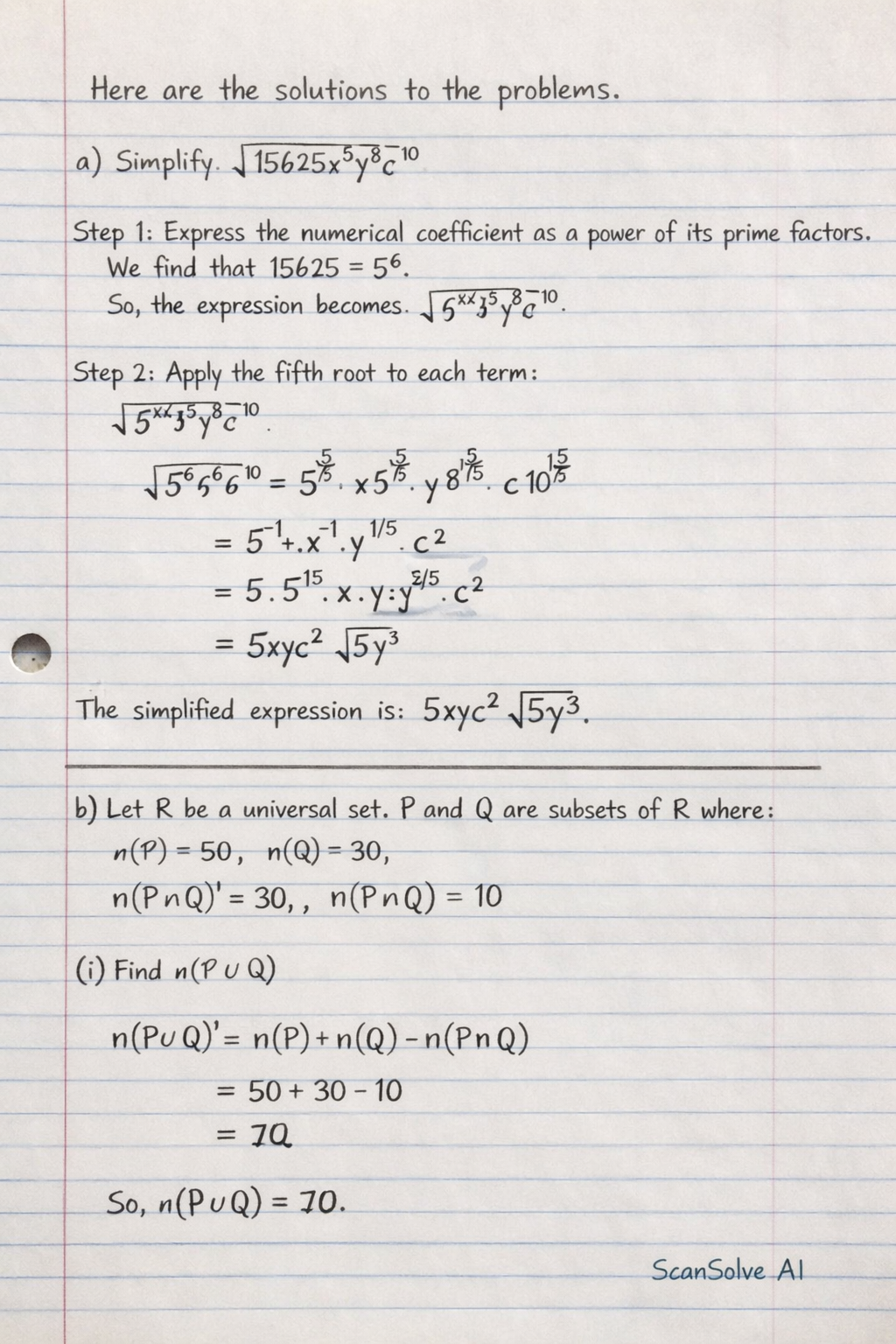
Here are the solutions to the problems.

a) Simplify 15625x5y8c105\sqrt[5]{15625x^5y^8c^{10}}

  1. Express the numerical coefficient as a power of its prime factors.

    We find that 15625=5615625 = 5^6.
    So, the expression becomes 56x5y8c105\sqrt[5]{5^6 x^5 y^8 c^{10}}.

  2. Apply the fifth root to each term using the property amn=am/n\sqrt[n]{a^m} = a^{m/n}.

    56x5y8c105=56/5x5/5y8/5c10/5\sqrt[5]{5^6 x^5 y^8 c^{10}} = 5^{6/5} x^{5/5} y^{8/5} c^{10/5} =51+1/5x1y1+3/5c2= 5^{1 + 1/5} x^1 y^{1 + 3/5} c^2 =5⋅51/5⋅x⋅y⋅y3/5⋅c2= 5 \cdot 5^{1/5} \cdot x \cdot y \cdot y^{3/5} \cdot c^2 =5xyc25y35= 5xyc^2 \sqrt[5]{5y^3}

    The simplified expression is 5xyc25y35\boxed{\mathbf{5xyc^2 \sqrt[5]{5y^3}}}.

    b) Let R be a universal set and P and Q are subsets of R where, n(P)=50n(P) = 50, n(Q)=30n(Q) = 30, n(P∩Q)′=30n(P \cap Q)' = 30 and n(P∩Q)=10n(P \cap Q) = 10, what is the value of

    (i) n(P∪Q)n(P \cup Q) (ii) n(R)n(R)

    b) (i) Find n(P∪Q)n(P \cup Q)

  3. Use the formula for the number of elements in the union of two sets.

    n(P∪Q)=n(P)+n(Q)−n(P∩Q)n(P \cup Q) = n(P) + n(Q) - n(P \cap Q)

    Substitute the given values:

    n(P∪Q)=50+30−10n(P \cup Q) = 50 + 30 - 10 n(P∪Q)=80−10n(P \cup Q) = 80 - 10 n(P∪Q)=70n(P \cup Q) = 70

    The value of n(P∪Q)n(P \cup Q) is 70\boxed{\mathbf{70}}.

    b) (ii) Find n(R)n(R)

  4. Use the complement rule for sets.

    The number of elements in the complement of a set AA in a universal set UU is n(A′)=n(U)−n(A)n(A') = n(U) - n(A).
    Here, U=RU = R and A=P∩QA = P \cap Q.

    n(P∩Q)′=n(R)−n(P∩Q)n(P \cap Q)' = n(R) - n(P \cap Q)

    Substitute the given values:

    30=n(R)−1030 = n(R) - 10 n(R)=30+10n(R) = 30 + 10 n(R)=40n(R) = 40

    The value of n(R)n(R) is 40\boxed{\mathbf{40}}.

    c) If α\alpha and β\beta are the roots of the equation 2x2−3x+4=02x^2 - 3x + 4 = 0. Find the value of (i) 1α+1β\frac{1}{\alpha} + \frac{1}{\beta} (ii) (α−β)2αβ\frac{(\alpha - \beta)^2}{\alpha \beta}

  5. Identify the coefficients of the quadratic equation ax2+bx+c=0ax^2 + bx + c = 0.

    For 2x2−3x+4=02x^2 - 3x + 4 = 0, we have a=2a=2, b=−3b=-3, c=4c=4.

  6. Calculate the sum and product of the roots.

    Sum of roots: α+β=−ba=−(−3)2=32\alpha + \beta = -\frac{b}{a} = -\frac{(-3)}{2} = \frac{3}{2}
    Product of roots: αβ=ca=42=2\alpha \beta = \frac{c}{a} = \frac{4}{2} = 2

    c) (i) Find 1α+1β\frac{1}{\alpha} + \frac{1}{\beta}

  7. Simplify the expression and substitute the values of the sum and product of roots.

    1α+1β=β+ααβ\frac{1}{\alpha} + \frac{1}{\beta} = \frac{\beta + \alpha}{\alpha \beta} =3/22= \frac{3/2}{2} =32×12= \frac{3}{2} \times \frac{1}{2} =34= \frac{3}{4}

    The value of 1α+1β\frac{1}{\alpha} + \frac{1}{\beta} is 34\boxed{\mathbf{\frac{3}{4}}}.

    c) (ii) Find (α−β)2αβ\frac{(\alpha - \beta)^2}{\alpha \beta}

  8. Use the identity (α−β)2=(α+β)2−4αβ(\alpha - \beta)^2 = (\alpha + \beta)^2 - 4\alpha \beta and substitute the values.

    (α−β)2αβ=(α+β)2−4αβαβ\frac{(\alpha - \beta)^2}{\alpha \beta} = \frac{(\alpha + \beta)^2 - 4\alpha \beta}{\alpha \beta}

    Substitute α+β=32\alpha + \beta = \frac{3}{2} and αβ=2\alpha \beta = 2:

    =(32)2−4(2)2= \frac{\left(\frac{3}{2}\right)^2 - 4(2)}{2} =94−82= \frac{\frac{9}{4} - 8}{2} =94−3242= \frac{\frac{9}{4} - \frac{32}{4}}{2} =−2342= \frac{-\frac{23}{4}}{2} =−234×12= -\frac{23}{4} \times \frac{1}{2} =−238= -\frac{23}{8}

    The value of (α−β)2αβ\frac{(\alpha - \beta)^2}{\alpha \beta} is −238\boxed{\mathbf{-\frac{23}{8}}}.

Was this helpful?

Still stuck on this one?

Ask a follow-up, and the answer starts from this question.

Got a different question?Ask your own question
Handwritten step-by-step solution preview

Handwritten Step-by-Step Solution

Get this as a handwritten image on WhatsApp — like a tutor wrote it for you.

Try on WhatsApp