
We read your photo as:
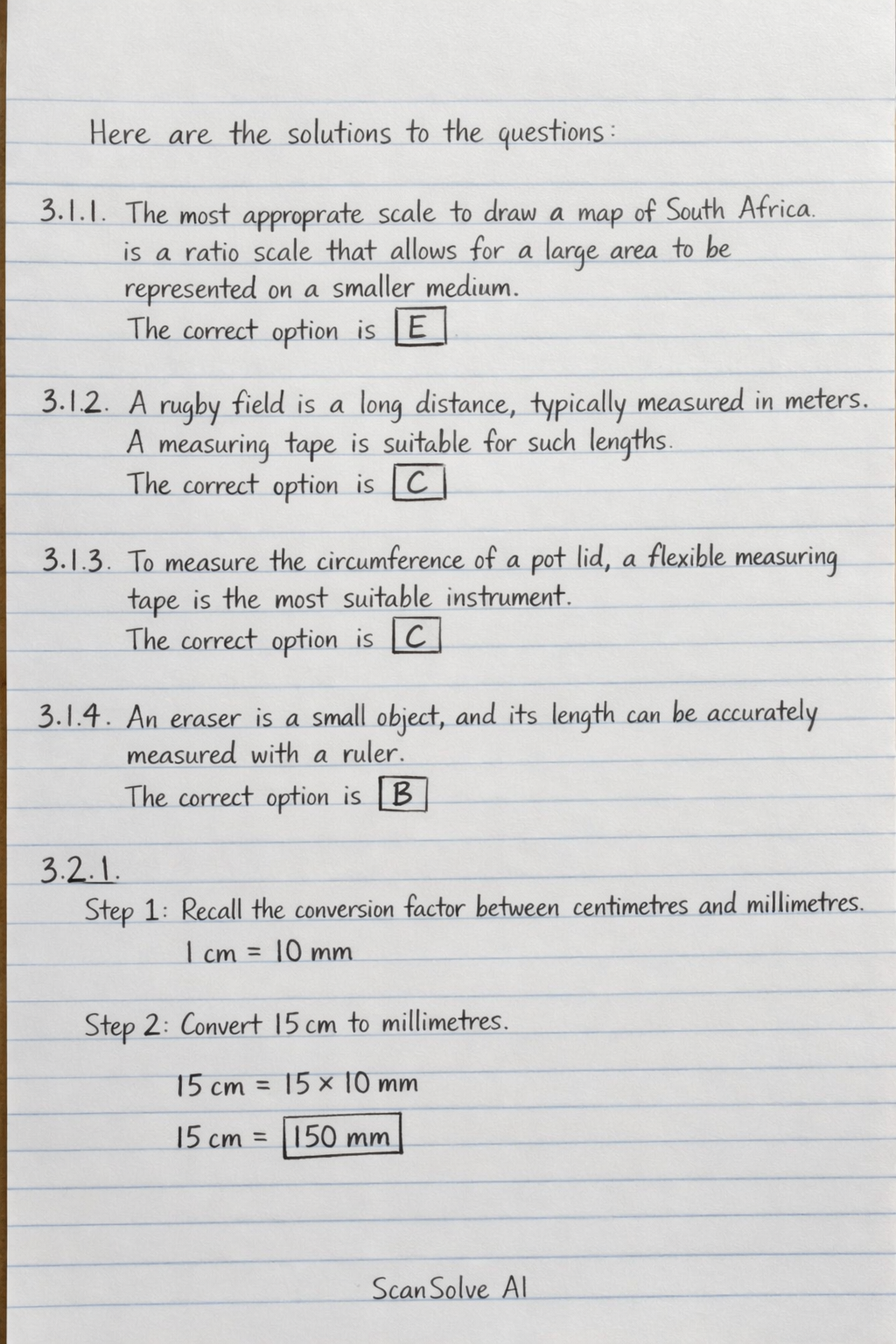
The most appropriate scale to draw a map of South Africa is a ratio scale that allows for a large area to be represented on a smaller medium.
ScanSolve AI Answer
Step-by-step solution
10 stepsHere are the solutions to the questions:
3.1.1
The most appropriate scale to draw a map of South Africa is a ratio scale that allows for a large area to be represented on a smaller medium.
The correct option is .
3.1.2
A rugby field is a long distance, typically measured in meters. A measuring tape is suitable for such lengths.
The correct option is .
3.1.3
To measure the circumference of a pot lid, a flexible measuring tape is the most suitable instrument.
The correct option is .
3.1.4
An eraser is a small object, and its length can be accurately measured with a ruler.
The correct option is .
3.2.1
Recall the conversion factor between centimetres and millimetres.
Convert to millimetres.
3.2.2
Identify the total thickness of a bundle and the thickness of one flattened box.
Bundle thickness = (from 3.2.1)
Thickness of one box =Calculate the number of boxes per bundle.
Since you cannot have a fraction of a box, round down to the nearest whole number.
3.2.3
Identify the height of one block and the thickness of one bundle.
Block height =
Bundle thickness =Convert units to be consistent.
Convert metres to centimetres.
Calculate the number of bundles per block.
3.3.1
The display shows a clock with hands, which is characteristic of an analogue clock.
This is an time display.3.3.2
Read the time from the clock.
The hour hand is between 8 and 9.
The minute hand is pointing at 9, which represents 45 minutes past the hour.
So the time is 8:45.Convert to 24-hour format, noting it's "Thursday afternoon".
For afternoon (PM) times, add 12 to the hour.
The time in 24-hour format is .
Still stuck on this one?
Ask a follow-up, and the answer starts from this question.
More Mathematics Questions
Handwritten Step-by-Step Solution
Get this as a handwritten image on WhatsApp — like a tutor wrote it for you.
Try on WhatsApp