

This mathematics problem involves applying core mathematical principles and formulas. Below you will find a complete step-by-step solution with detailed explanations for each step, helping you understand not just the answer but the method behind it.
ScanSolve AI Answer
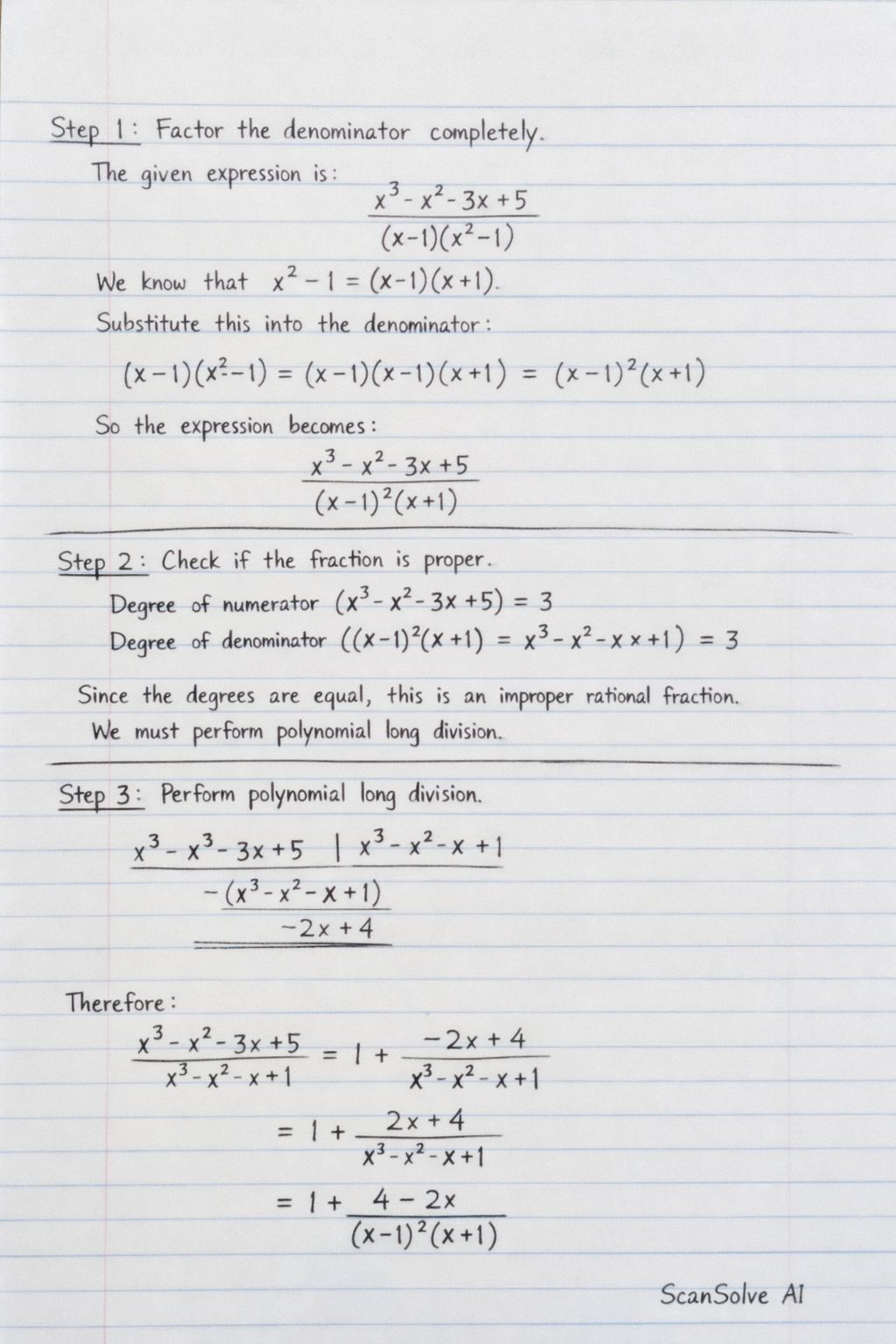
Step 1: Factor the denominator completely. The given expression is: (x^3 - x^2 - 3x + 5)/((x-1)(x^2-1)) We know that x^2-1 = (x-1)(x+1). Substitute this into the denominator: (x-1)(x^2-1) = (x-1)(x-1)(x+1) = (x-1)^2(x+1) So the expression becomes: (x^3 - x^2 - 3x + 5)/((x-1)^2(x+1)) Step 2: Check if the fraction is proper. The degree of the numerator (x^3 - x^2 - 3x + 5) is 3. The degree of the denominator ((x-1)^2(x+1) = (x^2-2x+1)(x+1) = x^3 - x^2 - x + 1) is 3. Since the degree of the numerator is equal to the degree of the denominator, this is an improper rational fraction. We must perform polynomial long division first. Step 3: Perform polynomial long division. Divide x^3 - x^2 - 3x + 5 by x^3 - x^2 - x + 1. (x^3 - x^2 - 3x + 5)/(x^3 - x^2 - x + 1) = 1 + ((x^3 - x^2 - 3x + 5) - (x^3 - x^2 - x + 1))/(x^3 - x^2 - x + 1) = 1 + (-2x + 4)/(x^3 - x^2 - x + 1) So, the expression can be written as: 1 + (4 - 2x)/((x-1)^2(x+1)) Step 4: Set up the partial fraction decomposition for the proper fraction. Let f(x) = (4 - 2x)/((x-1)^2(x+1)). The denominator has a repeated linear factor (x-1)^2 and a distinct linear factor (x+1). The form of the partial fraction decomposition is: (4 - 2x)/((x-1)^2(x+1)) = (A)/(x-1) + (B)/((x-1)^2) + (C)/(x+1) Step 5: Clear the denominators to solve for A, B, and C. Multiply both sides by (x-1)^2(x+1): 4 - 2x = A(x-1)(x+1) + B(x+1) + C(x-1)^2 4 - 2x = A(x^2-1) + B(x+1) + C(x^2-2x+1) Step 6: Solve for A, B, and C by substituting convenient values for x. • Let x=1: 4 - 2(1) = A(1^2-1) + B(1+1) + C(1-1)^2 2 = A(0) + B(2) + C(0) 2 = 2B B = 1 • Let x=-1: 4 - 2(-1) = A((-1)^2-1) + B(-1+1) + C(-1-1)^2 4 + 2 = A(0) + B(0) + C(-2)^2 6 = 4C C = (6)/(4) = (3)/(2) • Let x=0: 4 - 2(0) = A(0^2-1) + B(0+1) + C(0-1)^2 4 = A(-1) + B(1) + C(1) 4 = -A + B + C Substitute the values of B=1 and C=(3)/(2): 4 = -A + 1 + (3)/(2) 4 = -A + (2)/(2) + (3)/(2) 4 = -A + (5)/(2) A = (5)/(2) - 4 A = (5)/(2) - (8)/(2) A = -(3)/(2) Step 7: Write the complete partial fraction decomposition. Substitute the values of A, B, and C back into the expression from Step 3: 1 + (-3)/(2)x-1 + (1)/((x-1)^2) + (3)/(2)x+1 1 - (3)/(2(x-1)) + (1)/((x-1)^2) + (3)/(2(x+1)) The final answer is 1 - (3)/(2(x-1)) + (1)/((x-1)^2) + (3)/(2(x+1)).