

This mathematics problem involves applying core mathematical principles and formulas. Below you will find a complete step-by-step solution with detailed explanations for each step, helping you understand not just the answer but the method behind it.
ScanSolve AI Answer
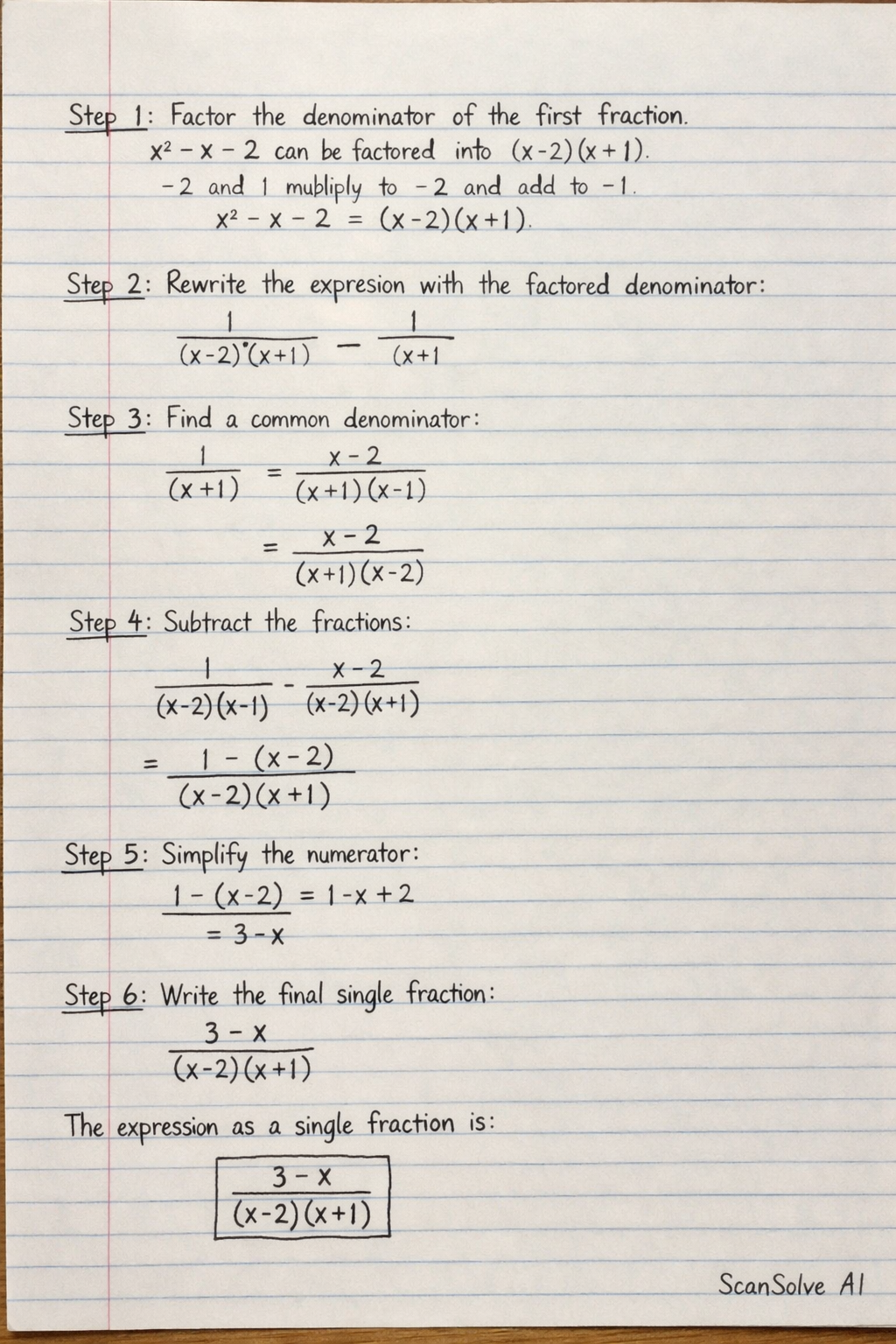
Step 1: Factor the denominator of the first fraction. The quadratic expression x^2 - x - 2 can be factored into two binomials. We need two numbers that multiply to -2 and add to -1. These numbers are -2 and 1. x^2 - x - 2 = (x-2)(x+1) Step 2: Rewrite the expression with the factored denominator. (1)/((x-2)(x+1)) - (1)/(x+1) Step 3: Find a common denominator. The common denominator for both fractions is (x-2)(x+1). The first fraction already has this denominator. For the second fraction, multiply the numerator and denominator by (x-2). (1)/(x+1) = (1 · (x-2))/((x+1) · (x-2)) = (x-2)/((x+1)(x-2)) Step 4: Subtract the fractions. Now that both fractions have the same denominator, subtract their numerators. (1)/((x-2)(x+1)) - (x-2)/((x-2)(x+1)) = (1 - (x-2))/((x-2)(x+1)) Step 5: Simplify the numerator. 1 - (x-2) = 1 - x + 2 = 3 - x Step 6: Write the final single fraction. (3 - x)/((x-2)(x+1)) The expression as a single fraction is: (3 - x)/((x-2)(x+1))