
We read your photo as:
Factor the denominator using the difference of squares formula, a² − b² = (a−b)(a+b).
ScanSolve AI Answer
Step-by-step solution
11 stepsHere are the solutions to the questions:
Part i· 5 steps
Resolve into partial fraction:
Factor the denominator using the difference of squares formula, .
Set up the partial fraction decomposition.
Multiply both sides by to clear the denominators.
Solve for and .
To find , substitute :
To find , substitute :
Substitute the values of and back into the decomposition.
The partial fraction decomposition is .
Part ii
What is the difference between proper and improper fraction?
A proper fraction is a rational expression where the degree of the numerator polynomial is less than the degree of the denominator polynomial. An improper fraction is a rational expression where the degree of the numerator polynomial is greater than or equal to the degree of the denominator polynomial.
Part iii
Define union of two sets. Give an example.
The union of two sets and , denoted by , is the set containing all elements that are members of , or members of , or members of both.
Example: If and , then .
Part iv
If and then find .
The Cartesian product is the set of all ordered pairs where and .
Given and .
The Cartesian product is .
Part v
Write any two subsets of the set .
A subset is a set containing some or all of the elements of the original set.
Two subsets of are and . (Other valid subsets include and ).
Part vi
If and , then find .
(the complement of ) consists of all elements in the universal set that are not in .
Given and .
To find , we remove the elements of from .
The complement of is .
Part vii
What is the difference between median and mode?
The median is the middle value in a dataset when the values are arranged in numerical order. If there is an even number of data points, the median is the average of the two middle values. The mode is the value that appears most frequently in a dataset. A dataset can have one mode, multiple modes, or no mode.
Part viii· 3 steps
Find arithmetic mean of the data: .
The arithmetic mean () is the sum of all values divided by the number of values ().
Sum the data values.
Count the number of values.
Calculate the mean.
The arithmetic mean is .
Part ix· 3 steps
Find the range of the data: $12, 14, 17, 20, 24, 29, 35, 45$.
The range is the difference between the maximum and minimum values in a dataset.
Identify the maximum value.
Maximum value = 45
Identify the minimum value.
Minimum value = 12
Calculate the range.
The range of the data is .
Still stuck on this one?
Ask a follow-up, and the answer starts from this question.
More Mathematics Questions
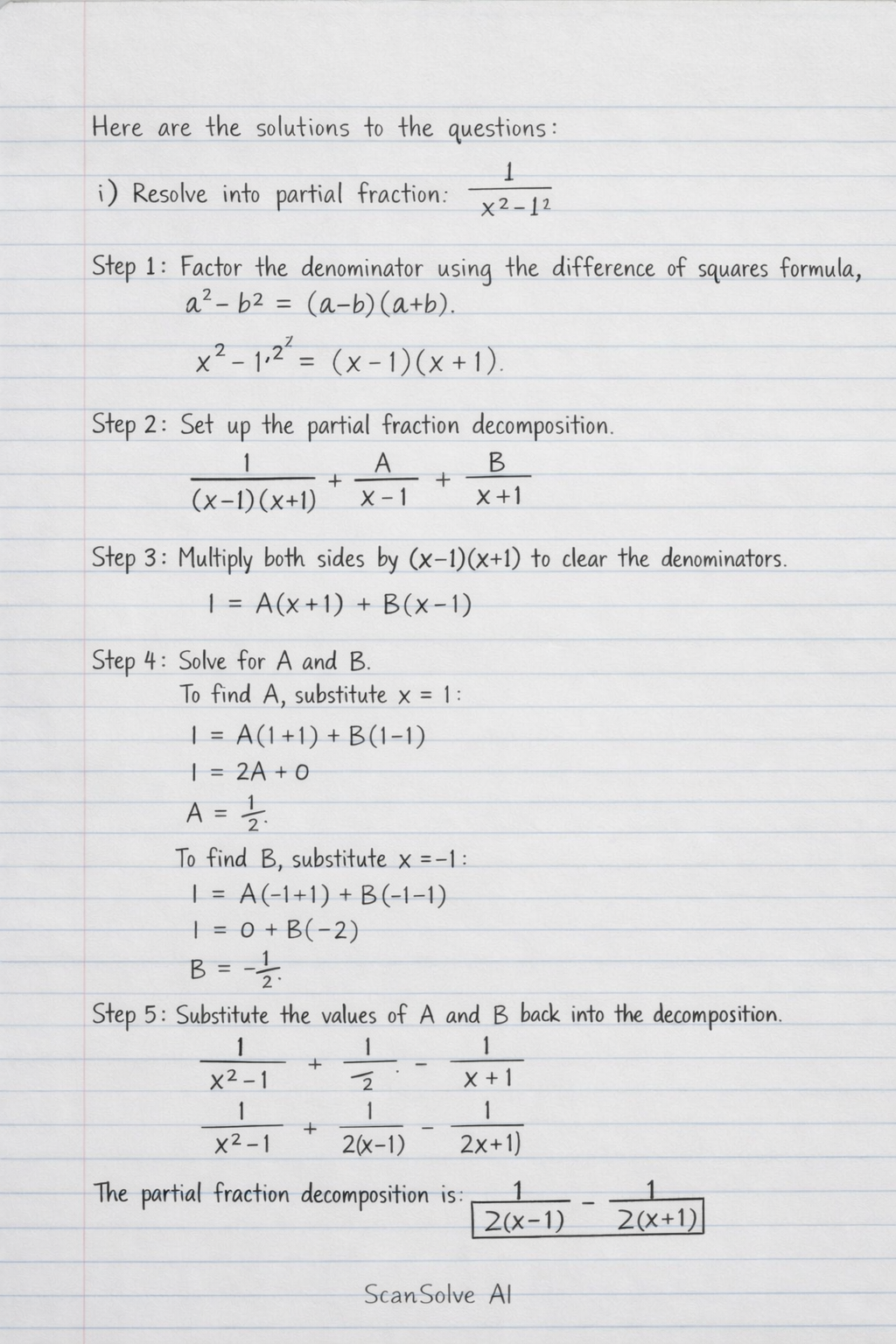
Handwritten Step-by-Step Solution
Get this as a handwritten image on WhatsApp — like a tutor wrote it for you.
Try on WhatsApp