

This mathematics problem involves applying core mathematical principles and formulas. Below you will find a complete step-by-step solution with detailed explanations for each step, helping you understand not just the answer but the method behind it.
ScanSolve AI Answer
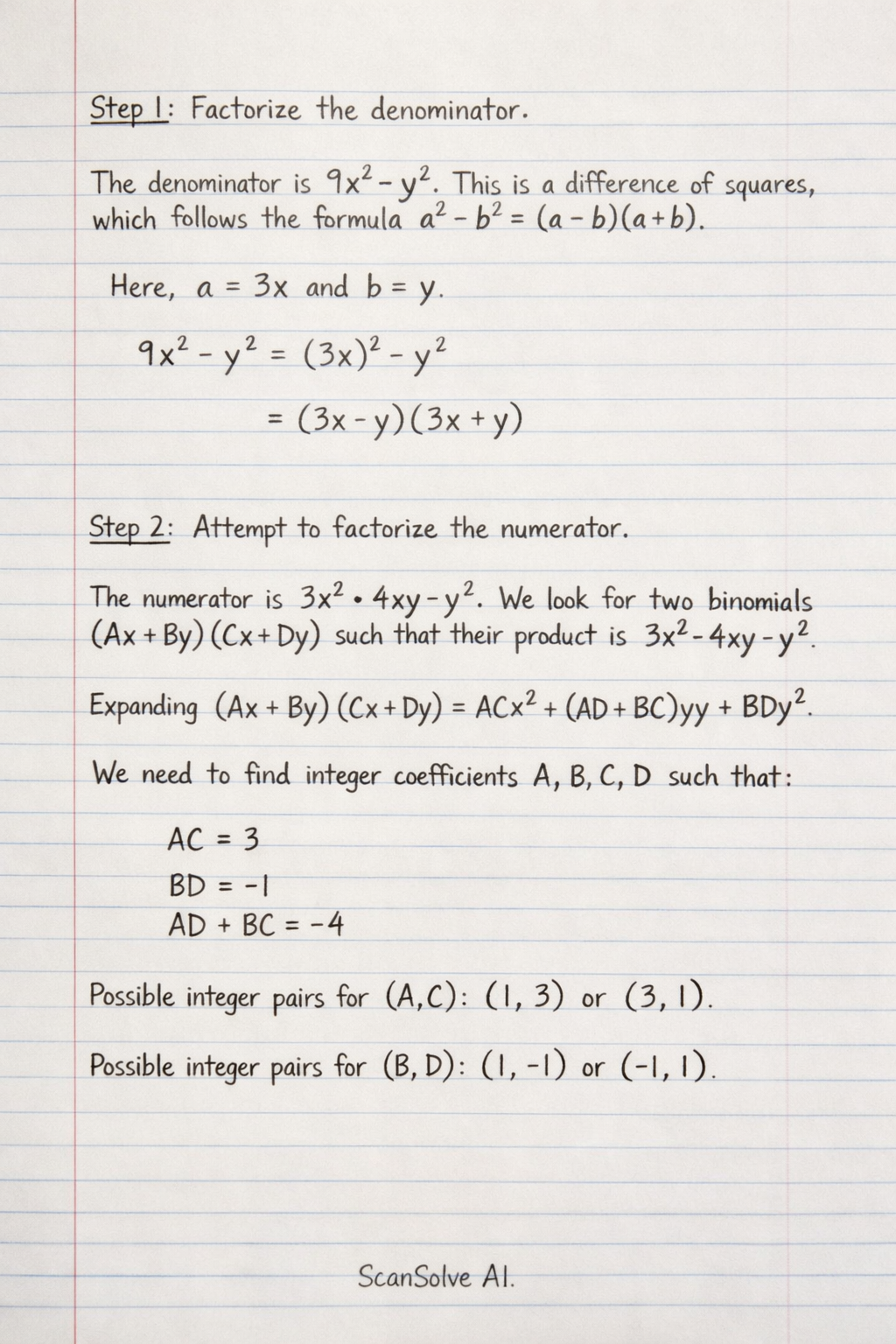
Step 1: Factorize the denominator. The denominator is 9x^2 - y^2. This is a difference of squares, which follows the formula a^2 - b^2 = (a-b)(a+b). Here, a = 3x and b = y. 9x^2 - y^2 = (3x)^2 - y^2 = (3x - y)(3x + y) Step 2: Attempt to factorize the numerator. The numerator is 3x^2 - 4xy - y^2. We look for two binomials (Ax+By)(Cx+Dy) such that their product is 3x^2 - 4xy - y^2. Expanding (Ax+By)(Cx+Dy) = ACx^2 + (AD+BC)xy + BDy^2. We need to find integer coefficients A, B, C, D such that: AC = 3 BD = -1 AD+BC = -4 Possible integer pairs for (A,C): (1,3) or (3,1). Possible integer pairs for (B,D): (1,-1) or (-1,1). Let's test all combinations: • If (A,C) = (1,3) and (B,D) = (1,-1): (x+y)(3x-y) = 3x^2 - xy + 3xy - y^2 = 3x^2 + 2xy - y^2. (Incorrect middle term) • If (A,C) = (1,3) and (B,D) = (-1,1): (x-y)(3x+y) = 3x^2 + xy - 3xy - y^2 = 3x^2 - 2xy - y^2. (Incorrect middle term) • If (A,C) = (3,1) and (B,D) = (1,-1): (3x+y)(x-y) = 3x^2 - 3xy + xy - y^2 = 3x^2 - 2xy - y^2. (Incorrect middle term) • If (A,C) = (3,1) and (B,D) = (-1,1): (3x-y)(x+y) = 3x^2 + 3xy - xy - y^2 = 3x^2 + 2xy - y^2. (Incorrect middle term) Since none of these combinations result in the middle term -4xy, the numerator 3x^2 - 4xy - y^2 is not factorable over integers. Step 3: Write the final factored expression. Since the numerator cannot be factored over integers, the expression is presented with the denominator factored. The fully factorized expression is: (3x^2 - 4xy - y^2)/((3x - y)(3x + y)) The numerator 3x^2 - 4xy - y^2 is not factorable over integers. The final answer is (3x^2 - 4xy - y^2)/((3x - y)(3x + y)). Send me the next one 📸