
We read your photo as:
Figure 1 below shows a figure drawn on a cartesian plain, the vertices of which are A(2;6); B(-6; -4) and C(10; - 6): 4.1 Determine the length of AC 4.2 The midpoint of BC. 4.3 The angle of inclination of AB.
Mathematics
ScanSolve AI Answer
Step-by-step solution
8 stepsHere are the solutions for the given problems:
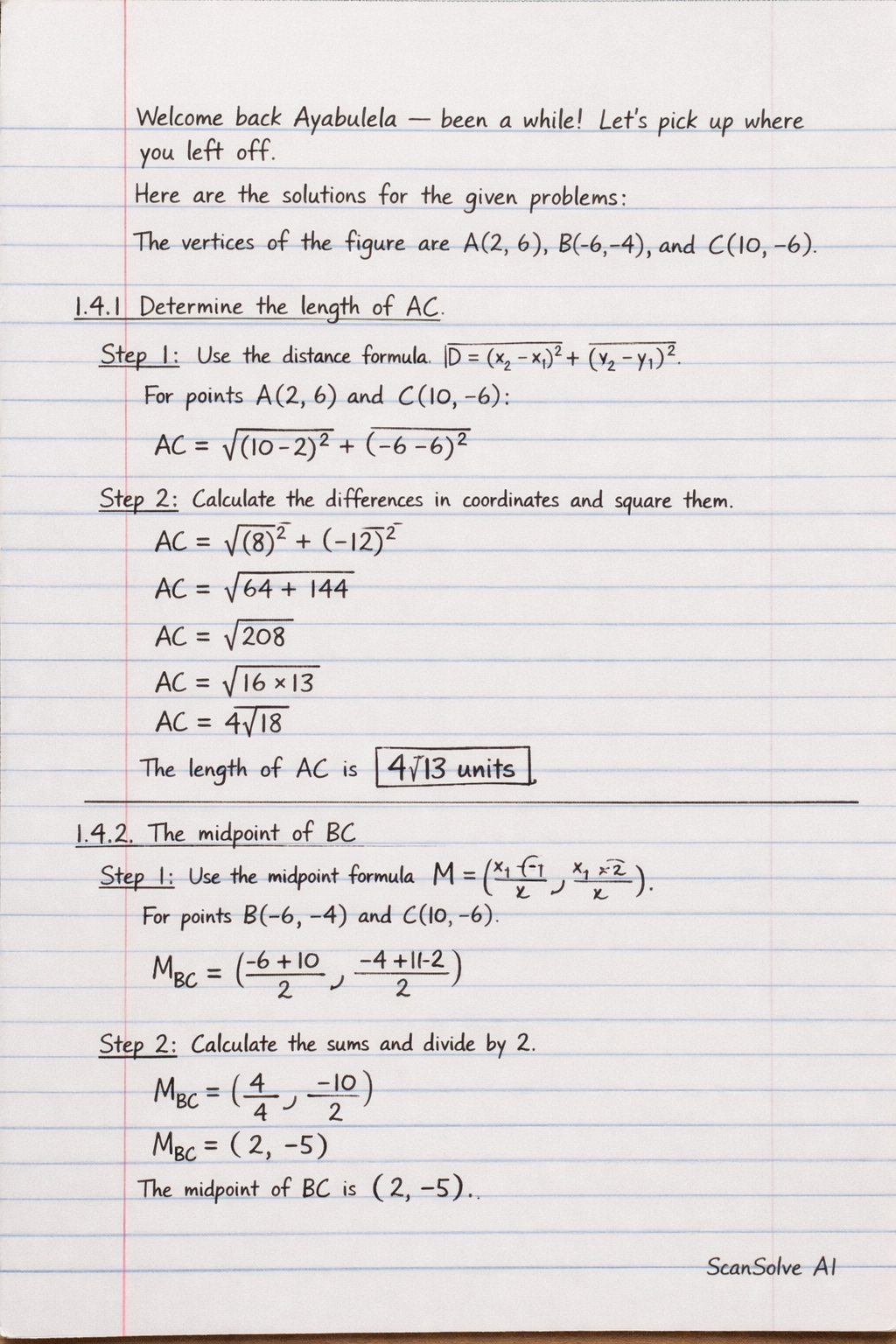
The vertices of the figure are A(2; 6), B(-6; -4), and C(10; -6).
1.4.1 Determine the length of AC
Use the distance formula .
For points A(2, 6) and C(10, -6):
Calculate the differences in coordinates and square them.
Add the squared values and find the square root.
The length of AC is
\boxed{\text{4\sqrt{13} units}}.1.4.2 The midpoint of BC
Use the midpoint formula .
For points B(-6, -4) and C(10, -6):
Calculate the sums and divide by 2.
The midpoint of BC is .
1.4.3 The angle of inclination of AB
Calculate the gradient (slope) of AB using the formula .
For points A(2, 6) and B(-6, -4):
Use the formula for the angle of inclination .
Calculate the angle.
The angle of inclination of AB is approximately
\boxed{\text{51.34^\circ}}.
Was this helpful?
Still stuck on this one?
Ask a follow-up, and the answer starts from this question.
Got a different question?Ask your own question
More Mathematics Questions
QPoints A, B, and C are represented on a Cartesian plane. Given the coordinates of A as (2; −1) and C…QGiven the vertices A(2;-1), B(−3;4), and C(4;5), sketch the triangle and calculate the lengths of…QThe xy-plane shows triangle ABC. The coordinates of A, B and C are (−4,6), (8,−2) and (2,−2)…QA(4, 7) is the vertex of triangle ABC. BA= 5 3 and AC= 4 −3 . (a) Find the coordinates of B and C…QDetermine the value of angle ACB and length of AB. Determine the value of angle A and b in the…
Handwritten Step-by-Step Solution
Get this as a handwritten image on WhatsApp — like a tutor wrote it for you.
Try on WhatsApp