We read your photo as:

Fill in the missing numbers for counting forwards from 1 to 4 in thirds and backwards from 3 to 0 in halves.

Mathematics

ScanSolve AI Answer

Step-by-step solution

3 steps
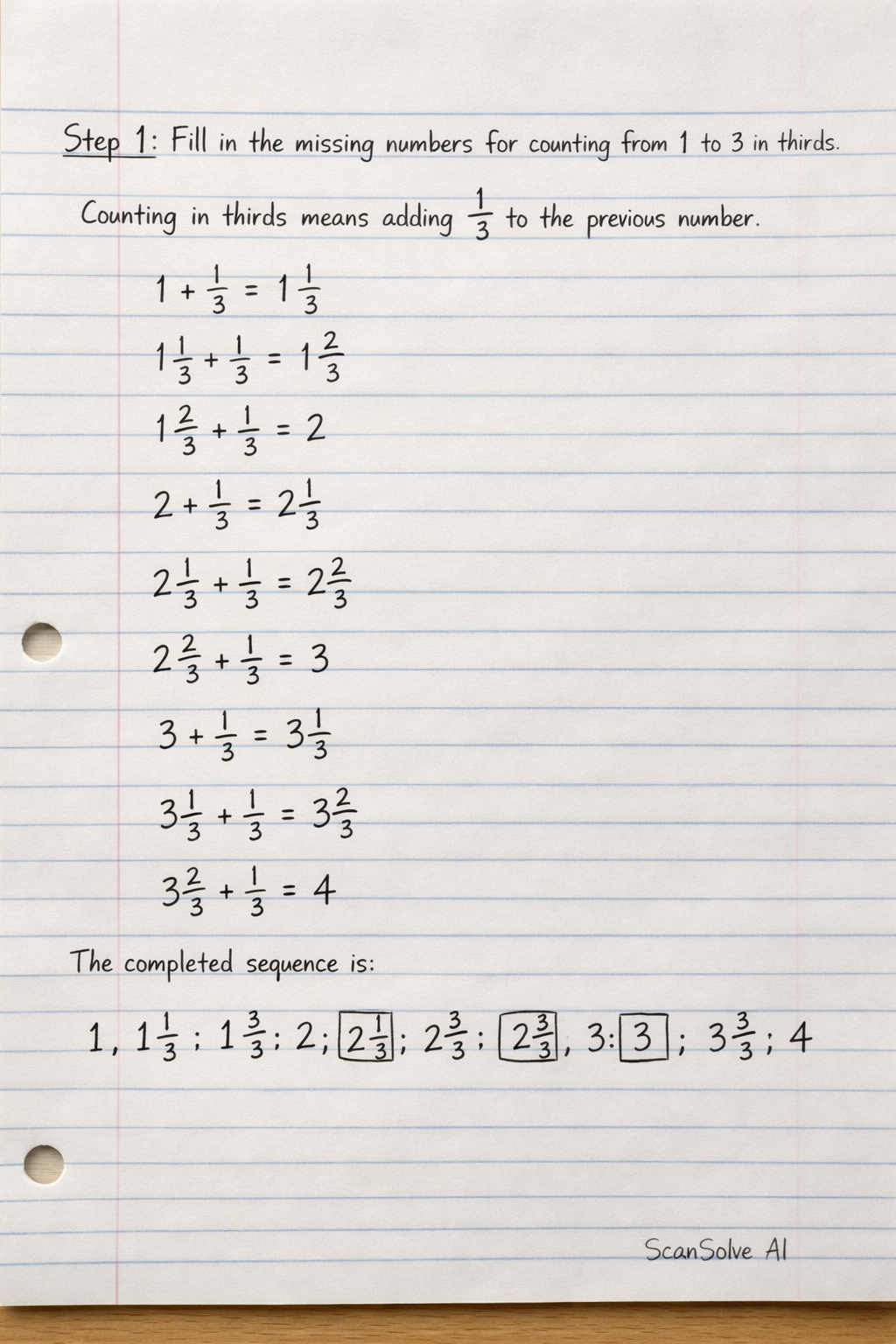
  1. Fill in the missing numbers for counting from 1 to 3 in thirds.

    Counting in thirds means adding 13\frac{1}{3} to the previous number.
    The sequence is 1;113;□;2;□;223;□;□;□;41; 1\frac{1}{3}; \square; 2; \square; 2\frac{2}{3}; \square; \square; \square; 4.

    • 1+13=1131 + \frac{1}{3} = 1\frac{1}{3}
    • 113+13=1231\frac{1}{3} + \frac{1}{3} = 1\frac{2}{3}
    • 123+13=21\frac{2}{3} + \frac{1}{3} = 2
    • 2+13=2132 + \frac{1}{3} = 2\frac{1}{3}
    • 213+13=2232\frac{1}{3} + \frac{1}{3} = 2\frac{2}{3}
    • 223+13=32\frac{2}{3} + \frac{1}{3} = 3
    • 3+13=3133 + \frac{1}{3} = 3\frac{1}{3}
    • 313+13=3233\frac{1}{3} + \frac{1}{3} = 3\frac{2}{3}
    • 323+13=43\frac{2}{3} + \frac{1}{3} = 4

    The completed sequence is:

    1;113;123;2;213;223;3;313;323;41; 1\frac{1}{3}; \boxed{1\frac{2}{3}}; 2; \boxed{2\frac{1}{3}}; 2\frac{2}{3}; \boxed{3}; \boxed{3\frac{1}{3}}; \boxed{3\frac{2}{3}}; 4
  2. Fill in the missing numbers for counting backwards from 3 to 0 in halves.

    Counting backwards in halves means subtracting 12\frac{1}{2} from the previous number.
    The sequence is 3;□;2;□;□;□;03; \square; 2; \square; \square; \square; 0.

    • 3−12=2123 - \frac{1}{2} = 2\frac{1}{2}
    • 212−12=22\frac{1}{2} - \frac{1}{2} = 2
    • 2−12=1122 - \frac{1}{2} = 1\frac{1}{2}
    • 112−12=11\frac{1}{2} - \frac{1}{2} = 1
    • 1−12=121 - \frac{1}{2} = \frac{1}{2}
    • 12−12=0\frac{1}{2} - \frac{1}{2} = 0

    The completed sequence is:

    3;212;2;112;1;12;03; \boxed{2\frac{1}{2}}; 2; \boxed{1\frac{1}{2}}; \boxed{1}; \boxed{\frac{1}{2}}; 0
  3. Describe how to draw the number lines.

    a) 0 to 4 in fifths:
    Draw a straight line. Mark the whole numbers 0,1,2,3,40, 1, 2, 3, 4 at equal intervals. Between each whole number, divide the segment into five equal parts. Label these divisions as 15,25,35,45\frac{1}{5}, \frac{2}{5}, \frac{3}{5}, \frac{4}{5} (or 115,1251\frac{1}{5}, 1\frac{2}{5}, etc.).
    The points on the number line would be:
    0,15,25,35,45,1,115,125,135,145,2,215,225,235,245,3,315,325,335,345,40, \frac{1}{5}, \frac{2}{5}, \frac{3}{5}, \frac{4}{5}, 1, 1\frac{1}{5}, 1\frac{2}{5}, 1\frac{3}{5}, 1\frac{4}{5}, 2, 2\frac{1}{5}, 2\frac{2}{5}, 2\frac{3}{5}, 2\frac{4}{5}, 3, 3\frac{1}{5}, 3\frac{2}{5}, 3\frac{3}{5}, 3\frac{4}{5}, 4.

    b) 4 to 7 in quarters:
    Draw a straight line. Mark the whole numbers 4,5,6,74, 5, 6, 7 at equal intervals. Between each whole number, divide the segment into four equal parts. Label these divisions as 14,24,34\frac{1}{4}, \frac{2}{4}, \frac{3}{4} (or 414,4244\frac{1}{4}, 4\frac{2}{4}, etc.).
    The points on the number line would be:
    4,414,424,434,5,514,524,534,6,614,624,634,74, 4\frac{1}{4}, 4\frac{2}{4}, 4\frac{3}{4}, 5, 5\frac{1}{4}, 5\frac{2}{4}, 5\frac{3}{4}, 6, 6\frac{1}{4}, 6\frac{2}{4}, 6\frac{3}{4}, 7.

Was this helpful?

Still stuck on this one?

Ask a follow-up, and the answer starts from this question.

Got a different question?Ask your own question
Handwritten step-by-step solution preview

Handwritten Step-by-Step Solution

Get this as a handwritten image on WhatsApp — like a tutor wrote it for you.

Try on WhatsApp