

This mathematics problem involves applying core mathematical principles and formulas. Below you will find a complete step-by-step solution with detailed explanations for each step, helping you understand not just the answer but the method behind it.
ScanSolve AI Answer
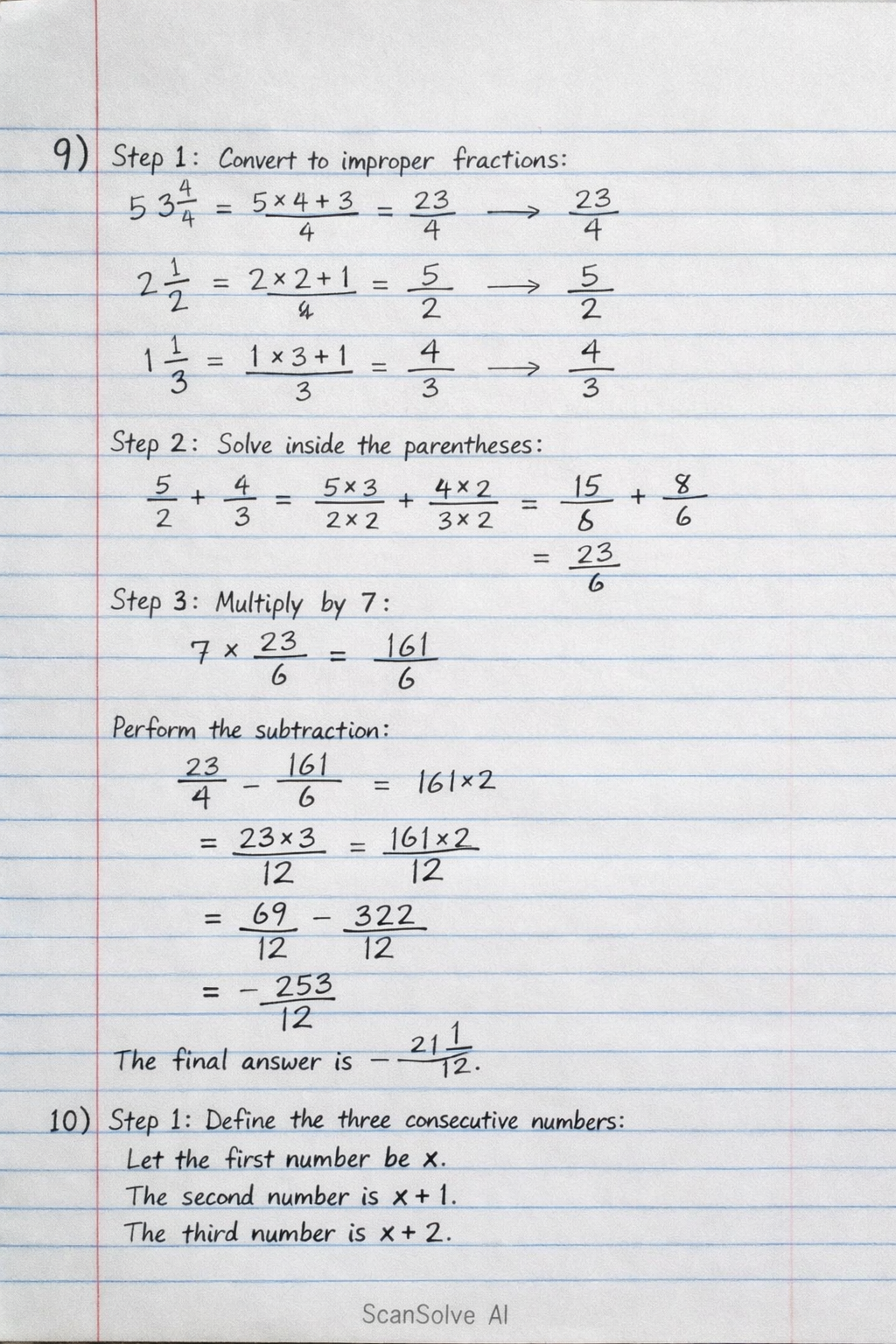
Here are the solutions to your problems: 9) Step 1: Convert mixed numbers to improper fractions. 5(3)/(4) = (5 × 4 + 3)/(4) = (23)/(4) 2(1)/(2) = (2 × 2 + 1)/(2) = (5)/(2) 1(1)/(3) = (1 × 3 + 1)/(3) = (4)/(3) Step 2: Solve the expression inside the parentheses. (5)/(2) + (4)/(3) = (5 × 3)/(2 × 3) + (4 × 2)/(3 × 2) = (15)/(6) + (8)/(6) = (15+8)/(6) = (23)/(6) Step 3: Multiply the result by 7. 7 × (23)/(6) = (161)/(6) Step 4: Perform the subtraction. (23)/(4) - (161)/(6) Find a common denominator, which is 12. (23 × 3)/(4 × 3) - (161 × 2)/(6 × 2) = (69)/(12) - (322)/(12) = (69 - 322)/(12) = (-253)/(12) The answer can also be expressed as a mixed number: (-253)/(12) = -21(1)/(12) The final answer is -(253)/(12). 10) Step 1: Define the three consecutive numbers. Let the first number be x. The second number is x+1. The third number is x+2. Step 2: Set up the equation based on their sum. x + (x+1) + (x+2) = 87 Step 3: Solve for x. 3x + 3 = 87 3x = 87 - 3 3x = 84 x = (84)/(3) x = 28 Step 4: Find the three numbers. First number: 28 Second number: 28+1 = 29 Third number: 28+2 = 30 The final answer is 28, 29, and 30. 11) Step 1: Write the decimal as a fraction. 0.312 = (312)/(1000) Step 2: Simplify the fraction by dividing the numerator and denominator by their greatest common divisor. Divide by 2: (312 ÷ 2)/(1000 ÷ 2) = (156)/(500) Divide by 2 again: (156 ÷ 2)/(500 ÷ 2) = (78)/(250) Divide by 2 again: (78 ÷ 2)/(250 ÷ 2) = (39)/(125) The final answer is (39)/(125). 14) Step 1: Perform division. 12.8 ÷ 0.8 = 16 Step 2: Perform multiplication. 0.2 × 3 = 0.6 Step 3: Substitute these values back into the expression and perform subtraction and addition from left to right. 16 - 0.6 + 1.2 15.4 + 1.2 16.6 The final answer is 16.6. 15) a) Determine the fraction that represents the cost of each bunch of vegetables. Step 1: Find the total number of ratio parts. The ratio of carrots : spinach : onions is 2 : 4 : 3. Total parts = 2 + 4 + 3 = 9. Step 2: Determine the fraction of the total cost for each type of vegetable. Fraction for carrots = Carrots ratio partTotal ratio parts = (2)/(9) Fraction for spinach = Spinach ratio partTotal ratio parts = (4)/(9) Fraction for onions = Onions ratio partTotal ratio parts = (3)/(9) The fractions representing the cost of each bunch of vegetables are: Carrots: (2)/(9) Spinach: (4)/(9) Onions: (3)/(9)