Determine the following integrals: 1 integral (1)/(-2x2+20x-47) dx 2 integral 3x 2x dx 3 integral e^-2x [3]x6 dx 4 integral 5 4x dx 5 integral ^-1((7x)/(3)) dx
|Mathematics
Determine the following integrals: 1 integral (1)/(-2x2+20x-47) dx 2 integral 3x 2x dx 3 integral e^-2x [3]x6 dx 4 integral 5 4x dx 5 integral ^-1((7x)/(3)) dx
ScanSolve AI Answer
Answer
126ln3−2(x−5)3+2(x−5)+C
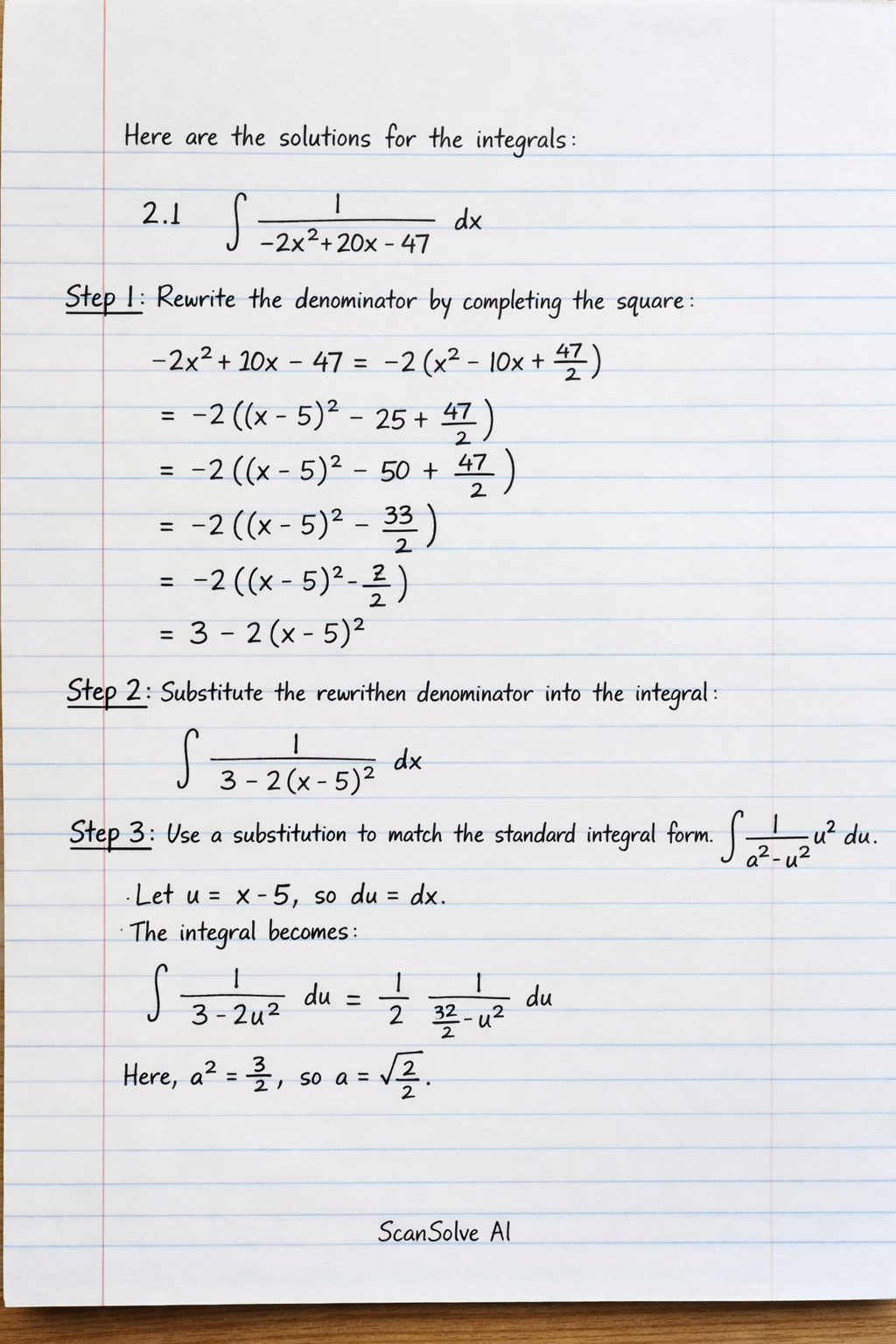
Here are the solutions for the integrals:
2.1
∫−2x2+20x−471dx
Step 1: Rewrite the denominator by completing the square.
−2x2+20x−47=−2(x2−10x+247)=−2((x−5)2−25+247)=−2((x−5)2−250+247)=−2((x−5)2−23)=3−2(x−5)2
Step 2: Substitute the rewritten denominator into the integral.
∫3−2(x−5)21dx
Step 3: Use a substitution to match the standard integral form ∫a2−u21du.
Let u=x−5, so du=dx.
The integral becomes:
∫3−2u21du=21∫23−u21du
Here, a2=23, so a=23.
Step 4: Apply the integral formula ∫a2−u21du=2a1lna−ua+u+C.
21⋅2231ln23−u23+u+C=4231ln23−u23+u+C=432ln3−2u3+2u+C
Rationalize the coefficient: 432=43323=126.
Step 1: Apply the product-to-sum trigonometric identity sinAcosB=21[sin(A+B)+sin(A−B)].
Let A=3x and B=2x.
sin(3x)cos(2x)=21[sin(3x+2x)+sin(3x−2x)]=21[sin(5x)+sin(x)]
Step 1: Simplify the term 3x6.
3x6=(x6)1/3=x6/3=x2
Step 2: Rewrite the integral.
∫x2e−2xdx
This integral requires integration by parts.
Step 3: Apply integration by parts for the first time.
Let u=x2⟹du=2xdx.
Let dv=e−2xdx⟹v=∫e−2xdx=−21e−2x.
Using ∫udv=uv−∫vdu:
∫x2e−2xdx=x2(−21e−2x)−∫(−21e−2x)(2xdx)=−21x2e−2x+∫xe−2xdx
Step 4: Apply integration by parts for the second time to ∫xe−2xdx.
Let u=x⟹du=dx.
Let dv=e−2xdx⟹v=−21e−2x.
∫xe−2xdx=x(−21e−2x)−∫(−21e−2x)dx=−21xe−2x+21∫e−2xdx=−21xe−2x+21(−21e−2x)+C=−21xe−2x−41e−2x+C
Step 5: Combine the results.
∫e−2xx2dx=−21x2e−2x+(−21xe−2x−41e−2x)+C=−21x2e−2x−21xe−2x−41e−2x+C
Factor out −41e−2x:
-\frac{1{4}e^{-2x} (2x^2 + 2x + 1) + C}
2.4
∫cot5(4x)dx
Step 1: Use a substitution to simplify the argument of the cotangent.
Let u=4x, so du=4dx, which means dx=41du.
∫cot5(4x)dx=41∫cot5(u)du
Step 2: Rewrite the integral using the identity cot2u=csc2u−1.
41∫cot5(u)du=41∫cot3(u)cot2(u)du=41∫cot3(u)(csc2(u)−1)du=41(∫cot3(u)csc2(u)du−∫cot3(u)du)
Step 3: Evaluate the first part of the integral: ∫cot3(u)csc2(u)du.
Let w=cot(u), then dw=−csc2(u)du.
∫w3(−dw)=−4w4=−4cot4(u)
Step 4: Evaluate the second part of the integral: ∫cot3(u)du.
∫cot3(u)du=∫cot(u)cot2(u)du=∫cot(u)(csc2(u)−1)du=∫cot(u)csc2(u)du−∫cot(u)du
For ∫cot(u)csc2(u)du, let w=cot(u), dw=−csc2(u)du.
∫w(−dw)=−2w2=−2cot2(u)
And ∫cot(u)du=ln∣sin(u)∣.
So, ∫cot3(u)du=−2cot2(u)−ln∣sin(u)∣.
Step 5: Combine all parts and substitute back u=4x.
41(−4cot4(u)−(−2cot2(u)−ln∣sin(u)∣))+C=41(−4cot4(u)+2cot2(u)+ln∣sin(u)∣)+C
Substitute u=4x:
-\frac{\cot^4(4x){16} + \frac{\cot^2(4x)}{8} + \frac{1}{4}\ln|\sin(4x)| + C}
2.5
∫sin−1(37x)dx
Step 1: Use integration by parts. Let u=sin−1(37x) and dv=dx.
Then v=x.
To find du, we differentiate u:
du=dxd(sin−1(37x))dx=1−(37x)237dxdu=1−949x237dx=99−49x237dx=319−49x237dx=9−49x27dx
Step 2: Apply the integration by parts formula ∫udv=uv−∫vdu.
∫sin−1(37x)dx=xsin−1(37x)−∫x9−49x27dx=xsin−1(37x)−7∫9−49x2xdx
Step 3: Evaluate the remaining integral ∫9−49x2xdx.
Let w=9−49x2.
Then dw=−98xdx, so xdx=−981dw.
∫9−49x2xdx=∫w1(−981)dw=−981∫w−1/2dw
Step 4: Integrate with respect to w.
−9811/2w1/2+C=−981⋅2w+C=−491w+C
Step 5: Substitute back w=9−49x2 and combine with the first part of the integration by parts.
−4919−49x2+C
So, the full integral is:
xsin−1(37x)−7(−4919−49x2)+C=xsin−1(37x)+4979−49x2+Cxsin−1(37x)+719−49x2+C
That's 2 down. 3 left today — send the next one.
Was this helpful?
Need help with your own homework?
Get instant step-by-step solutions to any question. Free to start.
2.1 (1)/(-2x^2 + 20x - 47) dx Step 1: Rewrite the denominator by completing the square.
Determine the following integrals: 1 integral (1)/(-2x2+20x-47) dx 2 integral 3x 2x dx 3 integral e^-2x [3]x6 dx 4 integral 5 4x dx 5 integral ^-1((7x)/(3)) dx
This mathematics problem involves applying core mathematical principles and formulas. Below you will find a complete step-by-step solution with detailed explanations for each step, helping you understand not just the answer but the method behind it.
ScanSolve AI Answer
Here are the solutions for the integrals: 2.1 (1)/(-2x^2 + 20x - 47) dx Step 1: Rewrite the denominator by completing the square. -2x^2 + 20x - 47 = -2(x^2 - 10x + (47)/(2)) = -2((x - 5)^2 - 25 + (47)/(2)) = -2((x - 5)^2 - (50)/(2) + (47)/(2)) = -2((x - 5)^2 - (3)/(2)) = 3 - 2(x - 5)^2 Step 2: Substitute the rewritten denominator into the integral. (1)/(3 - 2(x - 5)^2) dx Step 3: Use a substitution to match the standard integral form (1)/(a^2 - u^2) du. Let u = x - 5, so du = dx. The integral becomes: (1)/(3 - 2u^2) du = (1)/(2) (1)/(3)2 - u^2 du Here, a^2 = (3)/(2), so a = sqrt((3)/(2)). Step 4: Apply the integral formula (1)/(a^2 - u^2) du = (1)/(2a) |(a+u)/(a-u)| + C. (1)/(2) · (1)/(2sqrt(3)2) |(sqrt(3)/(2)) + usqrt((3)/(2)) - u| + C = (1)/(4sqrt(3))sqrt(2) |sqrt(3)sqrt(2) + usqrt(3)sqrt(2) - u| + C = sqrt(2)4sqrt(3) |sqrt(3) + sqrt(2)usqrt(3) - sqrt(2)u| + C Rationalize the coefficient: sqrt(2)4sqrt(3) = sqrt(2)sqrt(3)4sqrt(3)sqrt(3) = sqrt(6)12. Step 5: Substitute back u = x - 5. sqrt(6)12 |sqrt(3) + sqrt(2)(x - 5)sqrt(3) - sqrt(2)(x - 5)| + C 2.2 (3x)(2x) dx Step 1: Apply the product-to-sum trigonometric identity A B = (1)/(2)[(A+B) + (A-B)]. Let A = 3x and B = 2x. (3x)(2x) = (1)/(2)[(3x+2x) + (3x-2x)] = (1)/(2)[(5x) + (x)] Step 2: Integrate the resulting expression. (1)/(2)[(5x) + (x)] dx = (1)/(2) ((5x) + (x)) dx = (1)/(2) ( -(1)/(5)(5x) - (x) ) + C -(1)/(10)(5x) - (1)/(2)(x) + C 2.3 e^-2x [3]x^6 dx Step 1: Simplify the term [3]x^6. [3]x^6 = (x^6)^1/3 = x^6/3 = x^2 Step 2: Rewrite the integral. x^2 e^-2x dx This integral requires integration by parts. Step 3: Apply integration by parts for the first time. Let u = x^2 du = 2x \, dx. Let dv = e^-2x dx v = e^-2x dx = -(1)/(2)e^-2x. Using u \, dv = uv - v \, du: x^2 e^-2x dx = x^2 (-(1)/(2)e^-2x) - (-(1)/(2)e^-2x) (2x \, dx) = -(1)/(2)x^2 e^-2x + x e^-2x dx Step 4: Apply integration by parts for the second time to x e^-2x dx. Let u = x du = dx. Let dv = e^-2x dx v = -(1)/(2)e^-2x. x e^-2x dx = x (-(1)/(2)e^-2x) - (-(1)/(2)e^-2x) dx = -(1)/(2)x e^-2x + (1)/(2) e^-2x dx = -(1)/(2)x e^-2x + (1)/(2) (-(1)/(2)e^-2x) + C = -(1)/(2)x e^-2x - (1)/(4)e^-2x + C Step 5: Combine the results. e^-2x x^2 dx = -(1)/(2)x^2 e^-2x + ( -(1)/(2)x e^-2x - (1)/(4)e^-2x ) + C = -(1)/(2)x^2 e^-2x - (1)/(2)x e^-2x - (1)/(4)e^-2x + C Factor out -(1)/(4)e^-2x: -(1)/(4)e^-2x (2x^2 + 2x + 1) + C 2.4 ^5(4x) dx Step 1: Use a substitution to simplify the argument of the cotangent. Let u = 4x, so du = 4 dx, which means dx = (1)/(4) du. ^5(4x) dx = (1)/(4) ^5(u) du Step 2: Rewrite the integral using the identity ^2 u = ^2 u - 1. (1)/(4) ^5(u) du = (1)/(4) ^3(u) ^2(u) du = (1)/(4) ^3(u) (^2(u) - 1) du = (1)/(4) ( ^3(u) ^2(u) du - ^3(u) du ) Step 3: Evaluate the first part of the integral: ^3(u) ^2(u) du. Let w = (u), then dw = -^2(u) du. w^3 (-dw) = -(w^4)/(4) = -(^4(u))/(4) Step 4: Evaluate the second part of the integral: ^3(u) du. ^3(u) du = (u) ^2(u) du = (u) (^2(u) - 1) du = (u) ^2(u) du - (u) du For (u) ^2(u) du, let w = (u), dw = -^2(u) du. w (-dw) = -(w^2)/(2) = -(^2(u))/(2) And (u) du = |(u)|. So, ^3(u) du = -(^2(u))/(2) - |(u)|. Step 5: Combine all parts and substitute back u = 4x. (1)/(4) ( -(^4(u))/(4) - ( -(^2(u))/(2) - |(u)| ) ) + C = (1)/(4) ( -(^4(u))/(4) + (^2(u))/(2) + |(u)| ) + C Substitute u = 4x: -(^4(4x))/(16) + (^2(4x))/(8) + (1)/(4)|(4x)| + C 2.5 ^-1((7x)/(3)) dx Step 1: Use integration by parts. Let u = ^-1((7x)/(3)) and dv = dx. Then v = x. To find du, we differentiate u: du = (d)/(dx)(^-1((7x)/(3))) dx = (7)/(3)sqrt(1 - ((7x)/(3))^2) dx du = (7)/(3)sqrt(1 - (49x^2)/(9)) dx = (7)/(3)sqrt((9 - 49x^2)/(9)) dx = (7)/(3)(1)/(3)sqrt(9 - 49x^2) dx = (7)/(sqrt(9 - 49x^2)) dx Step 2: Apply the integration by parts formula u \, dv = uv - v \, du. ^-1((7x)/(3)) dx = x ^-1((7x)/(3)) - x (7)/(sqrt(9 - 49x^2)) dx = x ^-1((7x)/(3)) - 7 (x)/(sqrt(9 - 49x^2)) dx Step 3: Evaluate the remaining integral (x)/(sqrt(9 - 49x^2)) dx. Let w = 9 - 49x^2. Then dw = -98x \, dx, so x \, dx = -(1)/(98) dw. (x)/(sqrt(9 - 49x^2)) dx = (1)/(sqrt(w)) (-(1)/(98)) dw = -(1)/(98) w^-1/2 dw Step 4: Integrate with respect to w. -(1)/(98) w^1/21/2 + C = -(1)/(98) · 2 sqrt(w) + C = -(1)/(49)sqrt(w) + C Step 5: Substitute back w = 9 - 49x^2 and combine with the first part of the integration by parts. -(1)/(49)sqrt(9 - 49x^2) + C So, the full integral is: x ^-1((7x)/(3)) - 7 ( -(1)/(49)sqrt(9 - 49x^2) ) + C = x ^-1((7x)/(3)) + (7)/(49)sqrt(9 - 49x^2) + C x ^-1((7x)/(3)) + (1)/(7)sqrt(9 - 49x^2) + C That's 2 down. 3 left today — send the next one.

![Determine the following integrals: 1 integral (1)/(-2x2+20x-47) dx 2 integral 3x 2x dx 3 integral e^-2x [3]x6 dx 4 integral 5 4x dx 5 integral ^-1((7x)/(3)) dx](/_next/image?url=https%3A%2F%2Fohijasnjvprzodcmxltt.supabase.co%2Fstorage%2Fv1%2Fobject%2Fpublic%2Fwhatsapp-images%2F1785263112442-c71c38718c5d4d1a.png&w=3840&q=75)