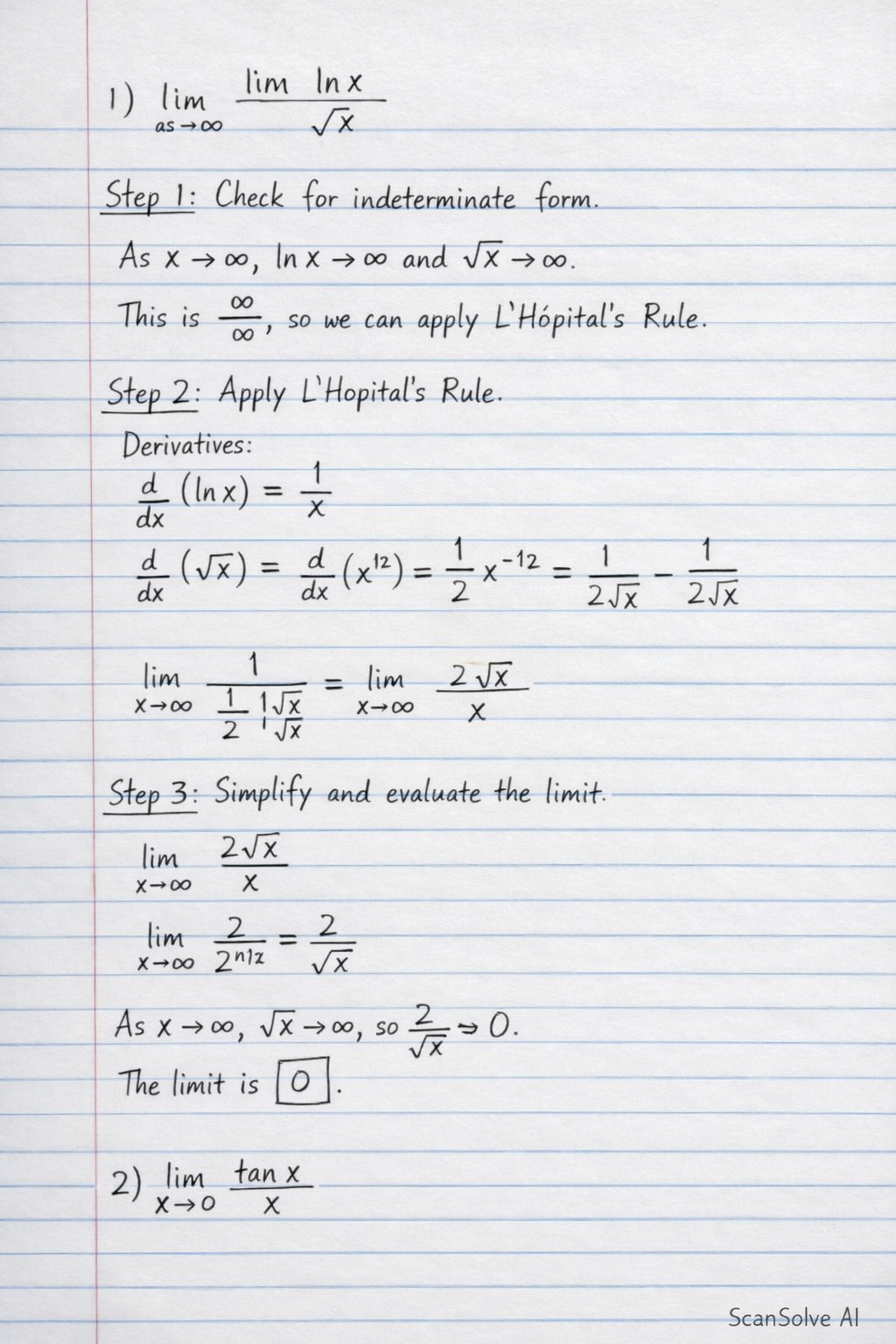
We read your photo as:

Evaluate the following limits: x infinity ( x)/(sqrt(x)) and x 0 ( x)/(x)

Mathematics

ScanSolve AI Answer

Answer

0
1

Step-by-step solution

13 steps

let's evaluate these limits.

1) lim⁡x→∞ln⁡xx\lim_{x \to \infty} \frac{\ln x}{\sqrt{x}}

  1. Check for indeterminate form.

    As x→∞x \to \infty, ln⁡x→∞\ln x \to \infty and x→∞\sqrt{x} \to \infty. This is an indeterminate form of type ∞∞\frac{\infty}{\infty}, so we can apply L'Hôpital's Rule.

  2. Apply L'Hôpital's Rule.

    Take the derivative of the numerator and the denominator:

    ddx(ln⁡x)=1x\frac{d}{dx}(\ln x) = \frac{1}{x} ddx(x)=ddx(x1/2)=12x−1/2=12x\frac{d}{dx}(\sqrt{x}) = \frac{d}{dx}(x^{1/2}) = \frac{1}{2}x^{-1/2} = \frac{1}{2\sqrt{x}}

    Now, evaluate the limit of the ratio of these derivatives:

    lim⁡x→∞1x12x=lim⁡x→∞1x⋅2x\lim_{x \to \infty} \frac{\frac{1}{x}}{\frac{1}{2\sqrt{x}}} = \lim_{x \to \infty} \frac{1}{x} \cdot 2\sqrt{x}
  3. Simplify and evaluate the limit.

    lim⁡x→∞2xx=lim⁡x→∞2x1/2=lim⁡x→∞2x\lim_{x \to \infty} \frac{2\sqrt{x}}{x} = \lim_{x \to \infty} \frac{2}{x^{1/2}} = \lim_{x \to \infty} \frac{2}{\sqrt{x}}

    As x→∞x \to \infty, x→∞\sqrt{x} \to \infty, so 2x→0\frac{2}{\sqrt{x}} \to 0.

    The limit is 0\boxed{0}.

    2) lim⁡x→0tan⁡xx\lim_{x \to 0} \frac{\tan x}{x}

  4. Check for indeterminate form.

    As x→0x \to 0, tan⁡x→tan⁡0=0\tan x \to \tan 0 = 0 and x→0x \to 0. This is an indeterminate form of type 00\frac{0}{0}, so we can apply L'Hôpital's Rule.

  5. Apply L'Hôpital's Rule.

    Take the derivative of the numerator and the denominator:

    ddx(tan⁡x)=sec⁡2x\frac{d}{dx}(\tan x) = \sec^2 x ddx(x)=1\frac{d}{dx}(x) = 1

    Now, evaluate the limit of the ratio of these derivatives:

    lim⁡x→0sec⁡2x1\lim_{x \to 0} \frac{\sec^2 x}{1}
  6. Evaluate the limit.

    Substitute x=0x=0:

    sec⁡201=1(cos⁡0)2=112=1\frac{\sec^2 0}{1} = \frac{1}{(\cos 0)^2} = \frac{1}{1^2} = 1

    The limit is 1\boxed{1}.

    3) lim⁡x→∞x2ex\lim_{x \to \infty} \frac{x^2}{e^x}

  7. Check for indeterminate form.

    As x→∞x \to \infty, x2→∞x^2 \to \infty and ex→∞e^x \to \infty. This is an indeterminate form of type ∞∞\frac{\infty}{\infty}, so we can apply L'Hôpital's Rule.

  8. Apply L'Hôpital's Rule (first time).

    Take the derivative of the numerator and the denominator:

    ddx(x2)=2x\frac{d}{dx}(x^2) = 2x ddx(ex)=ex\frac{d}{dx}(e^x) = e^x

    The new limit is lim⁡x→∞2xex\lim_{x \to \infty} \frac{2x}{e^x}. This is still an indeterminate form of type ∞∞\frac{\infty}{\infty}.

  9. Apply L'Hôpital's Rule (second time).

    Take the derivative of the new numerator and denominator:

    ddx(2x)=2\frac{d}{dx}(2x) = 2 ddx(ex)=ex\frac{d}{dx}(e^x) = e^x

    The new limit is lim⁡x→∞2ex\lim_{x \to \infty} \frac{2}{e^x}.

  10. Evaluate the limit.

    As x→∞x \to \infty, ex→∞e^x \to \infty, so 2ex→0\frac{2}{e^x} \to 0.

    The limit is 0\boxed{0}.

    4) lim⁡x→0ln⁡(1+x)x\lim_{x \to 0} \frac{\ln(1+x)}{x}

  11. Check for indeterminate form.

    As x→0x \to 0, ln⁡(1+x)→ln⁡(1)=0\ln(1+x) \to \ln(1) = 0 and x→0x \to 0. This is an indeterminate form of type 00\frac{0}{0}, so we can apply L'Hôpital's Rule.

  12. Apply L'Hôpital's Rule.

    Take the derivative of the numerator and the denominator:

    ddx(ln⁡(1+x))=11+x\frac{d}{dx}(\ln(1+x)) = \frac{1}{1+x} ddx(x)=1\frac{d}{dx}(x) = 1

    Now, evaluate the limit of the ratio of these derivatives:

    lim⁡x→011+x1\lim_{x \to 0} \frac{\frac{1}{1+x}}{1}
  13. Evaluate the limit.

    Substitute x=0x=0:

    11+0=11=1\frac{1}{1+0} = \frac{1}{1} = 1

    The limit is 1\boxed{1}.

Was this helpful?

Try one yourself

A new problem that tests the same skill.

Still stuck on this one?

Ask a follow-up, and the answer starts from this question.

Got a different question?Ask your own question
Handwritten step-by-step solution preview

Handwritten Step-by-Step Solution

Get this as a handwritten image on WhatsApp — like a tutor wrote it for you.

Try on WhatsApp