
We read your photo as:
Solve the following question: a) Convert 500 cm to m. b) If the perimeter and length of the rectangle are 20 cm and 6 cm respectively, calculate the breadth of the rectangle. c) Find the volume of the
ScanSolve AI Answer
Step-by-step solution
19 stepsHere are the solutions to the questions:
6. Solve the following question
a) Convert 500 cm to m.
Recall the conversion factor between centimeters and meters.
Convert 500 cm to meters.
The conversion is .
b) If the perimeter and length of the rectangle are 20 cm and 6 cm respectively, calculate the breadth of the rectangle.
Write the formula for the perimeter of a rectangle.
where is the perimeter, is the length, and is the breadth.
Substitute the given values (, ) into the formula.
Solve for .
The breadth of the rectangle is .
c) Find the volume of the given cuboid.
Identify the dimensions of the cuboid from the image.
Length () = 5 cm
Width () = 3 cm
Height () = 4 cmWrite the formula for the volume of a cuboid.
Substitute the dimensions and calculate the volume.
The volume of the cuboid is .
7. Solve the following question
a) Write in indices: .
Express all numbers as products of their prime factors.
Substitute the prime factors back into the expression.
Group terms with the same base and apply the exponent rule .
The expression in indices is .
b) Simplify: .
Identify and group like terms.
Combine the like terms.
The simplified expression is .
8. Solve the following question
a) Multiply: .
Perform the multiplication first.
Substitute the result back into the expression.
The multiplied expression is .
b) Divide: .
Write the division as a fraction.
Divide the coefficients and apply the exponent rule for variables.
The result of the division is .
c) 1 is a prime number. Is this statement true, false or open?
Recall the definition of a prime number.
A prime number is a natural number greater than 1 that has exactly two distinct positive divisors: 1 and itself.
Evaluate the number 1 against this definition.
The number 1 is not greater than 1, and it only has one positive divisor (which is 1). Therefore, 1 does not fit the definition of a prime number.
The statement "1 is a prime number" is .
Still stuck on this one?
Ask a follow-up, and the answer starts from this question.
More Mathematics Questions
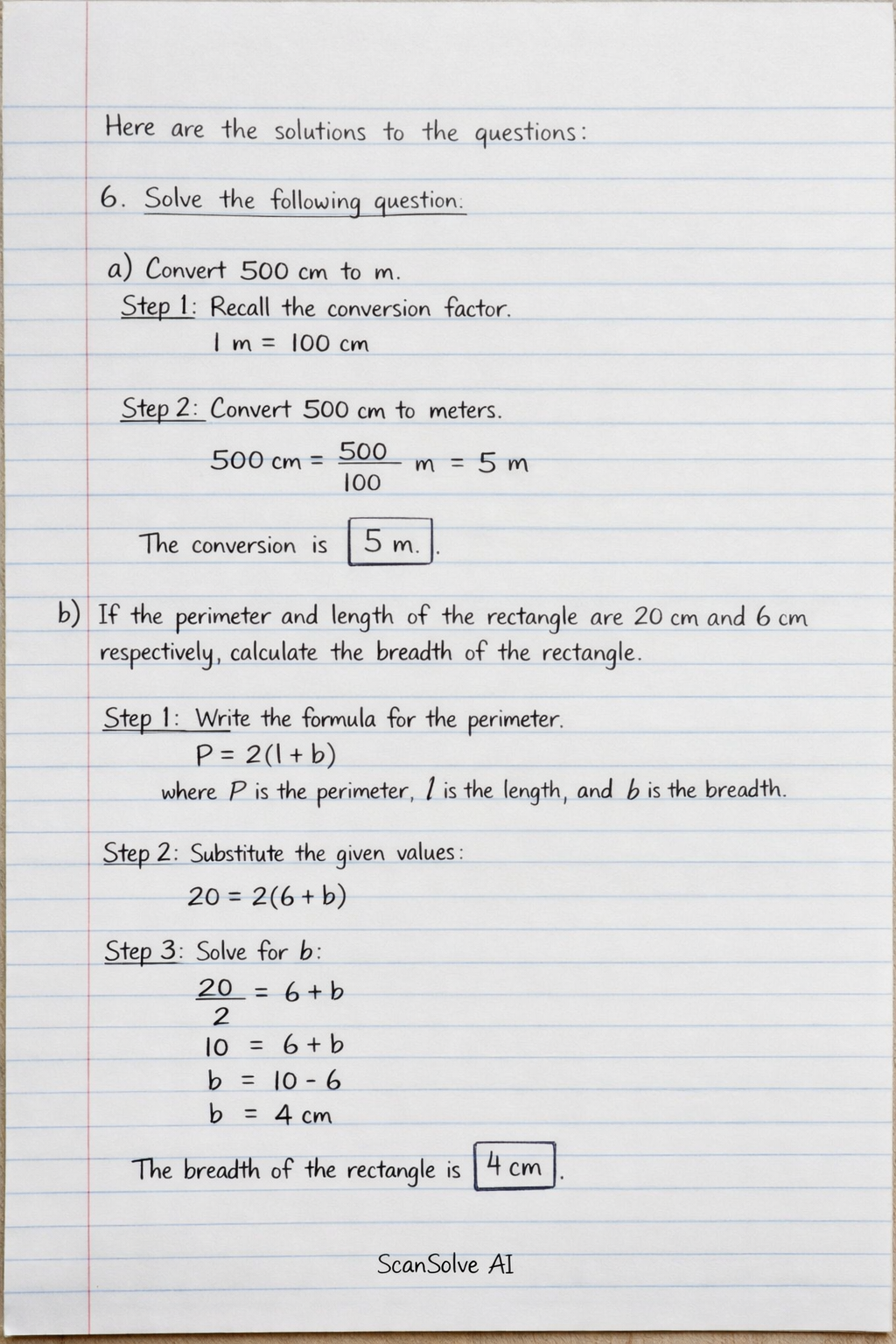
Handwritten Step-by-Step Solution
Get this as a handwritten image on WhatsApp — like a tutor wrote it for you.
Try on WhatsApp