We read your photo as:

Solve the following trigonometry problems: 1. In triangle ABC, angle ABC = 80, angle CAB = 45, AC = 50. Find BC. 2. In triangle PQR, angle RPQ = 60, angle QRP = 50, RP = 6.5. Find PQ.

Mathematics

ScanSolve AI Answer

Step-by-step solution

25 steps

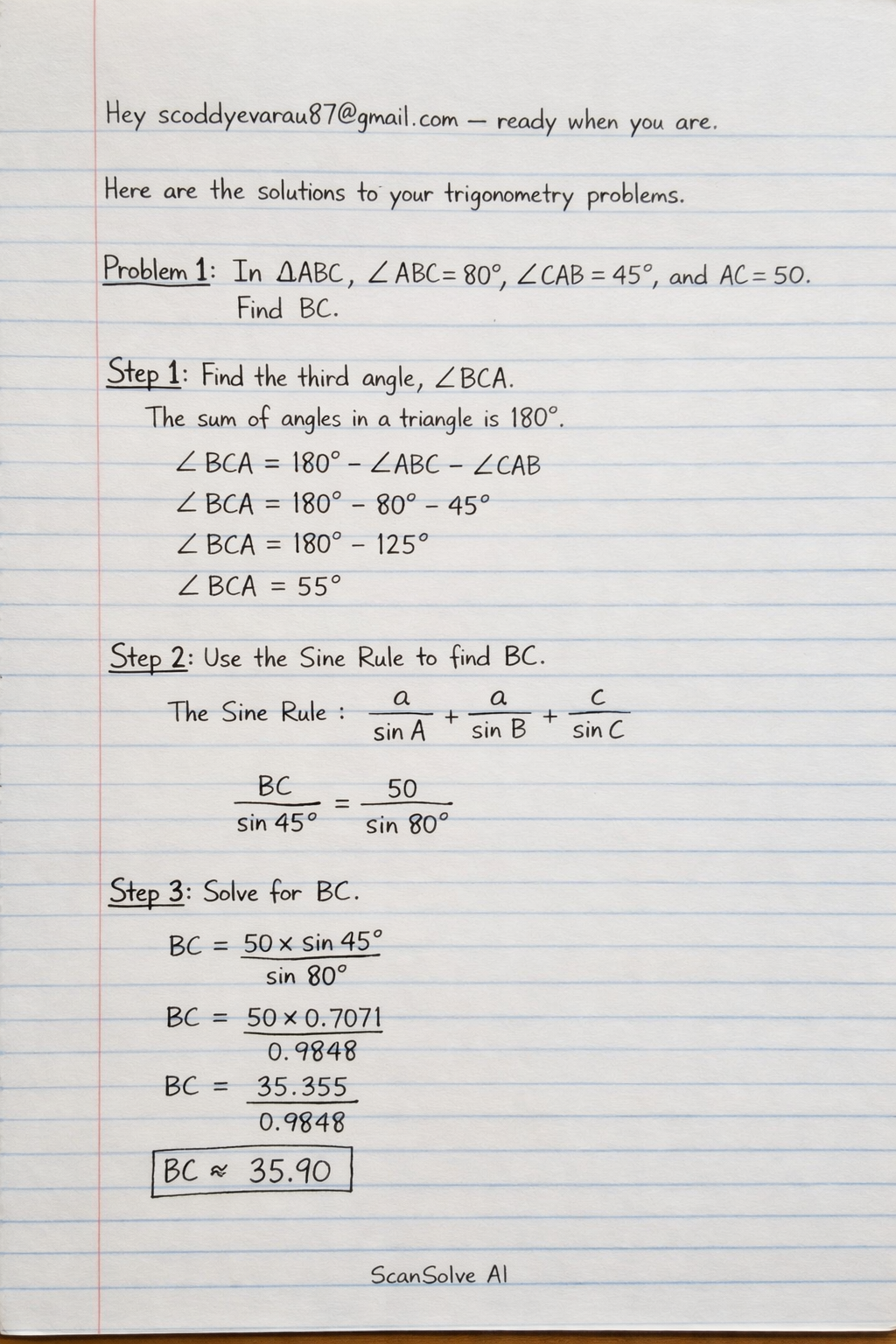
Here are the solutions to your trigonometry problems.

: In the triangle ABC, ∠ABC=80∘\angle ABC = 80^\circ, ∠CAB=45∘\angle CAB = 45^\circ and AC=50AC = 50. Find BCBC.

  1. Find the third angle, ∠BCA\angle BCA.

    The sum of angles in a triangle is 180∘180^\circ.

    ∠BCA=180∘−∠ABC−∠CAB\angle BCA = 180^\circ - \angle ABC - \angle CAB ∠BCA=180∘−80∘−45∘\angle BCA = 180^\circ - 80^\circ - 45^\circ ∠BCA=180∘−125∘\angle BCA = 180^\circ - 125^\circ ∠BCA=55∘\angle BCA = 55^\circ
  2. Use the Sine Rule to find BCBC.

    The Sine Rule states asin⁡A=bsin⁡B=csin⁡C\frac{a}{\sin A} = \frac{b}{\sin B} = \frac{c}{\sin C}.
    We want to find side BCBC (let's call it aa), which is opposite ∠CAB\angle CAB. We are given side ACAC (let's call it bb), which is opposite ∠ABC\angle ABC.

    BCsin⁡(∠CAB)=ACsin⁡(∠ABC)\frac{BC}{\sin(\angle CAB)} = \frac{AC}{\sin(\angle ABC)} BCsin⁡(45∘)=50sin⁡(80∘)\frac{BC}{\sin(45^\circ)} = \frac{50}{\sin(80^\circ)}
  3. Solve for BCBC.

    BC=50×sin⁡(45∘)sin⁡(80∘)BC = \frac{50 \times \sin(45^\circ)}{\sin(80^\circ)} BC=50×0.70710.9848BC = \frac{50 \times 0.7071}{0.9848} BC=35.3550.9848BC = \frac{35.355}{0.9848} BC≈35.90BC \approx \boxed{35.90}

    : In the triangle PQR, ∠RPQ=60∘\angle RPQ = 60^\circ, ∠QRP=50∘\angle QRP = 50^\circ and RP=6.5RP = 6.5. Find PQPQ.

  4. Find the third angle, ∠PQR\angle PQR.

    ∠PQR=180∘−∠RPQ−∠QRP\angle PQR = 180^\circ - \angle RPQ - \angle QRP ∠PQR=180∘−60∘−50∘\angle PQR = 180^\circ - 60^\circ - 50^\circ ∠PQR=180∘−110∘\angle PQR = 180^\circ - 110^\circ ∠PQR=70∘\angle PQR = 70^\circ
  5. Use the Sine Rule to find PQPQ.

    We want to find side PQPQ (opposite ∠QRP\angle QRP). We are given side RPRP (opposite ∠PQR\angle PQR).

    PQsin⁡(∠QRP)=RPsin⁡(∠PQR)\frac{PQ}{\sin(\angle QRP)} = \frac{RP}{\sin(\angle PQR)} PQsin⁡(50∘)=6.5sin⁡(70∘)\frac{PQ}{\sin(50^\circ)} = \frac{6.5}{\sin(70^\circ)}
  6. Solve for PQPQ.

    PQ=6.5×sin⁡(50∘)sin⁡(70∘)PQ = \frac{6.5 \times \sin(50^\circ)}{\sin(70^\circ)} PQ=6.5×0.76600.9397PQ = \frac{6.5 \times 0.7660}{0.9397} PQ=4.9800.9397PQ = \frac{4.980}{0.9397} PQ≈5.30PQ \approx \boxed{5.30}

    : Find the height of a flagpole which casts a shadow of 6.35 m6.35 \text{ m} when the sun makes an angle of 65∘65^\circ to the horizontal.

  7. Identify the trigonometric relationship.

    Let hh be the height of the flagpole and ss be the length of the shadow. The angle of elevation is θ=65∘\theta = 65^\circ. This forms a right-angled triangle where hh is the opposite side and ss is the adjacent side to the angle θ\theta.

    tan⁡θ=oppositeadjacent=hs\tan \theta = \frac{\text{opposite}}{\text{adjacent}} = \frac{h}{s}
  8. Substitute the given values.

    Given s=6.35 ms = 6.35 \text{ m} and θ=65∘\theta = 65^\circ.

    tan⁡(65∘)=h6.35 m\tan(65^\circ) = \frac{h}{6.35 \text{ m}}
  9. Solve for hh.

    h=6.35 m×tan⁡(65∘)h = 6.35 \text{ m} \times \tan(65^\circ) h=6.35 m×2.1445h = 6.35 \text{ m} \times 2.1445 h≈13.61 mh \approx \boxed{13.61 \text{ m}}

    : A rectangle is 9.2 m9.2 \text{ m} by 3.8 m3.8 \text{ m}. What angle does its diagonal make with its longer side?

  10. Identify the sides of the right-angled triangle.

    The longer side is 9.2 m9.2 \text{ m} and the shorter side is 3.8 m3.8 \text{ m}. The diagonal forms a right-angled triangle with these two sides. Let θ\theta be the angle the diagonal makes with the longer side. In this triangle, the shorter side is opposite to θ\theta, and the longer side is adjacent to θ\theta.

    tan⁡θ=oppositeadjacent=shorter sidelonger side\tan \theta = \frac{\text{opposite}}{\text{adjacent}} = \frac{\text{shorter side}}{\text{longer side}}
  11. Substitute the given values.

    tan⁡θ=3.8 m9.2 m\tan \theta = \frac{3.8 \text{ m}}{9.2 \text{ m}} tan⁡θ=0.41304\tan \theta = 0.41304
  12. Solve for θ\theta.

    θ=arctan⁡(0.41304)\theta = \arctan(0.41304) θ≈22.43∘\theta \approx \boxed{22.43^\circ}

    : The diagonal and the longer side of a rectangle make an angle of 43.2∘43.2^\circ. If the longer side is 12.6 cm12.6 \text{ cm}, find the length of the shorter side.

  13. Identify the trigonometric relationship.

    Let the angle be θ=43.2∘\theta = 43.2^\circ. The longer side is adjacent to this angle, and the shorter side is opposite to this angle in the right-angled triangle formed by the sides and the diagonal.

    tan⁡θ=oppositeadjacent=shorter sidelonger side\tan \theta = \frac{\text{opposite}}{\text{adjacent}} = \frac{\text{shorter side}}{\text{longer side}}
  14. Substitute the given values.

    Given longer side =12.6 cm= 12.6 \text{ cm} and θ=43.2∘\theta = 43.2^\circ. Let the shorter side be xx.

    tan⁡(43.2∘)=x12.6 cm\tan(43.2^\circ) = \frac{x}{12.6 \text{ cm}}
  15. Solve for xx.

    x=12.6 cm×tan⁡(43.2∘)x = 12.6 \text{ cm} \times \tan(43.2^\circ) x=12.6 cm×0.9391x = 12.6 \text{ cm} \times 0.9391 x≈11.83 cmx \approx \boxed{11.83 \text{ cm}}

    : A rhombus has diagonals of length 12 cm12 \text{ cm} and 7 cm7 \text{ cm} respectively. Find the larger angle of the rhombus.

  16. Understand the properties of a rhombus.

    The diagonals of a rhombus bisect each other at right angles. This creates four congruent right-angled triangles. The half-diagonals are the legs of these triangles.
    Half of the longer diagonal =12 cm2=6 cm= \frac{12 \text{ cm}}{2} = 6 \text{ cm}.
    Half of the shorter diagonal =7 cm2=3.5 cm= \frac{7 \text{ cm}}{2} = 3.5 \text{ cm}.

  17. Find the angles within one of the right-angled triangles.

    Let α\alpha be the angle opposite the 3.5 cm3.5 \text{ cm} side and adjacent to the 6 cm6 \text{ cm} side.

    tan⁡α=3.5 cm6 cm\tan \alpha = \frac{3.5 \text{ cm}}{6 \text{ cm}} tan⁡α=0.5833\tan \alpha = 0.5833 α=arctan⁡(0.5833)\alpha = \arctan(0.5833) α≈30.25∘\alpha \approx 30.25^\circ

    Let β\beta be the angle opposite the 6 cm6 \text{ cm} side and adjacent to the 3.5 cm3.5 \text{ cm} side.

    tan⁡β=6 cm3.5 cm\tan \beta = \frac{6 \text{ cm}}{3.5 \text{ cm}} tan⁡β=1.7143\tan \beta = 1.7143 β=arctan⁡(1.7143)\beta = \arctan(1.7143) β≈59.75∘\beta \approx 59.75^\circ

    Note that α+β=30.25∘+59.75∘=90∘\alpha + \beta = 30.25^\circ + 59.75^\circ = 90^\circ, which is correct for a right-angled triangle.

  18. Find the angles of the rhombus.

    The angles of the rhombus are formed by two of these angles from the right-angled triangles.
    The smaller angle of the rhombus is 2α2\alpha.

    2α=2×30.25∘=60.5∘2\alpha = 2 \times 30.25^\circ = 60.5^\circ

    The larger angle of the rhombus is 2β2\beta.

    2β=2×59.75∘=119.5∘2\beta = 2 \times 59.75^\circ = 119.5^\circ

    The sum of adjacent angles in a rhombus is 180∘180^\circ, so 60.5∘+119.5∘=180∘60.5^\circ + 119.5^\circ = 180^\circ.
    The larger angle of the rhombus is 119.5∘\boxed{119.5^\circ}.

    : Find the angle of elevation to the top of a 62 m62 \text{ m} high building from point A, which is at ground level 155 m155 \text{ m} from its base. What is the angle of depression from the top of the building to A?

  19. Find the angle of elevation.

    Let hh be the height of the building (62 m62 \text{ m}) and dd be the distance from the base (155 m155 \text{ m}). Let θ\theta be the angle of elevation.

    tan⁡θ=oppositeadjacent=hd\tan \theta = \frac{\text{opposite}}{\text{adjacent}} = \frac{h}{d} tan⁡θ=62 m155 m\tan \theta = \frac{62 \text{ m}}{155 \text{ m}} tan⁡θ=0.4\tan \theta = 0.4 θ=arctan⁡(0.4)\theta = \arctan(0.4) θ≈21.80∘\theta \approx \boxed{21.80^\circ}
  20. Find the angle of depression.

    The angle of depression from the top of the building to point A is equal to the angle of elevation from point A to the top of the building, due to alternate interior angles being equal when parallel lines (ground and horizontal line from top of building) are intersected by a transversal (line of sight).
    Therefore, the angle of depression is also 21.80∘\boxed{21.80^\circ}.

    : The angle of depression from the top of a 180 m180 \text{ m} high vertical cliff to a boat B is 26∘26^\circ. Find how far the boat is from the base of the cliff.

  21. Identify the trigonometric relationship.

    Let hh be the height of the cliff (180 m180 \text{ m}). Let xx be the distance of the boat from the base of the cliff. The angle of depression from the top of the cliff to the boat is 26∘26^\circ. This means the angle of elevation from the boat to the top of the cliff is also 26∘26^\circ.
    In the right-angled triangle formed, hh is the opposite side and xx is the adjacent side to the angle of elevation.

    tan⁡(angle of elevation)=oppositeadjacent=hx\tan(\text{angle of elevation}) = \frac{\text{opposite}}{\text{adjacent}} = \frac{h}{x}
  22. Substitute the given values.

    tan⁡(26∘)=180 mx\tan(26^\circ) = \frac{180 \text{ m}}{x}
  23. Solve for xx.

    x=180 mtan⁡(26∘)x = \frac{180 \text{ m}}{\tan(26^\circ)} x=180 m0.4877x = \frac{180 \text{ m}}{0.4877} x≈369.08 mx \approx \boxed{369.08 \text{ m}}

    : Sarah measures the angle of elevation to the top of a tree as 25∘25^\circ from where she is standing at a point 150 m150 \text{ m} from its base. Her eye level, where the angle measurement was taken, is 2.5 m2.5 \text{ m} above the ground. Assuming the ground is horizontal, find the height of the tree.

  24. Calculate the height of the tree above Sarah's eye level.

    Let h′h' be the height of the tree above Sarah's eye level. The distance from the base of the tree to Sarah is 150 m150 \text{ m}. The angle of elevation is 25∘25^\circ.

    tan⁡(25∘)=h′150 m\tan(25^\circ) = \frac{h'}{150 \text{ m}} h′=150 m×tan⁡(25∘)h' = 150 \text{ m} \times \tan(25^\circ) h′=150 m×0.4663h' = 150 \text{ m} \times 0.4663 h′≈69.945 mh' \approx 69.945 \text{ m}
  25. Calculate the total height of the tree.

    The total height of the tree (HH) is the height above eye level plus Sarah's eye level height.

    H=h′+eye level heightH = h' + \text{eye level height} H=69.945 m+2.5 mH = 69.945 \text{ m} + 2.5 \text{ m} H=72.445 mH = \boxed{72.445 \text{ m}}
Was this helpful?

Still stuck on this one?

Ask a follow-up, and the answer starts from this question.

Got a different question?Ask your own question
Handwritten step-by-step solution preview

Handwritten Step-by-Step Solution

Get this as a handwritten image on WhatsApp — like a tutor wrote it for you.

Try on WhatsApp