
We read your photo as:
Solve the following word problems: 1. Michael took 1 1/4 hours to do his homework. Henry took 1/2 hour more than Michael to do his homework. How long did Henry take to do his homework? 2. Alan wanted
ScanSolve AI Answer
Step-by-step solution
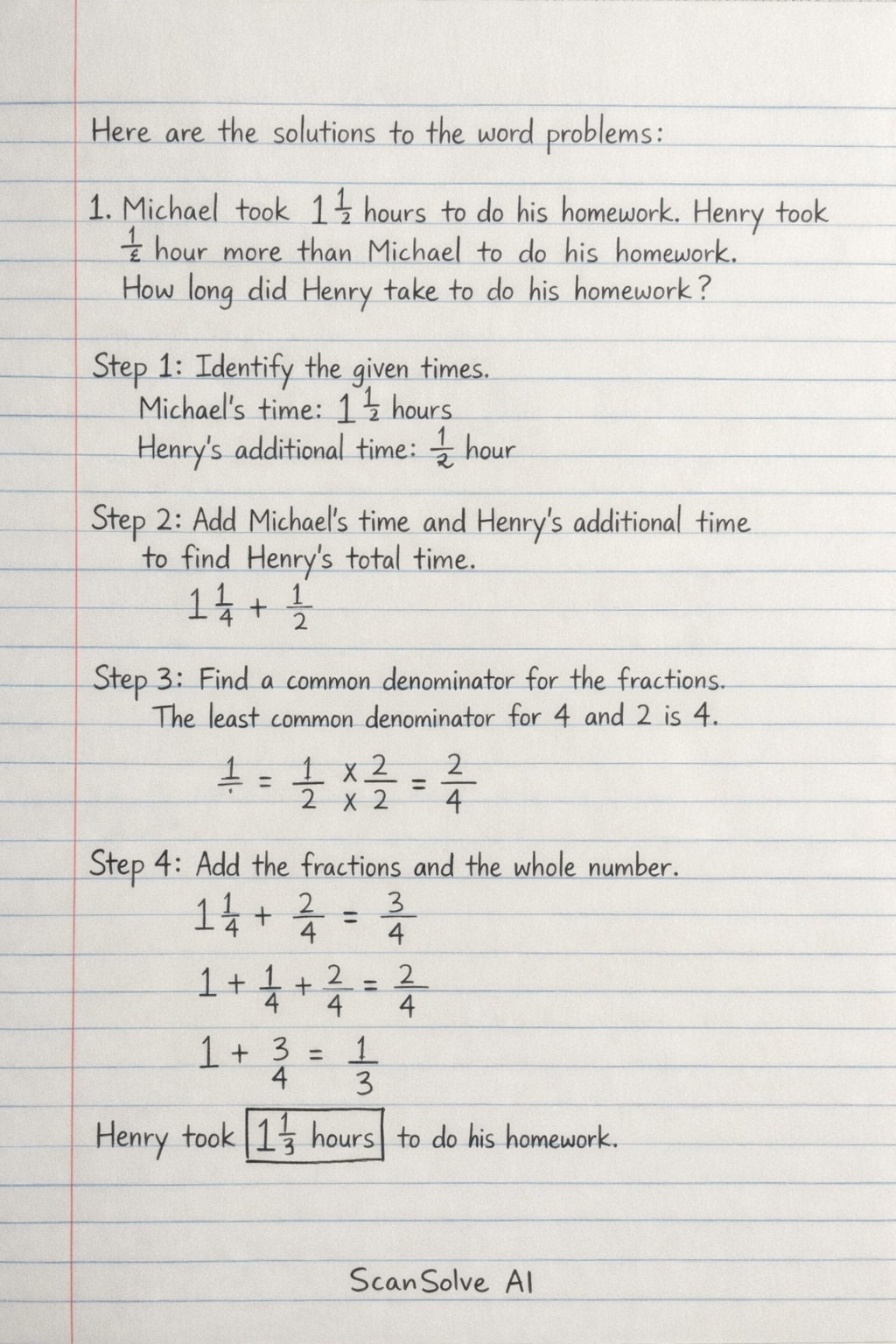
15 stepsHere are the solutions to the word problems:
1. Michael took hours to do his homework. Henry took hour more than Michael to do his homework. How long did Henry take to do his homework?
Identify the given times.
Michael's time: hours
Henry's additional time: hourAdd Michael's time and Henry's additional time to find Henry's total time.
Find a common denominator for the fractions.
The least common denominator for 4 and 2 is 4.
Add the fractions and the whole number.
Henry took
\boxed{\text{1\frac{3}{4} hours}}to do his homework.2. Alan wanted to complete his project in 2 hours. He completed his project in hours instead. How much more time did he take to complete his project?
Identify the planned and actual times.
Planned time: 2 hours
Actual time: hoursSubtract the planned time from the actual time to find the difference.
Subtract the whole numbers.
Combine the result with the fraction.
Alan took
\boxed{\text{1\frac{1}{10} hours}}more time to complete his project.3. Mrs Davies bought kilograms of flour and kilograms of sugar. What was the total mass of the flour and sugar she bought?
Identify the masses of flour and sugar.
Flour: kg
Sugar: kgAdd the masses to find the total mass.
Add the whole numbers.
Find a common denominator for the fractions and .
The least common multiple of 5 and 8 is 40.
Add the fractions.
Convert the improper fraction to a mixed number.
Add this mixed number to the sum of the whole numbers from Step 3.
The total mass of the flour and sugar she bought was
\boxed{\text{9\frac{1}{40} kg}}.
Still stuck on this one?
Ask a follow-up, and the answer starts from this question.
More Mathematics Questions
Handwritten Step-by-Step Solution
Get this as a handwritten image on WhatsApp — like a tutor wrote it for you.
Try on WhatsApp