
We read your photo as:
For each of the three sequences in Table 3, identify the pattern, state whether the next shape can be drawn and why, and provide the rule or pattern for the sequence.
Mathematics
ScanSolve AI Answer
Step-by-step solution
3 stepsHere are the patterns and rules for each sequence in Table 3:
Analyze Sequence 1
- Pattern: The sequence consists of squares made of smaller unit squares. The side length of the square increases by one unit in each step.
- Can you draw the next shape? Why or why not? Yes, the next shape can be drawn. The pattern is consistent: the side length of the square increases by 1 unit for each subsequent shape. The next shape would be a square.
- Rule or pattern: The -th shape in the sequence is an square. The number of unit squares in each shape is the square of its position in the sequence, given by .
Analyze Sequence 2
- Pattern: The sequence consists of a single triangle, and its orientation alternates.
- Can you draw the next shape? Why or why not? Yes, the next shape can be drawn. The pattern is a clear alternation of the triangle's orientation. The next shape would be a single triangle pointing upwards.
- Rule or pattern: The shape is always a single triangle. Its orientation alternates between pointing upwards and pointing downwards.
Analyze Sequence 3
- Pattern: The sequence consists of a horizontal row of circles. The number of circles in the row increases by one in each step.
- Can you draw the next shape? Why or why not? Yes, the next shape can be drawn. The pattern is consistent: one additional circle is added to the row for each subsequent shape. The next shape would be a row of 5 circles.
- Rule or pattern: The -th shape in the sequence is a row of circles. The number of circles in the row is equal to its position in the sequence.
Was this helpful?
Still stuck on this one?
Ask a follow-up, and the answer starts from this question.
Got a different question?Ask your own question
More Mathematics Questions
QDescribe the pattern, rule, next shape, and reason for each of the three sequences in Table 3.QIdentify the pattern in each sequence and determine the next three elements. Show your work and…QComplete the pattern: Identify the next two shapes in the sequence and explain the pattern. Also…QComplete the following number patterns and state the rule for each.QIdentify the pattern in each sequence of numbers and describe it.
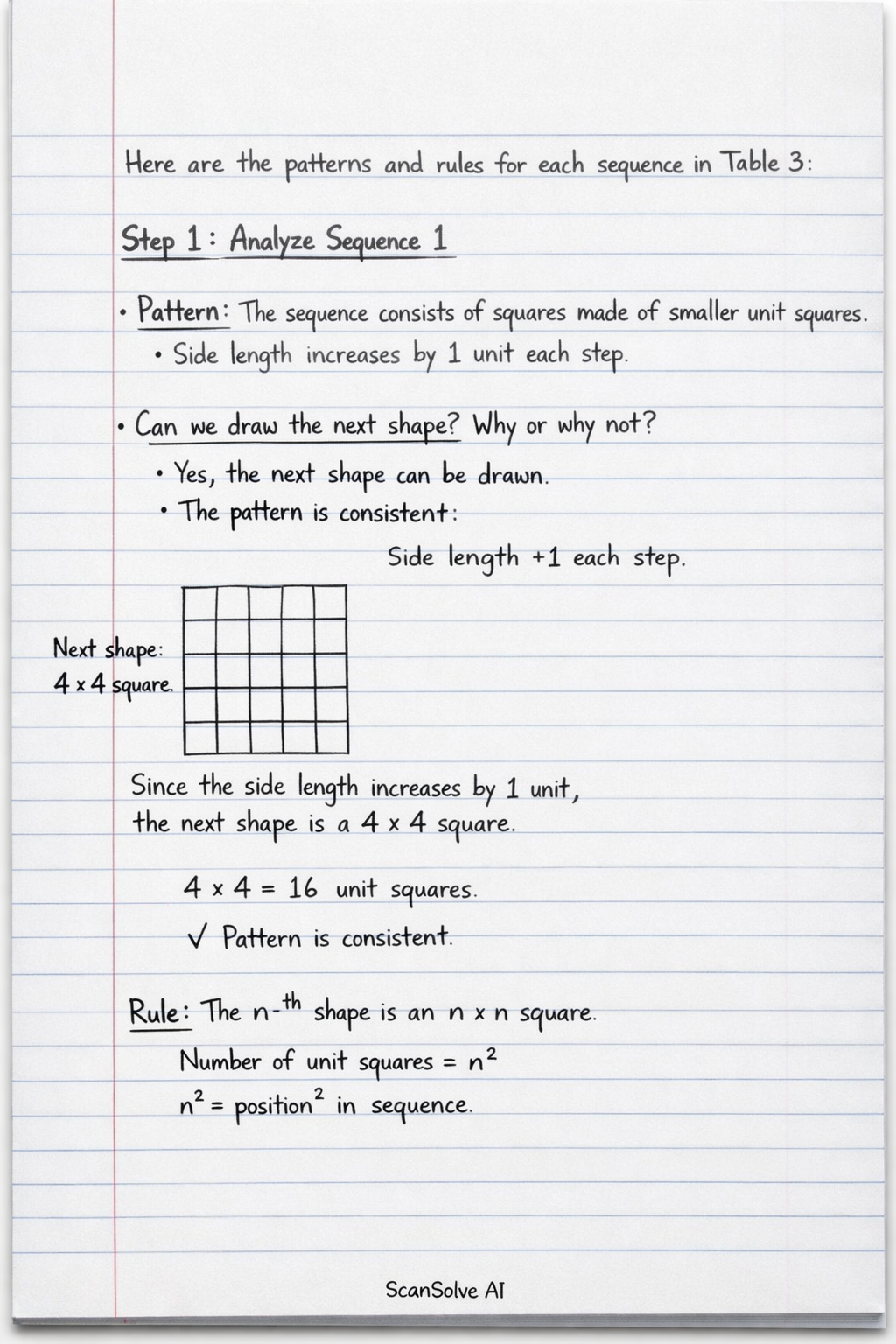
Handwritten Step-by-Step Solution
Get this as a handwritten image on WhatsApp — like a tutor wrote it for you.
Try on WhatsApp