
For the following set of ordered pairs, determine if the mapping is linear or exponential: - (1, 2), (2, 4), (3, 8), (4, 16) Justify your answer. Given a linear mapping with the rule y = 3x + 2, calculate the output values for x = 0, 1, 2, and 3. Organize your results in a table. A mobile phone plan charges a fixed fee of GH₵10 plus GH₵0.50 per minute. Write the rule for this mapping in the form y = mx + c, where x represents minutes and y represents total cost. Identify the constant difference in the domain and co-domain for the following mapping, then determine the rule: - Domain: 2, 4, 6, 8 - Co-domain: 7, 13, 19, 25 For the mapping y = 2x + 1, create a table of values for x = -2, -1, 0, 1, 2 and explain what the values of m and c represent. Given the rule y = -2x + 5, determine the output when x = 3 and explain what this ordered pair represents in the context of the mapping. A taxi charges GH₵2.50 per kilometre plus a fixed charge of GH₵5. Write the mapping rule and calculate the cost for a 15 km journey.
ScanSolve AI Answer
Step-by-step solution
26 stepsFor the following set of ordered pairs, determine if the mapping is linear or exponential: - (1, 2), (2, 4), (3, 8), (4, 16)
Justify your answer.
Check for a constant difference in the y-values.
The y-values are 2, 4, 8, 16.
Differences:
Since the differences are not constant (2, 4, 8), the mapping is not linear.Check for a constant ratio in the y-values.
Ratios:
Since there is a constant ratio of 2 between consecutive y-values, the mapping is exponential.The mapping is exponential because there is a constant ratio of 2 between consecutive y-values.
15. Given a linear mapping with the rule y = 3x + 2, calculate the output values for x = 0, 1, 2, and 3. Organize your results in a table.
Calculate output for .
Calculate output for .
Calculate output for .
Calculate output for .
Organize results in a table.
16. A mobile phone plan charges a fixed fee of GH₵10 plus GH₵0.50 per minute. Write the rule for this mapping in the form y = mx + c, where x represents minutes and y represents total cost.
Identify the fixed fee (c).
The fixed fee is GH₵10, so .
Identify the rate per minute (m).
The charge per minute is GH₵0.50, so .
Write the rule in the form .
Substituting the values of m and c:
The rule is .
17. Identify the constant difference in the domain and co-domain for the following mapping, then determine the rule: - Domain: 2, 4, 6, 8 - Co-domain: 7, 13, 19, 25
Identify the constant difference in the domain (x-values).
Differences:
The constant difference in the domain is 2.Identify the constant difference in the co-domain (y-values).
Differences:
The constant difference in the co-domain is 6.Determine the slope (m).
The slope .
Determine the y-intercept (c) using one ordered pair and the slope.
Using the point and in :
Write the rule.
The rule is .
The constant difference in the domain is 2.
The constant difference in the co-domain is 6.
The rule is .
18. For the mapping y = 2x + 1, create a table of values for x = -2, -1, 0, 1, 2 and explain what the values of m and c represent.
Calculate output for .
Calculate output for .
Calculate output for .
Calculate output for .
Calculate output for .
Create a table of values.
Explain what m and c represent.
In the equation :
- represents the slope of the line, indicating that for every unit increase in x, y increases by 2 units.
- represents the y-intercept, which is the value of y when x is 0.
19. Given the rule y = -2x + 5, determine the output when x = 3 and explain what this ordered pair represents in the context of the mapping.
Determine the output when .
Substitute into the rule:
Explain what the ordered pair represents.
The output when is . This forms the ordered pair .
This ordered pair represents a specific point on the line defined by the mapping rule . It means that when the input is 3, the corresponding output is -1.The output when is .
The ordered pair represents a point on the line where an input of 3 yields an output of -1.
20. A taxi charges GH₵2.50 per kilometre plus a fixed charge of GH₵5. Write the mapping rule and calculate the cost for a 15 km journey.
Write the mapping rule.
Let y be the total cost and x be the number of kilometres.
The charge per kilometre is GH₵2.50, so .
The fixed charge is GH₵5, so .
The mapping rule is .Calculate the cost for a 15 km journey.
Substitute into the rule:
The mapping rule is .
The cost for a 15 km journey is .
Still stuck on this one?
Ask a follow-up, and the answer starts from this question.
More Mathematics Questions
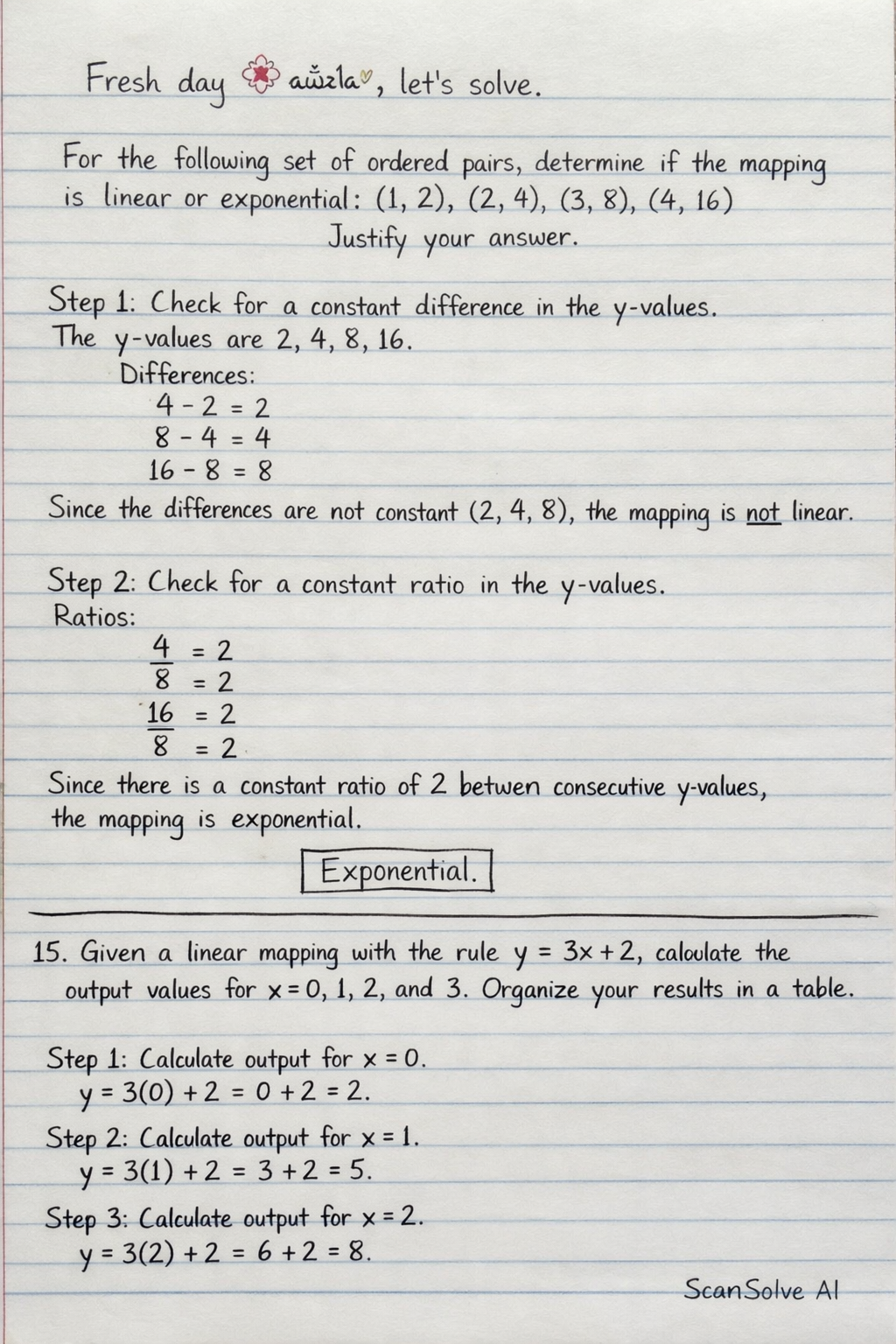
Handwritten Step-by-Step Solution
Get this as a handwritten image on WhatsApp — like a tutor wrote it for you.
Try on WhatsApp