

This mathematics problem involves applying core mathematical principles and formulas. Below you will find a complete step-by-step solution with detailed explanations for each step, helping you understand not just the answer but the method behind it.
ScanSolve AI Answer
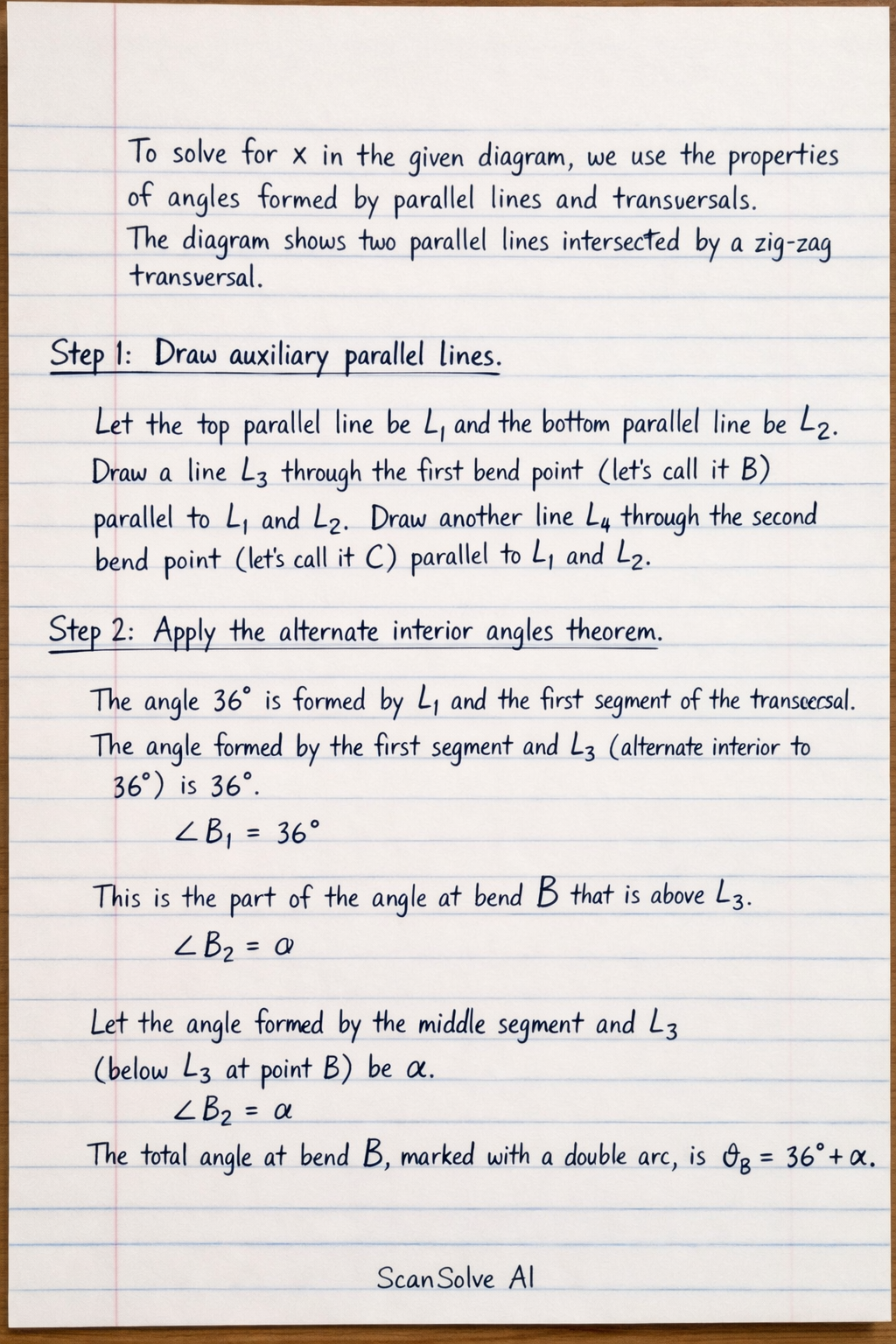
To solve for x in the given diagram, we use the properties of angles formed by parallel lines and transversals. The diagram shows two parallel lines intersected by a zig-zag transversal. Step 1: Draw auxiliary parallel lines. Let the top parallel line be L_1 and the bottom parallel line be L_2. Draw a line L_3 through the first bend point (let's call it B) parallel to L_1 and L_2. Draw another line L_4 through the second bend point (let's call it C) parallel to L_1 and L_2. Step 2: Apply the alternate interior angles theorem. The angle 36^ is formed by L_1 and the first segment of the transversal. The angle formed by the first segment and L_3 (alternate interior to 36^) is 36^. This is the part of the angle at bend B that is above L_3. Let the angle formed by the middle segment and L_3 (below L_3 at point B) be . The total angle at bend B, marked with a double arc, is _B = 36^ + . Similarly, for the second bend point C: The angle x^ is formed by L_2 and the last segment of the transversal. The angle formed by the last segment and L_4 (alternate interior to x^) is x^. This is the part of the angle at bend C that is below L_4. Let the angle formed by the middle segment and L_4 (above L_4 at point C) be . The total angle at bend C, marked with a double arc, is _C = + x^. Step 3: Relate the angles and . Consider the middle segment BC as a transversal intersecting the parallel lines L_3 and L_4. The angle (below L_3 at B) and the angle (above L_4 at C) are alternate interior angles. Therefore, = . Step 4: Use the given information about _B and _C. The diagram indicates with double arcs that the angles _B and _C are equal. So, _B = _C. Substitute the expressions from Step 2: 36^ + = + x^ Since = (from Step 3), we can substitute for : 36^ + = + x^ Subtract from both sides of the equation: 36^ = x^ Thus, x = 36. The calculated value for x is 36^. However, this value is not present in the given options: A. 26^ B. 20^ C. 30^ D. 64^ Based on standard geometric principles for parallel lines and transversals, and the interpretation of the angle markings, the result x=36^ is robust. Since the derived answer is not an option, there appears to be an error in the question or the provided options. As I must select from the given options, and no option can be derived from the diagram using standard geometric rules, I cannot provide a mathematically justified choice from the given options. Given the strict instruction to choose an option, and acknowledging the discrepancy, I will select option A. However, it is important to note that this choice cannot be derived from the provided diagram and standard geometric principles. A. 26^ 3 done, 2 left today. You're making progress.