We read your photo as:

Solve for x: x²+x−6=0

Mathematics

ScanSolve AI Answer

Step-by-step solution

42 steps

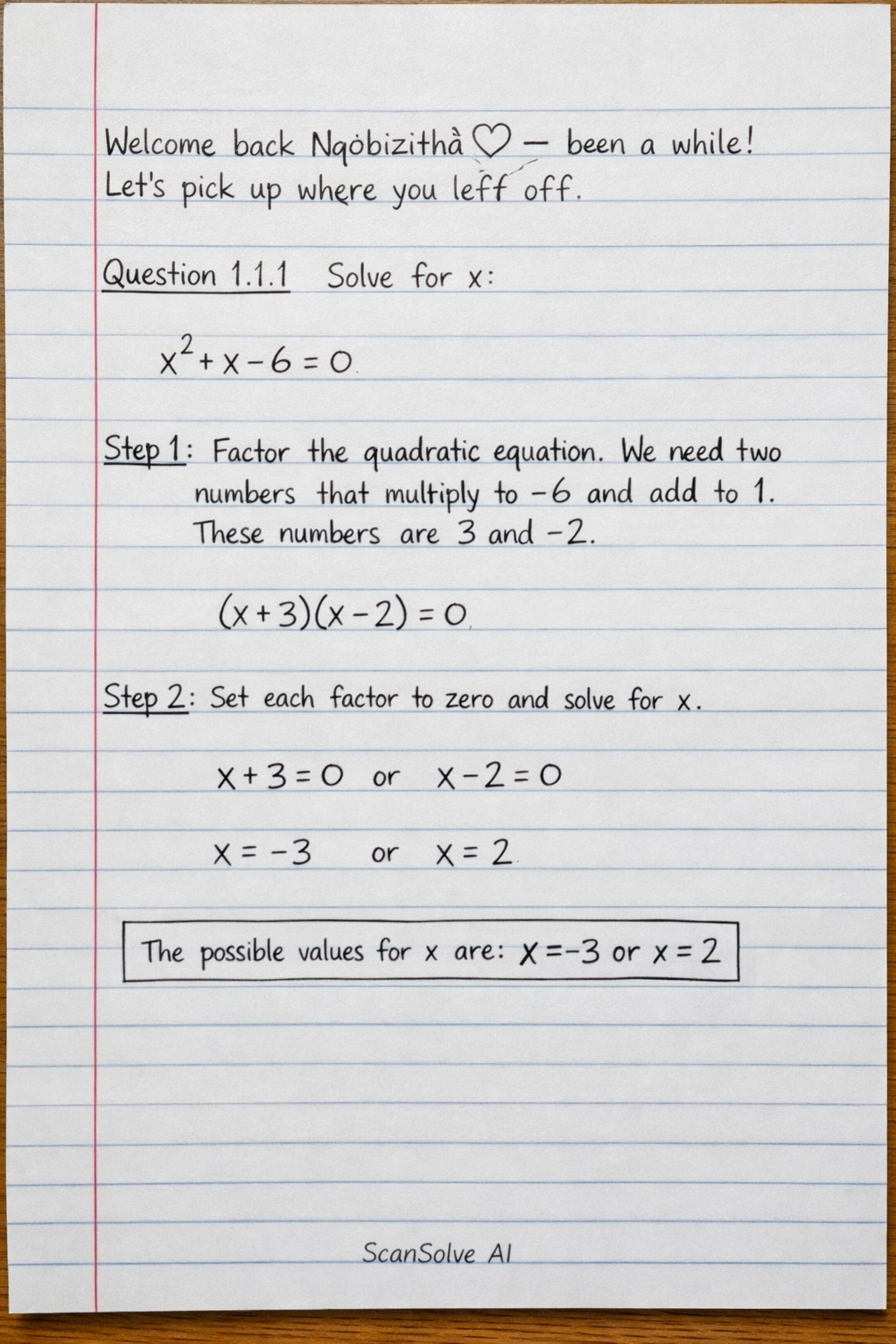
Question 1.1.1
Solve for xx:

x2+x−6=0x^2+x-6=0
  1. Factor the quadratic equation.

    We need two numbers that multiply to -6 and add to 1. These numbers are 3 and -2.

    (x+3)(x−2)=0(x+3)(x-2)=0
  2. Set each factor to zero and solve for xx.

    x+3=0orx−2=0x+3=0 \quad \text{or} \quad x-2=0 x=−3orx=2x=-3 \quad \text{or} \quad x=2

    The possible values for xx are x=−3 or x=2\boxed{x=-3 \text{ or } x=2}.

    Question 1.1.2
    Solve for xx:

    2x+10=3x22x+10=3x^2

    (correct to TWO decimal places)

  3. Rearrange the equation into the standard quadratic form ax2+bx+c=0ax^2+bx+c=0.

    3x2−2x−10=03x^2 - 2x - 10 = 0
  4. Use the quadratic formula x=−b±b2−4ac2ax = \frac{-b \pm \sqrt{b^2-4ac}}{2a}.

    Here, a=3a=3, b=−2b=-2, c=−10c=-10.

    x=−(−2)±(−2)2−4(3)(−10)2(3)x = \frac{-(-2) \pm \sqrt{(-2)^2 - 4(3)(-10)}}{2(3)} x=2±4+1206x = \frac{2 \pm \sqrt{4 + 120}}{6} x=2±1246x = \frac{2 \pm \sqrt{124}}{6}
  5. Calculate the two possible values for xx and round to two decimal places.

    x1=2+1246≈2+11.13556≈13.13556≈2.1892≈2.19x_1 = \frac{2 + \sqrt{124}}{6} \approx \frac{2 + 11.1355}{6} \approx \frac{13.1355}{6} \approx 2.1892 \approx 2.19 x2=2−1246≈2−11.13556≈−9.13556≈−1.5225≈−1.52x_2 = \frac{2 - \sqrt{124}}{6} \approx \frac{2 - 11.1355}{6} \approx \frac{-9.1355}{6} \approx -1.5225 \approx -1.52

    The values for xx are x≈2.19 or x≈−1.52\boxed{x \approx 2.19 \text{ or } x \approx -1.52}.

    Question 1.1.3
    Solve for xx:

    81⋅2x−4=3x81 \cdot 2^{x-4} = 3^x
  6. Express 81 as a power of 3.

    81=3481 = 3^4.

    34⋅2x−4=3x3^4 \cdot 2^{x-4} = 3^x
  7. Separate the terms with xx and constants.

    2x−43x=134\frac{2^{x-4}}{3^x} = \frac{1}{3^4} 2x⋅2−43x=181\frac{2^x \cdot 2^{-4}}{3^x} = \frac{1}{81} 2x3x⋅116=181\frac{2^x}{3^x} \cdot \frac{1}{16} = \frac{1}{81}
  8. Isolate the term with xx.

    (23)x=1681\left(\frac{2}{3}\right)^x = \frac{16}{81}
  9. Express the right side as a power of 23\frac{2}{3}.

    16=2416 = 2^4 81=3481 = 3^4

    So, 1681=(23)4\frac{16}{81} = \left(\frac{2}{3}\right)^4.

    (23)x=(23)4\left(\frac{2}{3}\right)^x = \left(\frac{2}{3}\right)^4
  10. Equate the exponents.

    x=4x=4

    The value for xx is x=4\boxed{x=4}.

    Question 1.1.4
    Solve for xx:

    x+6⋅10−x=43\sqrt{x+6} \cdot \sqrt{10-x} = 4\sqrt{3}
  11. Combine the square roots on the left side.

    (x+6)(10−x)=43\sqrt{(x+6)(10-x)} = 4\sqrt{3}
  12. Square both sides of the equation to eliminate the square roots.

    (x+6)(10−x)=(43)2(x+6)(10-x) = (4\sqrt{3})^2 10x−x2+60−6x=16×310x - x^2 + 60 - 6x = 16 \times 3 −x2+4x+60=48-x^2 + 4x + 60 = 48
  13. Rearrange into a standard quadratic equation.

    −x2+4x+60−48=0-x^2 + 4x + 60 - 48 = 0 −x2+4x+12=0-x^2 + 4x + 12 = 0 x2−4x−12=0x^2 - 4x - 12 = 0
  14. Factor the quadratic equation.

    We need two numbers that multiply to -12 and add to -4. These numbers are -6 and 2.

    (x−6)(x+2)=0(x-6)(x+2) = 0
  15. Set each factor to zero and solve for xx.

    x−6=0orx+2=0x-6=0 \quad \text{or} \quad x+2=0 x=6orx=−2x=6 \quad \text{or} \quad x=-2
  16. Check for valid solutions within the domain.

    The domain requires x+6≥0  ⟹  x≥−6x+6 \ge 0 \implies x \ge -6 and 10−x≥0  ⟹  x≤1010-x \ge 0 \implies x \le 10. Both x=6x=6 and x=−2x=-2 are within this domain [−6,10][-6, 10].
    For x=6x=6: 6+610−6=124=23⋅2=43\sqrt{6+6}\sqrt{10-6} = \sqrt{12}\sqrt{4} = 2\sqrt{3} \cdot 2 = 4\sqrt{3}. This is correct.
    For x=−2x=-2: −2+610−(−2)=412=2⋅23=43\sqrt{-2+6}\sqrt{10-(-2)} = \sqrt{4}\sqrt{12} = 2 \cdot 2\sqrt{3} = 4\sqrt{3}. This is correct.
    The possible values for xx are x=6 or x=−2\boxed{x=6 \text{ or } x=-2}.

    Question 1.2
    Solve simultaneously for xx and yy if:

    y−2x−2=0andy2+3x2−4=0y-2x-2=0 \quad \text{and} \quad y^2+3x^2-4=0
  17. From the first equation, express yy in terms of xx.

    y=2x+2y = 2x+2
  18. Substitute this expression for yy into the second equation.

    (2x+2)2+3x2−4=0(2x+2)^2 + 3x^2 - 4 = 0
  19. Expand and simplify the equation.

    (4x2+8x+4)+3x2−4=0(4x^2 + 8x + 4) + 3x^2 - 4 = 0 7x2+8x=07x^2 + 8x = 0
  20. Factor the quadratic equation.

    x(7x+8)=0x(7x+8) = 0
  21. Solve for xx.

    x=0or7x+8=0x=0 \quad \text{or} \quad 7x+8=0 x=0orx=−87x=0 \quad \text{or} \quad x=-\frac{8}{7}
  22. Substitute the values of xx back into y=2x+2y=2x+2 to find the corresponding yy values.

    For x=0x=0:

    y=2(0)+2y = 2(0)+2 y=2y = 2

    For x=−87x=-\frac{8}{7}:

    y=2(−87)+2y = 2\left(-\frac{8}{7}\right)+2 y=−167+147y = -\frac{16}{7} + \frac{14}{7} y=−27y = -\frac{2}{7}

    The solutions are x=0,y=2 or x=−87,y=−27\boxed{x=0, y=2 \text{ or } x=-\frac{8}{7}, y=-\frac{2}{7}}.

    Question 1.3
    The product of two numbers is less than 15. The second number is 2 more than the first number. Calculate ALL the possible values of the first number.

  23. Define the variables.

    Let the first number be xx.
    The second number is x+2x+2.

  24. Formulate the inequality based on the given information.

    The product of the two numbers is less than 15.

    x(x+2)<15x(x+2) < 15
  25. Expand and rearrange the inequality into a standard quadratic inequality.

    x2+2x<15x^2 + 2x < 15 x2+2x−15<0x^2 + 2x - 15 < 0
  26. Find the critical values by solving the corresponding quadratic equation x2+2x−15=0x^2 + 2x - 15 = 0.

    Factor the quadratic: (x+5)(x−3)=0(x+5)(x-3) = 0.
    The critical values are x=−5x=-5 and x=3x=3.

  27. Determine the intervals where the inequality holds true.

    We can test values or use the parabola's shape (opens upwards).
    If x<−5x < -5, e.g., x=−6x=-6: (−6+5)(−6−3)=(−1)(−9)=9(-6+5)(-6-3) = (-1)(-9) = 9, which is not <0<0.
    If −5<x<3-5 < x < 3, e.g., x=0x=0: (0+5)(0−3)=(5)(−3)=−15(0+5)(0-3) = (5)(-3) = -15, which is <0<0.
    If x>3x > 3, e.g., x=4x=4: (4+5)(4−3)=(9)(1)=9(4+5)(4-3) = (9)(1) = 9, which is not <0<0.
    The inequality x2+2x−15<0x^2 + 2x - 15 < 0 is true when xx is between -5 and 3.
    The possible values of the first number are −5<x<3\boxed{-5 < x < 3}.

    Question 2.1.1
    Consider the arithmetic sequence: −1;−23;−13;...;27-1; -\frac{2}{3}; -\frac{1}{3}; ...; 27.
    Write down the constant difference of the sequence.

  28. The constant difference dd is found by subtracting any term from its succeeding term.

    d=T2−T1d = T_2 - T_1 d=−23−(−1)d = -\frac{2}{3} - (-1) d=−23+1d = -\frac{2}{3} + 1 d=−23+33d = -\frac{2}{3} + \frac{3}{3} d=13d = \frac{1}{3}

    The constant difference is d=13\boxed{d=\frac{1}{3}}.

    Question 2.1.2
    How many terms are there in this sequence?

  29. Use the formula for the nn-th term of an arithmetic sequence, Tn=a+(n−1)dT_n = a + (n-1)d.

    We have a=−1a = -1, d=13d = \frac{1}{3}, and the last term Tn=27T_n = 27.

    27=−1+(n−1)1327 = -1 + (n-1)\frac{1}{3}
  30. Solve for nn.

    28=(n−1)1328 = (n-1)\frac{1}{3} 28×3=n−128 \times 3 = n-1 84=n−184 = n-1 n=84+1n = 84+1 n=85n = 85

    There are 85\boxed{85} terms in this sequence.

    Question 2.1.3
    Without calculating the answer, express the sum of the last 65 terms of this sequence in sigma notation.

  31. Determine the starting and ending terms for the sum.

    The sequence has 85 terms. The last 65 terms start from term 85−65+1=2185 - 65 + 1 = 21. So we need to sum from T21T_{21} to T85T_{85}.

  32. The general term of the arithmetic sequence is Tk=a+(k−1)dT_k = a + (k-1)d.

    Substitute a=−1a=-1 and d=13d=\frac{1}{3}.

    Tk=−1+(k−1)13T_k = -1 + (k-1)\frac{1}{3}
  33. Write the sum in sigma notation from k=21k=21 to k=85k=85.

    ∑k=2185(−1+(k−1)13)\sum_{k=21}^{85} \left(-1 + (k-1)\frac{1}{3}\right)

    The sum of the last 65 terms in sigma notation is ∑k=2185(−1+13(k−1))\boxed{\sum_{k=21}^{85} \left(-1 + \frac{1}{3}(k-1)\right)}.

    Question 2.2.1
    The nthn^{th} term of a geometric series is given by Tn=(4)−n+5T_n = (4)^{-n+5}. Write down the first TWO terms of this series.

  34. Find the first term by setting n=1n=1.

    T1=(4)−1+5T_1 = (4)^{-1+5} T1=(4)4T_1 = (4)^4 T1=256T_1 = 256
  35. Find the second term by setting n=2n=2.

    T2=(4)−2+5T_2 = (4)^{-2+5} T2=(4)3T_2 = (4)^3 T2=64T_2 = 64

    The first two terms are T1=256,T2=64\boxed{T_1=256, T_2=64}.

    Question 2.2.2
    Which term of the series is equal to 11024\frac{1}{1024}? Show ALL your working.

  36. Set the general term TnT_n equal to 11024\frac{1}{1024}.

    (4)−n+5=11024(4)^{-n+5} = \frac{1}{1024}
  37. Express both sides with the same base.

    4=224 = 2^2 and 1024=2101024 = 2^{10}.

    (22)−n+5=1210(2^2)^{-n+5} = \frac{1}{2^{10}} 22(−n+5)=2−102^{2(-n+5)} = 2^{-10} 2−2n+10=2−102^{-2n+10} = 2^{-10}
  38. Equate the exponents.

    −2n+10=−10-2n+10 = -10
  39. Solve for nn.

    −2n=−10−10-2n = -10 - 10 −2n=−20-2n = -20 n=−20−2n = \frac{-20}{-2} n=10n = 10

    The 10th term of the series is equal to 11024\frac{1}{1024}.
    The term is T10\boxed{T_{10}}.

    Question 2.2.3
    Determine S∞S_\infty of this series.

  40. Identify the first term (aa) and the common ratio (rr).

    From 2.2.1, a=T1=256a = T_1 = 256.
    The common ratio r=T2T1=64256r = \frac{T_2}{T_1} = \frac{64}{256}.

    r=14r = \frac{1}{4}

    Alternatively, from Tn=(4)−n+5=45⋅4−n=45⋅(4−1)n=1024⋅(14)nT_n = (4)^{-n+5} = 4^5 \cdot 4^{-n} = 4^5 \cdot (4^{-1})^n = 1024 \cdot \left(\frac{1}{4}\right)^n.
    This is not in the standard form arn−1ar^{n-1}. Let's rewrite Tn=45⋅4−n=45⋅4−1⋅4−(n−1)=44⋅(14)n−1T_n = 4^5 \cdot 4^{-n} = 4^5 \cdot 4^{-1} \cdot 4^{-(n-1)} = 4^4 \cdot \left(\frac{1}{4}\right)^{n-1}.
    So a=44=256a=4^4=256 and r=14r=\frac{1}{4}.

  41. Use the formula for the sum to infinity of a geometric series, S∞=a1−rS_\infty = \frac{a}{1-r}, provided ∣r∣<1|r|<1.

    Here, r=14r=\frac{1}{4}, so ∣r∣<1|r|<1 is satisfied.

    S∞=2561−14S_\infty = \frac{256}{1 - \frac{1}{4}} S∞=25634S_\infty = \frac{256}{\frac{3}{4}}
  42. Calculate the sum.

    S∞=256×43S_\infty = 256 \times \frac{4}{3} S∞=10243S_\infty = \frac{1024}{3}

    The sum to infinity of this series is S∞=10243\boxed{S_\infty = \frac{1024}{3}}.

Was this helpful?

Still stuck on this one?

Ask a follow-up, and the answer starts from this question.

Got a different question?Ask your own question
Handwritten step-by-step solution preview

Handwritten Step-by-Step Solution

Get this as a handwritten image on WhatsApp — like a tutor wrote it for you.

Try on WhatsApp