
Four coins are tossed, what is the probability of obtaining head on the second tossed?
Mathematics
ScanSolve AI Answer
Answer
Step-by-step solution
3 stepsHere's how to solve the problem:
Determine the total number of possible outcomes when four coins are tossed.
Each coin has 2 possible outcomes (Head or Tail). For four coins, the total number of outcomes is .
Determine the number of outcomes where the second toss is a head.
For the second toss to be a head, the outcome is fixed as 'H'. The other three tosses (first, third, and fourth) can be either a Head or a Tail.
- First toss: 2 possibilities (H or T)
- Second toss: 1 possibility (H)
- Third toss: 2 possibilities (H or T)
- Fourth toss: 2 possibilities (H or T)
Calculate the probability.
The probability of an event is the ratio of the number of favorable outcomes to the total number of possible outcomes.
The probability of obtaining a head on the second toss is .
Was this helpful?
Try one yourself
A new problem that tests the same skill.
Still stuck on this one?
Ask a follow-up, and the answer starts from this question.
Got a different question?Ask your own question
More Mathematics Questions
QIf two fair coins are tossed, what is the probability of getting at least one head?QA fair coin is tossed 3 times, what is the probability of getting at least two heads?QThe probability of getting at least one head in a toss of two coins is:QA coin is flipped 3 times. What is the probability of getting exactly 2 heads?QA coin is tossed three times. Calculate probability that the first and third - coin loses give heads…
Browse by topic:Statistics
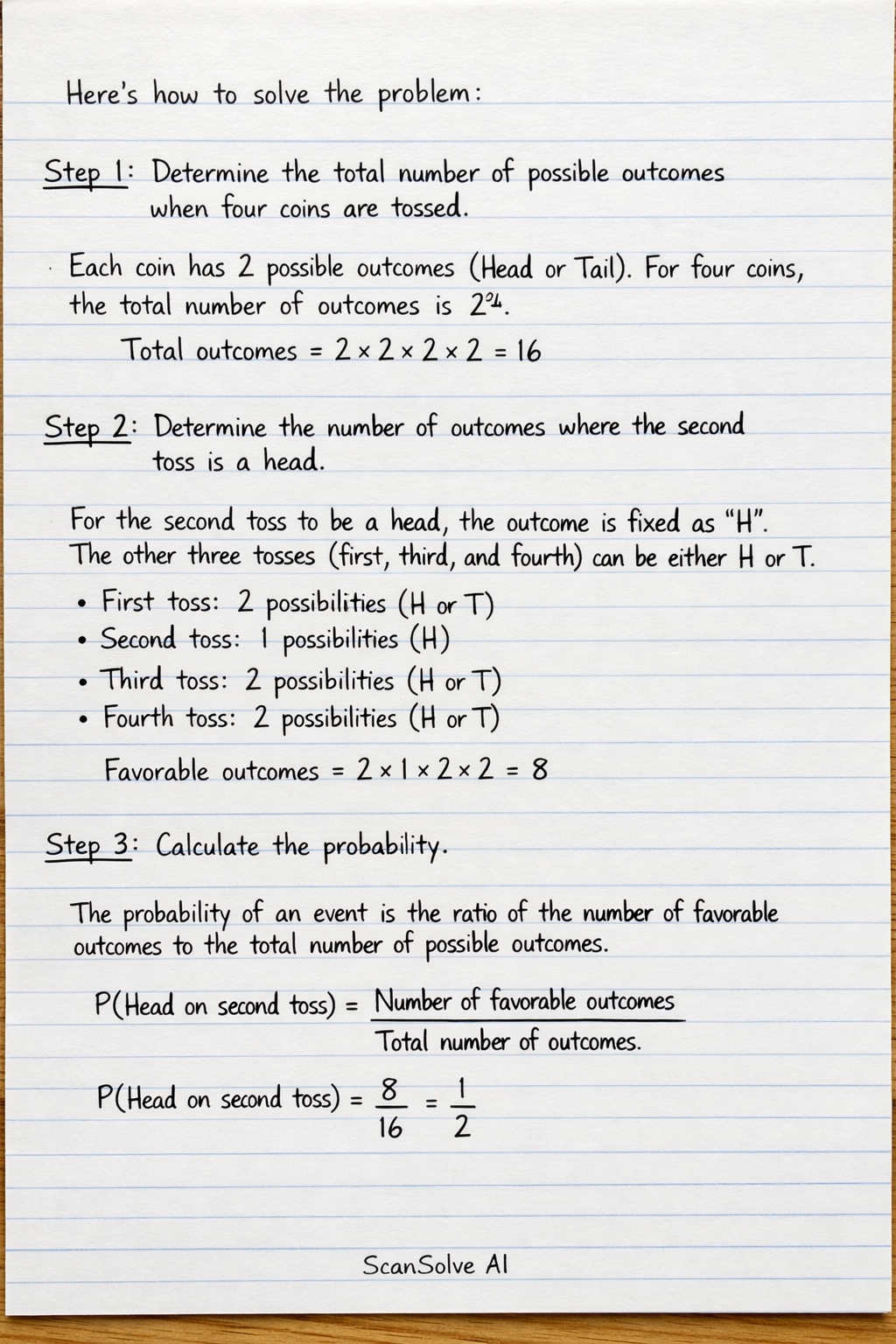
Handwritten Step-by-Step Solution
Get this as a handwritten image on WhatsApp — like a tutor wrote it for you.
Try on WhatsApp