
Determine the fraction of the amount remaining each month.
ScanSolve AI Answer
Answers
4 partsStep-by-step solution
8 stepsPart a· 2 steps
What fraction remains after 6 months?
Determine the fraction of the amount remaining each month.
Each month, half of the remaining amount is given away, so the fraction remaining is .
Calculate the fraction remaining after 6 months.
After 6 months, the fraction remaining will be .
The fraction remaining after 6 months is .
Part b
What fraction remains after 12 months?
Calculate the fraction remaining after 12 months.
After 12 months, the fraction remaining will be .
The fraction remaining after 12 months is .
Part c
Write each fraction as a power of 2 with a negative exponent.
Express the fraction from part a) as a power of 2 with a negative exponent.
Express the fraction from part b) as a power of 2 with a negative exponent.
The fractions as powers of 2 with negative exponents are and .
Part d\244.14$
\244.14$
What amount is remaining at the end of the year?
Identify the initial amount and the fraction remaining at the end of the year.
The initial amount is
\1,000,000\frac{1}{4096}$.Calculate the remaining amount.
Round the amount to two decimal places for currency.
The amount remaining at the end of the year is
\boxed{\244.14}$.
Try one yourself
A new problem that tests the same skill.
Still stuck on this one?
Ask a follow-up, and the answer starts from this question.
More Mathematics Questions
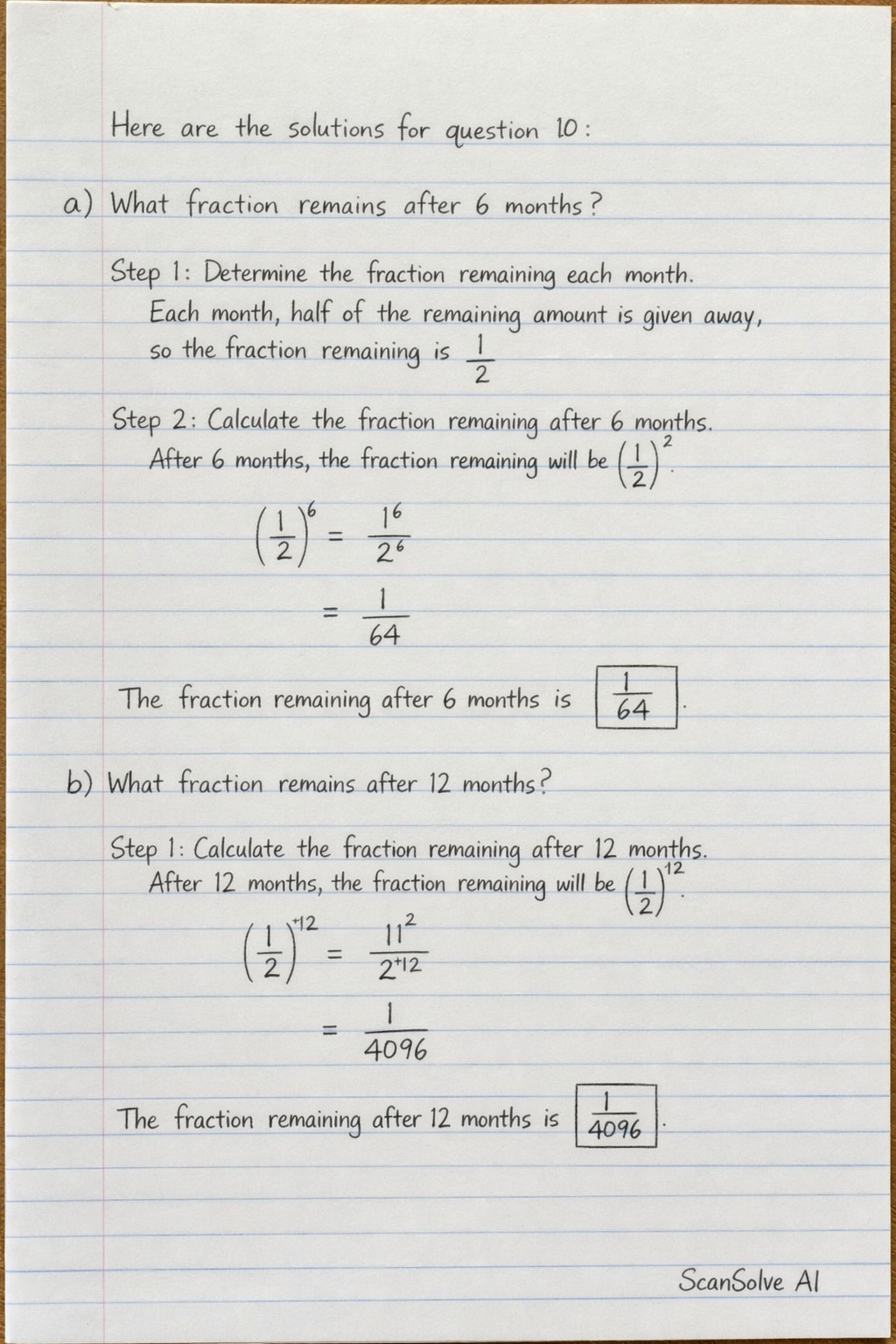
Handwritten Step-by-Step Solution
Get this as a handwritten image on WhatsApp — like a tutor wrote it for you.
Try on WhatsApp