
We read your photo as:
From the structures above. Which structure will you use and why? Present your answer basing it on your answers above.
ScanSolve AI Answer
Answer
Step-by-step solution
9 stepsThe image shows several questions related to patterns and geometry. I will address question 2.7, 2.8, 2.9, and 3.1.
Part 2.7
Determine the general rule to find the number of dots in the Structure.
The student's work shows . Let's verify this rule based on the information provided or implied by the previous questions.
From question 2.3, Structure 5 has 26 dots.
Using the rule :
For , . This matches the given information.
From question 2.5, Structure 6 has 37 dots.
Using the rule :
For , . This also matches.
The rule seems correct.
Part 2.8· 3 steps
Use the rule to calculate many dots are there in the Structure? Show calculations.
Identify the rule for the number of dots in the structure.
The general rule is .
Substitute into the rule.
Calculate the value.
The structure has 2501 dots.
Part 2.9
From the structures above. Which structure will you use and why? Present your answer basing it on your answers above.
The student's answer states: "I will use Structure 4, because structure 4 can house 9 families using only 17 dots/material". This answer seems to be based on an assumption that the number of families is related to the structure number, and the number of dots is the material. Let's re-evaluate based on the given information.
The question asks which structure to use, implying a choice based on efficiency or capacity. The previous questions relate the structure number () to the number of dots (). There is no explicit information about "families" or "material" in the problem statement itself, only in the student's written answer.
Let's assume "families" refers to the structure number , and "dots/material" refers to .
If Structure 4 houses 9 families, this implies .
The number of dots for Structure 4 is .
The number of dots for Structure 9 is .
The student's reasoning "structure 4 can house 9 families using only 17 dots/material" is contradictory. If it's Structure 4, it uses 17 dots. If it houses 9 families, it would be Structure 9, which uses 82 dots.
Without more context on what "families" means in relation to the structures, it's difficult to definitively answer this question. However, if the goal is to house 25 families (as mentioned in Q2.4, which asks "How much material/dots will you need to house 25 families?"), then we need to find an such that is sufficient for 25 families. If "families" directly corresponds to the structure number , then we would need Structure 25.
Let's assume the question is asking to choose a structure that can house a certain number of "families" (which is not defined) and the student's answer is trying to justify a choice. If "families" is related to the structure number, and the student chose Structure 4, then it would house 4 families, not 9. The number of dots for Structure 4 is 17.
Given the ambiguity, I will address the student's written answer directly and point out the inconsistency.
Analyze the student's statement.
The student states: "I will use Structure 4, because structure 4 can house 9 families using only 17 dots/material".
Check the consistency of the statement with the established rule .
For Structure 4 (), the number of dots is . This part is consistent.
However, if Structure 4 houses 9 families, this implies a relationship between and "families" that is not directly number of families. If "families" refers to the structure number, then Structure 4 houses 4 families. If it houses 9 families, it would be Structure 9.Provide a corrected interpretation based on the most likely intent, assuming "families" refers to the structure number.
If the question implies choosing a structure based on its number of dots, and the student chose Structure 4, then:
Structure 4 has dots.
If the question is about housing 25 families (from Q2.4), then we would need to find a structure that can accommodate this. If "families" is directly related to , then Structure 25 would be needed. dots.Given the student's specific answer, it seems they are trying to relate the number of families to the structure number. The statement "structure 4 can house 9 families" is inconsistent with "structure 4" if "families" is meant to be the structure number. The number of dots for structure 4 is indeed 17.
Let's assume the student meant that Structure 4 is chosen, and it uses 17 dots. The "9 families" part is likely a misunderstanding or a typo. Without further clarification on what "families" represents, it's hard to give a definitive "correct" answer for the choice of structure. However, the calculation for Structure 4's dots is correct.
Question 3.1: Triangle ABC on the Cartesian plane below represents a roof for one unit. To extend the roof to cater for 16 unit you need to enlarge the roof using . Calculate the coordinates of the enlarged roof.
The question asks to enlarge the roof using the transformation . This notation is unusual for coordinate transformations. Typically, a transformation is given as where and are functions of and . The notation suggests that the new x-coordinate will be and the new y-coordinate will be . This is a combination of a reflection across and a translation.
Let the original coordinates of a point be .
The transformation rule is given as .
This means the new x-coordinate, , will be .
And the new y-coordinate, , will be .
So, .The problem does not provide the original coordinates of Triangle ABC. Without these coordinates, it is impossible to calculate the coordinates of the enlarged roof. The boxes labeled "Pair 1" and "Pair 2" suggest that there might be two sets of coordinates or two points to transform, but the image of the triangle itself is missing.
Therefore, I cannot complete this question without the initial coordinates of Triangle ABC.
For question 2.7, the rule is correct.
For question 2.8, the calculation is as follows:Use the given rule for the number of dots in the structure.
Substitute to find the number of dots in the structure.
Calculate the value.
The number of dots in the structure is .
For question 2.9, the student's reasoning contains an inconsistency.
The number of dots for Structure 4 is . This part is correct.
However, the statement "structure 4 can house 9 families" is not directly supported by the pattern or any other information provided. If "families" refers to the structure number, then Structure 4 houses 4 families. If it houses 9 families, it would be Structure 9, which has dots.
Therefore, the student's justification for choosing Structure 4 is inconsistent regarding the number of families it can house.For question 3.1, the original coordinates of Triangle ABC are missing. Without these coordinates, the calculation for the enlarged roof cannot be performed.
Try one yourself
A new problem that tests the same skill.
Still stuck on this one?
Ask a follow-up, and the answer starts from this question.
More Mathematics Questions
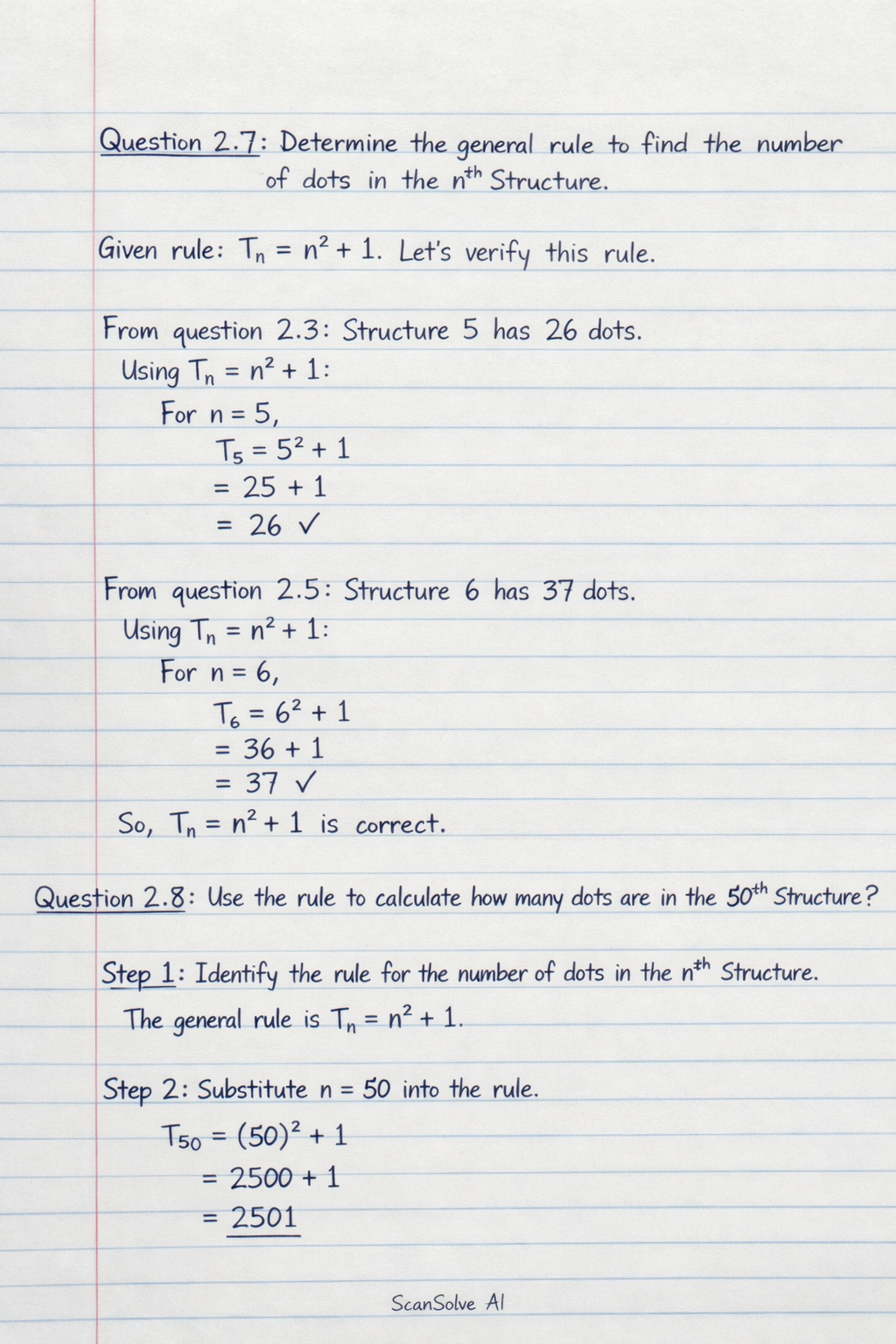
Handwritten Step-by-Step Solution
Get this as a handwritten image on WhatsApp — like a tutor wrote it for you.
Try on WhatsApp