We read your photo as:

Give the general direction of Worcester from Clanwilliam.

Mathematics

ScanSolve AI Answer

Step-by-step solution

15 steps

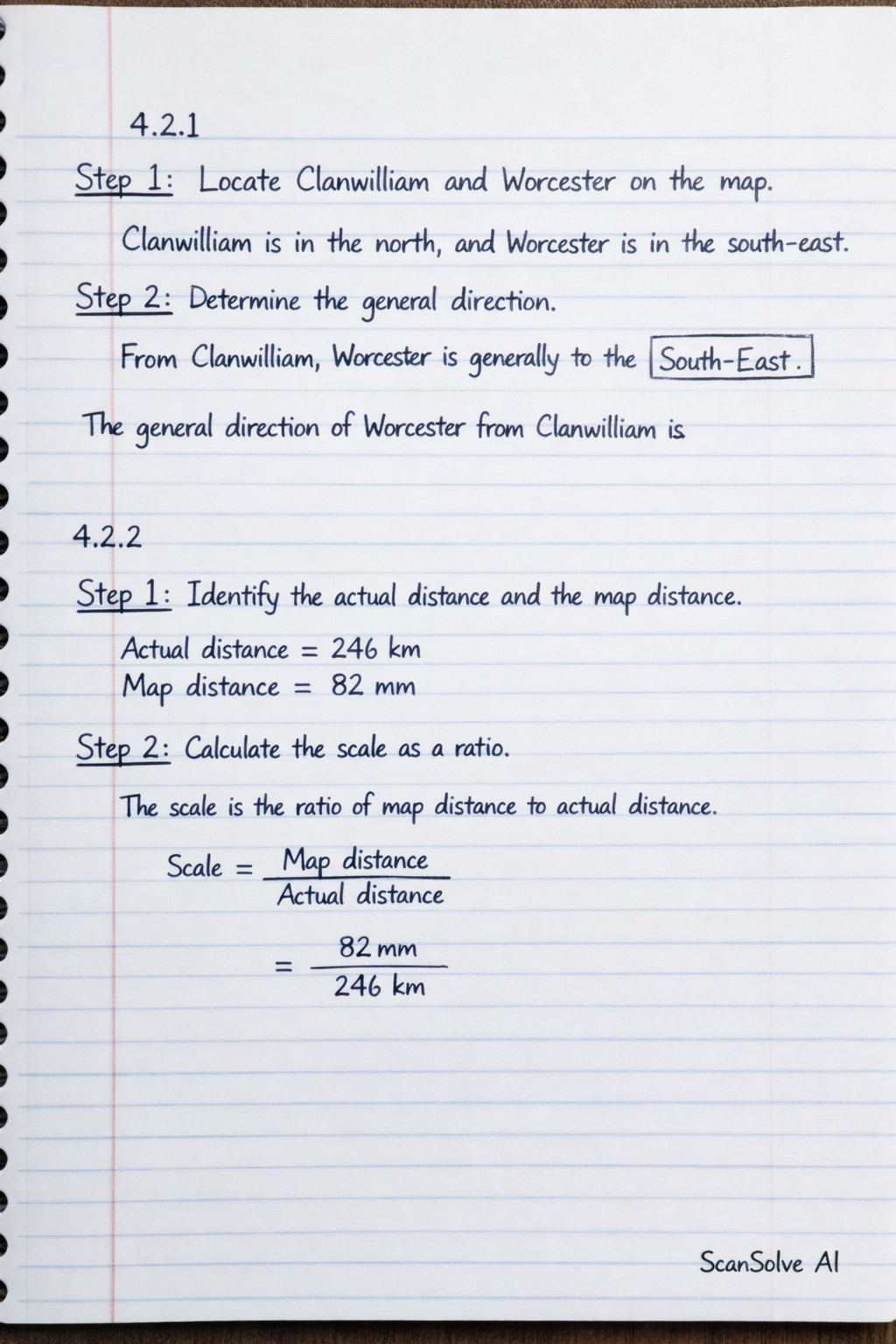
4.2.1

  1. Locate Clanwilliam and Worcester on the map.

    Clanwilliam is in the north, and Worcester is in the south-east.

  2. Determine the general direction.

    From Clanwilliam, Worcester is generally to the South-East.

    The general direction of Worcester from Clanwilliam is South-East\boxed{\text{South-East}}.

    4.2.2

  3. Identify the actual distance and the map distance.

    Actual distance = 246 km246 \text{ km}
    Map distance = 82 mm82 \text{ mm}

  4. Calculate the scale as a ratio.

    The scale is the ratio of map distance to actual distance.

    Scale=Map distanceActual distance=82 mm246 km\text{Scale} = \frac{\text{Map distance}}{\text{Actual distance}} = \frac{82 \text{ mm}}{246 \text{ km}}
  5. Convert units to be the same and simplify to a unit ratio.

    Convert kilometres to millimetres: 1 km=1000 m=1 000 000 mm1 \text{ km} = 1000 \text{ m} = 1\,000\,000 \text{ mm}.

    246 km=246×1 000 000 mm=246 000 000 mm246 \text{ km} = 246 \times 1\,000\,000 \text{ mm} = 246\,000\,000 \text{ mm}

    Now, the scale is:

    Scale=82 mm246 000 000 mm\text{Scale} = \frac{82 \text{ mm}}{246\,000\,000 \text{ mm}}

    Divide both sides by 82 to get a unit ratio:

    Scale=82÷82246 000 000÷82=13 000 000\text{Scale} = \frac{82 \div 82}{246\,000\,000 \div 82} = \frac{1}{3\,000\,000}

    The scale of the map is 1:3 000 000\boxed{1:3\,000\,000}.

    4.2.3

  6. Identify the given values.

    Distance = 246 km246 \text{ km}
    Speed = 105 km/h105 \text{ km/h}

  7. Use the formula Time=DistanceSpeed\text{Time} = \frac{\text{Distance}}{\text{Speed}} to calculate the travel time in hours.

    Time=246 km105 km/h\text{Time} = \frac{246 \text{ km}}{105 \text{ km/h}} Time≈2,342857 hours\text{Time} \approx 2,342857 \text{ hours}
  8. Convert the decimal part of the hours into minutes.

    The whole number part is 2 hours.
    The decimal part is 0,342857 hours0,342857 \text{ hours}.

    Minutes=0,342857×60 minutes/hour\text{Minutes} = 0,342857 \times 60 \text{ minutes/hour} Minutes≈20,57 minutes\text{Minutes} \approx 20,57 \text{ minutes}

    Rounding to the nearest minute, this is 21 minutes.

    It will take Nandipha's aunt approximately 2 hours and 21 minutes\boxed{2 \text{ hours and } 21 \text{ minutes}}.

    4.2.4

  9. Identify the departure time and travel time.

    Departure time = 13:50
    Travel time = 2 hours and 21 minutes (from 4.2.3)

  10. Add the travel time to the departure time.

    Start with hours: 13 hours+2 hours=15 hours13 \text{ hours} + 2 \text{ hours} = 15 \text{ hours}.
    Start with minutes: 50 minutes+21 minutes=71 minutes50 \text{ minutes} + 21 \text{ minutes} = 71 \text{ minutes}.

  11. Convert excess minutes to hours.

    71 minutes=1 hour and 11 minutes71 \text{ minutes} = 1 \text{ hour and } 11 \text{ minutes}.
    Add this 1 hour to the 15 hours: 15 hours+1 hour=16 hours15 \text{ hours} + 1 \text{ hour} = 16 \text{ hours}.
    So, the arrival time is 16 hours and 11 minutes.

    Nandipha's aunt will arrive at the Art Exhibition at 16:11\boxed{16:11}.

    4.2.5

  12. Calculate the normal petrol consumption for a single trip of 246 km.

    Fuel consumption rate = 7,5 litres per 100 km7,5 \text{ litres per } 100 \text{ km}.

    Normal consumption=246 km100 km×7,5 litres\text{Normal consumption} = \frac{246 \text{ km}}{100 \text{ km}} \times 7,5 \text{ litres} Normal consumption=2,46×7,5 litres\text{Normal consumption} = 2,46 \times 7,5 \text{ litres} Normal consumption=18,45 litres\text{Normal consumption} = 18,45 \text{ litres}
  13. Calculate the increased petrol consumption (20% more).

    Increased consumption=Normal consumption×(1+0,20)\text{Increased consumption} = \text{Normal consumption} \times (1 + 0,20) Increased consumption=18,45 litres×1,20\text{Increased consumption} = 18,45 \text{ litres} \times 1,20 Increased consumption=22,14 litres\text{Increased consumption} = 22,14 \text{ litres}
  14. Compare the increased consumption to 20 litres and state agreement/disagreement.

    The increased consumption is 22,14 litres22,14 \text{ litres}.
    The aunt insists she will use less than 20 litres.
    Since 22,14 litres>20 litres22,14 \text{ litres} > 20 \text{ litres}, her insistence is incorrect.

    I do not agree\boxed{\text{do not agree}} with her. She will use 22,14 litres22,14 \text{ litres}, which is more than 20 litres.

    4.2.6

  15. Consider factors that could affect travel time.

    The exhibition starts at 16:00. She arrives at 16:11 if she leaves at 13:50. This means she would already be late.
    Factors that could cause further delays or make her even later include:

    • Traffic congestion
    • Road construction or detours
    • Unexpected vehicle issues (e.g., flat tire)
    • Needing to stop for fuel or rest
    • Getting lost or taking a wrong turn
    • Weather conditions (e.g., rain, fog)

    One factor Nandipha's aunt should consider is traffic congestion\boxed{\text{traffic congestion}}.

Was this helpful?

Still stuck on this one?

Ask a follow-up, and the answer starts from this question.

Got a different question?Ask your own question
Handwritten step-by-step solution preview

Handwritten Step-by-Step Solution

Get this as a handwritten image on WhatsApp — like a tutor wrote it for you.

Try on WhatsApp