
We read your photo as:
Given a universal set U and subsets A, O, and C, find the elements of each subset based on specific properties (square numbers, odd numbers, composite numbers).
ScanSolve AI Answer
Step-by-step solution
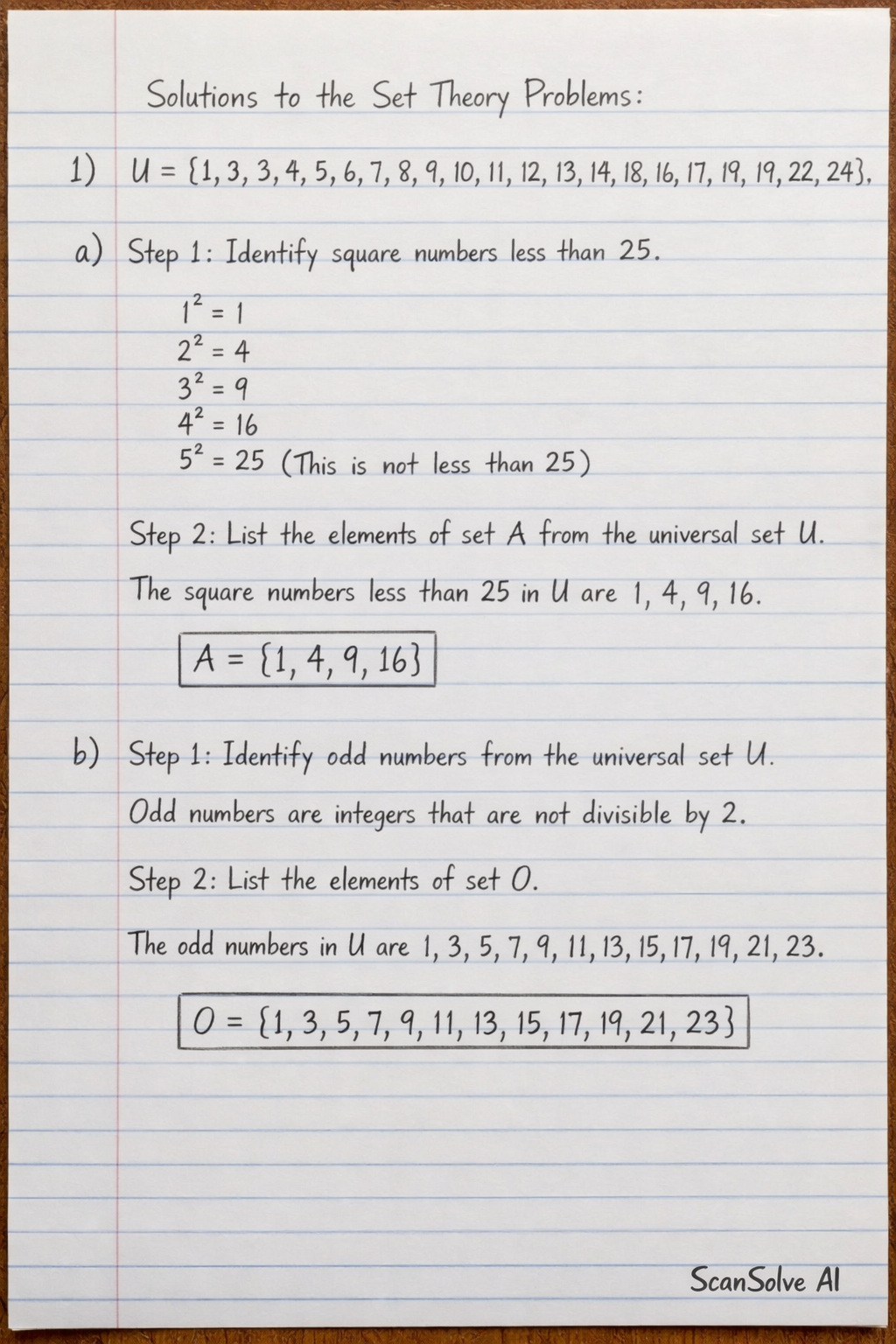
12 stepsHere are the solutions to the set theory problems:
1)
Given the universal set .
a)
Identify square numbers less than 25.
Square numbers are numbers obtained by squaring an integer.
(This is not less than 25)List the elements of set A from the universal set U.
The square numbers less than 25 that are in U are .
b)
Identify odd numbers from the universal set U.
Odd numbers are integers that are not divisible by 2.
List the elements of set O.
The odd numbers in U are .
c)
Identify composite numbers from the universal set U.
A composite number is a positive integer that has at least one divisor other than 1 and itself. (Note: 1 is neither prime nor composite).
List the elements of set C.
The composite numbers in U are .
2)
Given the universal set .a)
Identify even numbers from the universal set U.
Even numbers are integers divisible by 2.
List the elements of set E.
The even numbers in U are .
b)
Identify multiples of 3 from the universal set U.
Multiples of 3 are numbers that can be divided by 3 with no remainder.
List the elements of set .
The multiples of 3 in U are .
c)
Identify prime numbers from the universal set U.
A prime number is a natural number greater than 1 that has no positive divisors other than 1 and itself.
List the elements of set P.
The prime numbers in U are .
Still stuck on this one?
Ask a follow-up, and the answer starts from this question.
More Mathematics Questions
Handwritten Step-by-Step Solution
Get this as a handwritten image on WhatsApp — like a tutor wrote it for you.
Try on WhatsApp