
We read your photo as:
Given alpha = (12)/(-5) and 90^ alpha 180^.
ScanSolve AI Answer
Answer
Step-by-step solution
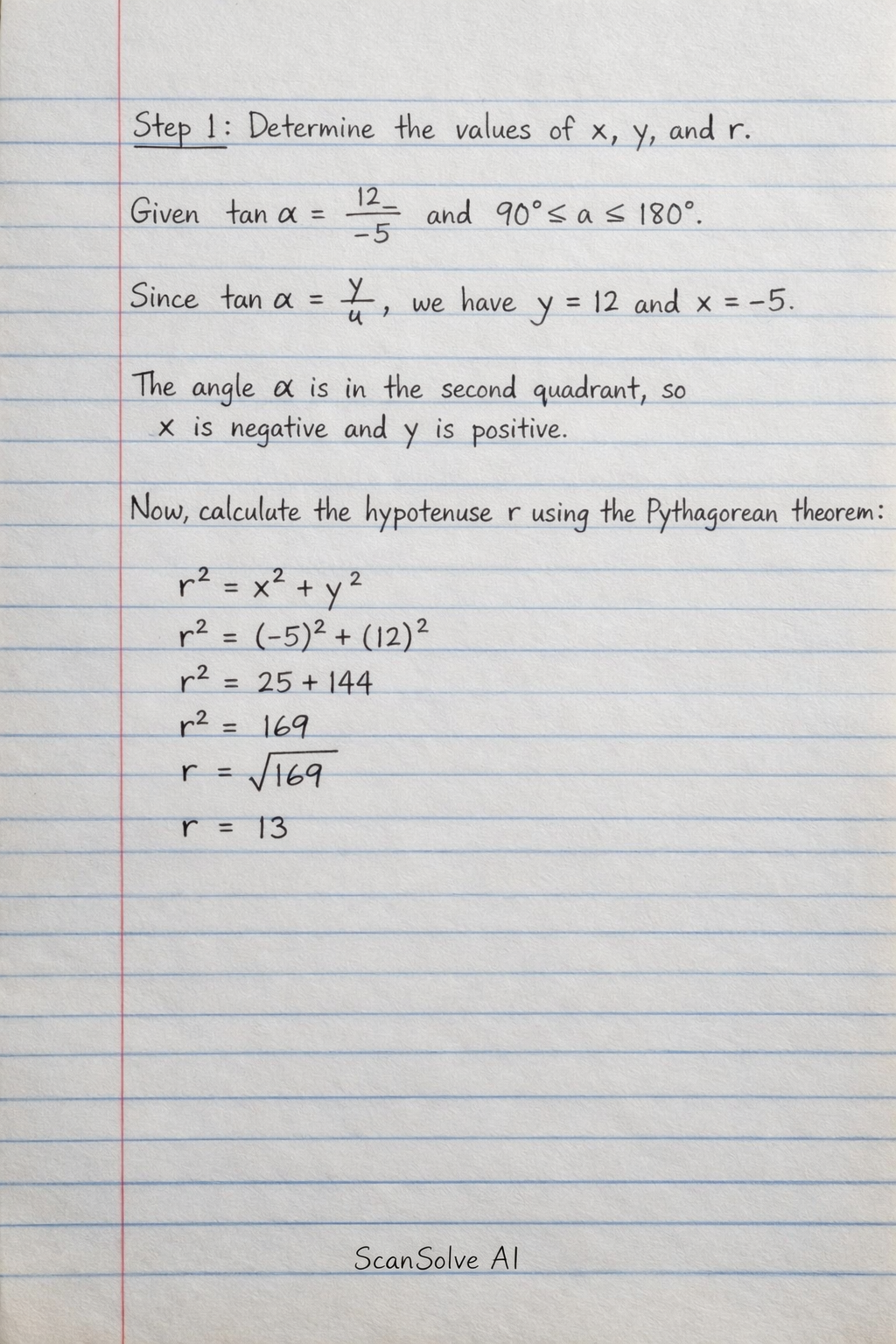
4 stepsDetermine the values of , , and .
Given and .
Since , we have and .
The angle is in the second quadrant, which is consistent with being negative and being positive.
Now, calculate the hypotenuse using the Pythagorean theorem:Sketch the diagram (3.1).
- Draw a Cartesian plane with the x-axis and y-axis.
- Mark the origin .
- Plot the point in the second quadrant.
- Draw a line segment from the origin to . This represents the hypotenuse .
- Drop a perpendicular line from to the x-axis, meeting it at . This forms a right-angled triangle.
- Label the horizontal side as , the vertical side as , and the hypotenuse as .
- Indicate the angle measured counter-clockwise from the positive x-axis to the line segment .
- Indicate the reference angle inside the triangle, between the line segment and the negative x-axis.
Determine (3.2.1).
Using the values from Step 1:
Now, calculate the sum:
Determine the value of (3.2.2).
First, find the reference angle using the absolute value of :
Since the problem states "without the use of calculator", we express using :
As is in the second quadrant (), the relationship between and is:
Substitute the expression for :
Still stuck on this one?
Ask a follow-up, and the answer starts from this question.
More Mathematics Questions
Handwritten Step-by-Step Solution
Get this as a handwritten image on WhatsApp — like a tutor wrote it for you.
Try on WhatsApp