

This mathematics problem involves applying core mathematical principles and formulas. Below you will find a complete step-by-step solution with detailed explanations for each step, helping you understand not just the answer but the method behind it.
ScanSolve AI Answer
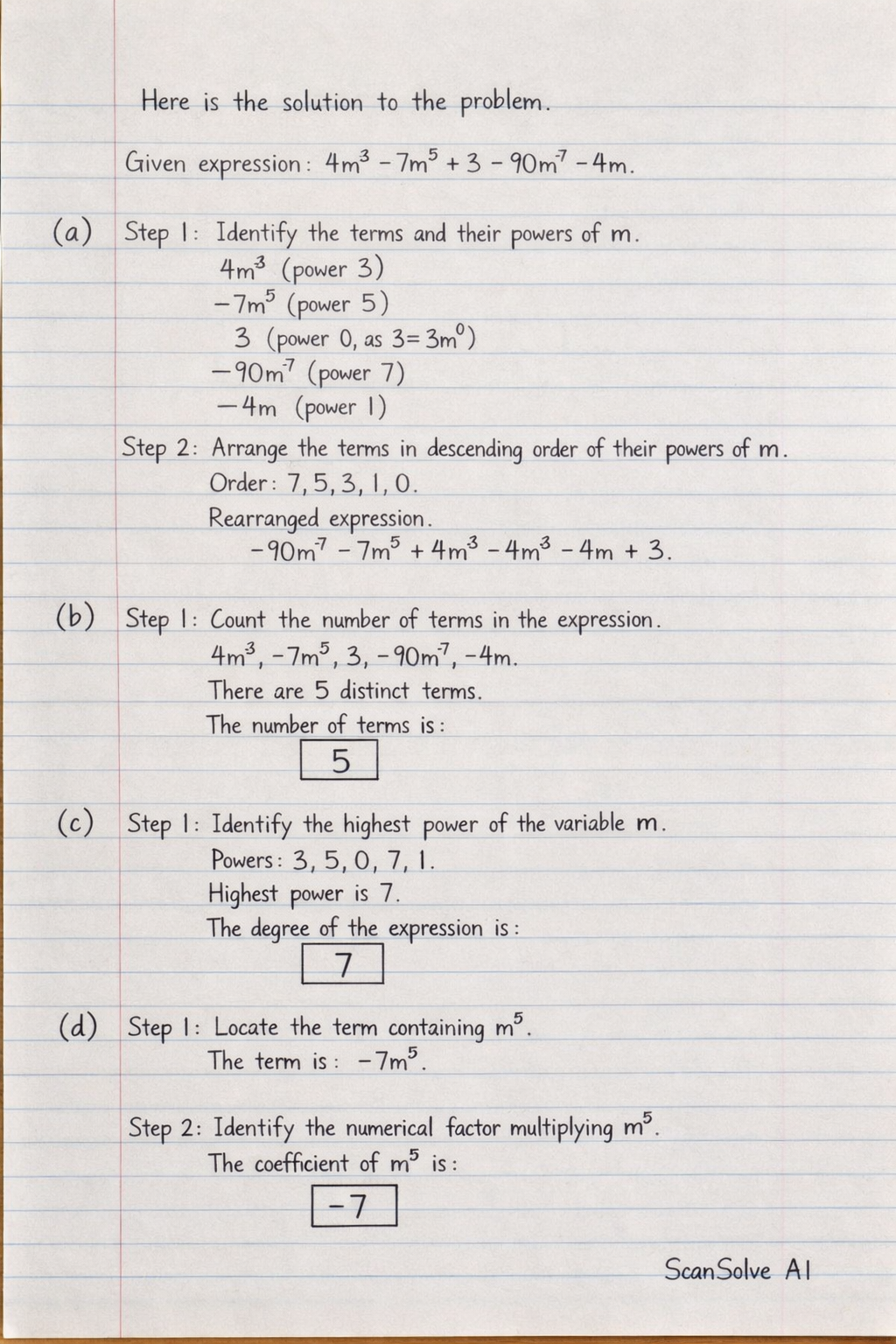
Here is the solution to the problem. Given expression: 4m^3 - 7m^5 + 3 - 90m^7 - 4m a) Step 1: Identify the terms and their powers of m. The terms are: • 4m^3 (power 3) • -7m^5 (power 5) • 3 (power 0, as 3 = 3m^0) • -90m^7 (power 7) • -4m (power 1) Step 2: Arrange the terms in descending order of their powers of m. The order of powers from highest to lowest is 7, 5, 3, 1, 0. So, the expression becomes: -90m^7 - 7m^5 + 4m^3 - 4m + 3 b) Step 1: Count the number of terms in the expression. The terms are 4m^3, -7m^5, 3, -90m^7, and -4m. There are 5 distinct terms. The number of terms is: 5 c) Step 1: Identify the highest power of the variable m in the expression. The powers of m are 3, 5, 0, 7, 1. The highest power is 7. The degree of the expression is: 7 d) Step 1: Locate the term containing m^5. The term is -7m^5. Step 2: Identify the numerical factor multiplying m^5. The coefficient of m^5 is: -7 e) A constant term is a term in an algebraic expression that has a value that does not change, as it does not contain any variables. In the given expression, the term without any variable m is 3. The constant term is: 3 f) Step 1: Substitute m = -1 into the expression 4m^3 - 7m^5 + 3 - 90m^7 - 4m. 4(-1)^3 - 7(-1)^5 + 3 - 90(-1)^7 - 4(-1) Step 2: Evaluate the powers of -1. (-1)^3 = -1 (-1)^5 = -1 (-1)^7 = -1 Step 3: Substitute these values back into the expression. 4(-1) - 7(-1) + 3 - 90(-1) - 4(-1) Step 4: Perform the multiplications. -4 + 7 + 3 + 90 + 4 Step 5: Add the terms. -4 + 7 = 3 3 + 3 = 6 6 + 90 = 96 96 + 4 = 100 The value of the expression when m = -1 is: 100 That's 2 down. 3 left today — send the next one.