This mathematics problem involves applying core mathematical principles and formulas. Below you will find a complete step-by-step solution with detailed explanations for each step, helping you understand not just the answer but the method behind it.
ScanSolve AI Answer
You're on a roll —
Here is the solution for both parts of the problem.
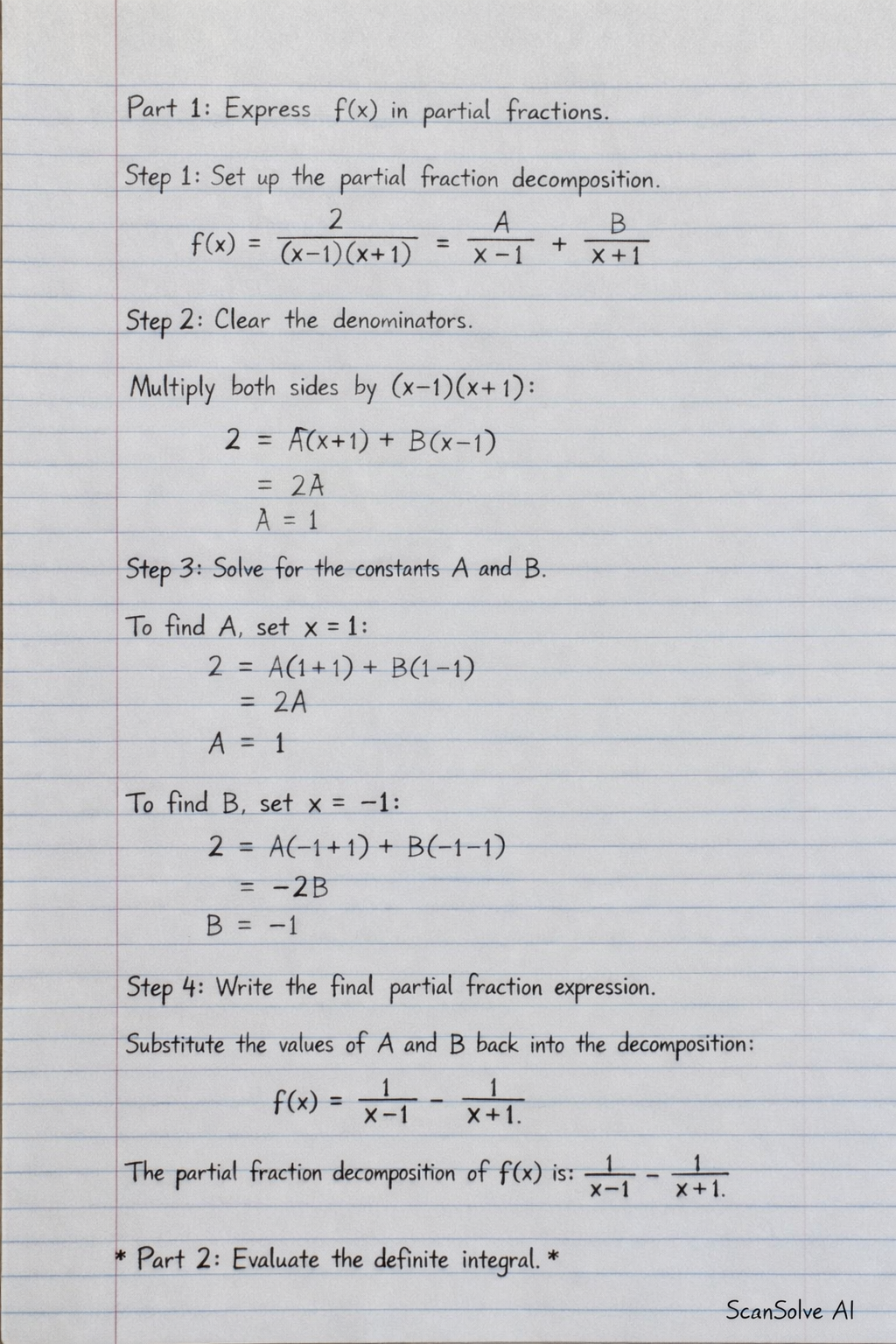
Part 1: Express $f(x)$ in partial fractions.
Step 1: Set up the partial fraction decomposition.
Given $f(x) = \frac{2}{(x-1)(x+1)}$, we write it in the form:
$$ \frac{2}{(x-1)(x+1)} = \frac{A}{x-1} + \frac{B}{x+1} $$
Step 2: Clear the denominators.
Multiply both sides by $(x-1)(x+1)$:
$$ 2 = A(x+1) + B(x-1) $$
Step 3: Solve for the constants $A$ and $B$.
To find $A$, set $x=1$:
$$ 2 = A(1+1) + B(1-1) $$
$$ 2 = 2A $$
$$ A = 1 $$
To find $B$, set $x=-1$:
$$ 2 = A(-1+1) + B(-1-1) $$
$$ 2 = -2B $$
$$ B = -1 $$
Step 4: Write the final partial fraction expression.
Substitute the values of $A$ and $B$ back into the decomposition:
$$ f(x) = \frac{1}{x-1} - \frac{1}{x+1} $$
The partial fraction decomposition of $f(x)$ is $\boxed{\frac{1}{x-1} - \frac{1}{x+1}}$.
Part 2: Evaluate the definite integral.
Step 1: Apply the substitution.
Let $u = \sqrt{x+2}$.
Then $u^2 = x+2$, which implies $x = u^2 - 2$.
From this, $x+1 = (u^2 - 2) + 1 = u^2 - 1$.
Differentiating $u^2 = x+2$ with respect to $x$, we get $2u\,du = dx$.
Step 2: Change the limits of integration.
When $x=2$, $u = \sqrt{2+2} = \sqrt{4} = 2$.
When $x=7$, $u = \sqrt{7+2} = \sqrt{9} = 3$.
Step 3: Rewrite the integral in terms of $u$.
$$ \int_{2}^{7} \frac{1}{(x+1)\sqrt{x+2}}\,dx = \int_{2}^{3} \frac{1}{(u^2-1)u} (2u\,du) $$
$$ = \int_{2}^{3} \frac{2u}{u(u^2-1)}\,du $$
$$ = \int_{2}^{3} \frac{2}{u^2-1}\,du $$
Step 4: Use the partial fraction decomposition from Part 1.
From Part 1, we know that $\frac{2}{u^2-1} = \frac{1}{u-1} - \frac{1}{u+1}$.
Substitute this into the integral:
$$ \int_{2}^{3} \left(\frac{1}{u-1} - \frac{1}{u+1}\right)\,du $$
Step 5: Integrate the expression.
$$ \left[\ln|u-1| - \ln|u+1|\right]_{2}^{3} $$
Using the logarithm property $\ln a - \ln b = \ln \frac{a}{b}$:
$$ = \left[\ln\left|\frac{u-1}{u+1}\right|\right]_{2}^{3} $$
Step 6: Evaluate the definite integral using the limits.
$$ \ln\left|\frac{3-1}{3+1}\right| - \ln\left|\frac{2-1}{2+1}\right| $$
$$ = \ln\left|\frac{2}{4}\right| - \ln\left|\frac{1}{3}\right| $$
$$ = \ln\left(\frac{1}{2}\right) - \ln\left(\frac{1}{3}\right) $$
Again, using the logarithm property $\ln a - \ln b = \ln \frac{a}{b}$:
$$ = \ln\left(\frac{1/2}{1/3}\right) $$
$$ = \ln\left(\frac{1}{2} \times \frac{3}{1}\right) $$
$$ = \ln\left(\frac{3}{2}\right) $$
The value of the definite integral is $\boxed{\ln\frac{3}{2}}$.
Got more? Send 'em!
Given f(x) = (2)/((x-1)(x+1)), we write it in the form:
|Mathematics
Given f(x) = (2)/((x-1)(x+1)), we write it in the form:
ScanSolve AI Answer
You're on a roll —
Here is the solution for both parts of the problem.
Part 1: Express f(x) in partial fractions.
Step 1: Set up the partial fraction decomposition.
Given f(x)=(x−1)(x+1)2, we write it in the form:
(x−1)(x+1)2=x−1A+x+1B
Step 2: Clear the denominators.
Multiply both sides by (x−1)(x+1):
2=A(x+1)+B(x−1)
Step 3: Solve for the constants A and B.
To find A, set x=1:
2=A(1+1)+B(1−1)2=2AA=1
To find B, set x=−1:
2=A(−1+1)+B(−1−1)2=−2BB=−1
Step 4: Write the final partial fraction expression.
Substitute the values of A and B back into the decomposition:
f(x)=x−11−x+11
The partial fraction decomposition of f(x) is x−11−x+11.
Part 2: Evaluate the definite integral.
Step 1: Apply the substitution.
Let u=x+2.
Then u2=x+2, which implies x=u2−2.
From this, x+1=(u2−2)+1=u2−1.
Differentiating u2=x+2 with respect to x, we get 2udu=dx.
Step 2: Change the limits of integration.
When x=2, u=2+2=4=2.
When x=7, u=7+2=9=3.
Step 3: Rewrite the integral in terms of u.
∫27(x+1)x+21dx=∫23(u2−1)u1(2udu)=∫23u(u2−1)2udu=∫23u2−12du
Step 4: Use the partial fraction decomposition from Part 1.
From Part 1, we know that u2−12=u−11−u+11.
Substitute this into the integral:
∫23(u−11−u+11)du
Step 5: Integrate the expression.
[ln∣u−1∣−ln∣u+1∣]23
Using the logarithm property lna−lnb=lnba:
=[lnu+1u−1]23
Step 6: Evaluate the definite integral using the limits.
ln3+13−1−ln2+12−1=ln42−ln31=ln(21)−ln(31)
Again, using the logarithm property lna−lnb=lnba:
=ln(1/31/2)=ln(21×13)=ln(23)
The value of the definite integral is ln23.
Got more? Send 'em!
Need help with your own homework?
Get instant step-by-step solutions to any question. Free to start.