

This mathematics problem involves applying core mathematical principles and formulas. Below you will find a complete step-by-step solution with detailed explanations for each step, helping you understand not just the answer but the method behind it.
ScanSolve AI Answer
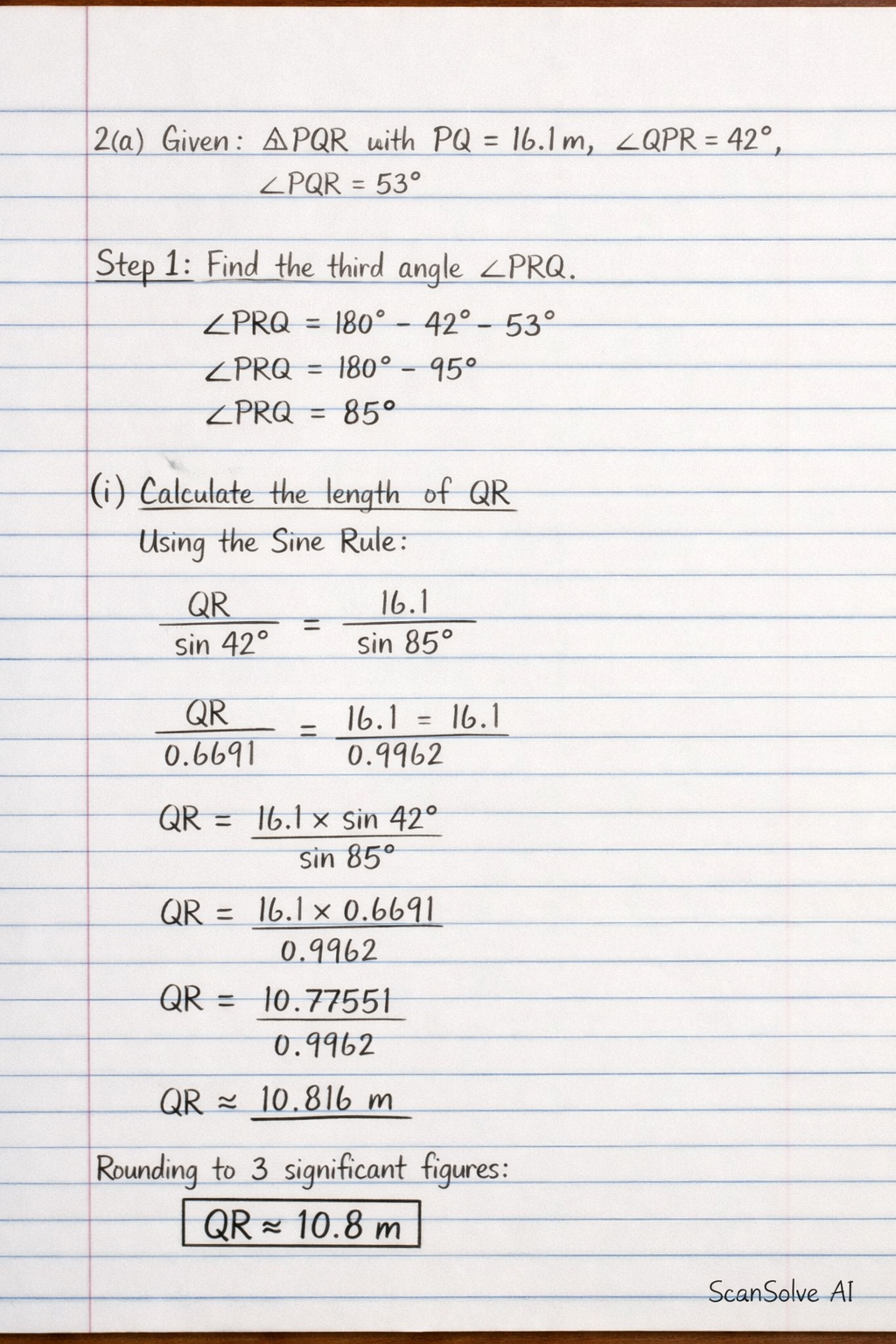
You're on a roll — The first question (1) cannot be solved as the diagram or values for triangle LMN are not visible in the image. Question 2(a): Given triangle PQR with PQ = 16.1\, m, QPR = 42^, and PQR = 53^. Step 1: Find the third angle, PRQ. The sum of angles in a triangle is 180^. PRQ = 180^ - QPR - PQR PRQ = 180^ - 42^ - 53^ PRQ = 180^ - 95^ PRQ = 85^ (i) Calculate the length of QR We use the Sine Rule: (a)/( A) = (b)/( B). (QR)/(( QPR)) = (PQ)/(( PRQ)) Substitute the known values: (QR)/((42^)) = 16.1\, m(85^) Solve for QR: QR = (16.1 × (42^))/((85^)) QR = (16.1 × 0.6691)/(0.9962) QR = (10.77551)/(0.9962) QR ≈ 10.816\, m Rounding to three significant figures: 10.8\, m (ii) Calculate the Area of triangle PQR We use the formula for the area of a triangle given one side and all angles: Area = (1)/(2) (c^2 A B)/( C). Here, c = PQ = 16.1\, m, A = QPR = 42^, B = PQR = 53^, and C = PRQ = 85^. Area = (1)/(2) ((PQ)^2 ( QPR) ( PQR))/(( PRQ)) Area = (1)/(2) ((16.1)^2 (42^) (53^))/((85^)) Area = (1)/(2) (259.21 × 0.6691 × 0.7986)/(0.9962) Area = (1)/(2) (138.471)/(0.9962) Area = (1)/(2) × 139.000 Area ≈ 69.500\, m^2 Rounding to three significant figures: 69.5\, m^2 (iii) Calculate the Shortest distance from R to PQ The shortest distance from R to PQ is the altitude (height) from